

Filed under: Ghana

♬ Hammatan
Tall Emma & His Skippers were from Ghana.
Unfortunately this record, like many singles from Africa, doesn’t have a picture sleeve. I can only imagine what they must have looked like.
The only information I have been able to find about this band is from a mention from an article by Miles Cleret from Soundway Records. While the single is credited to “Tall Emma”, the song writing credit is “Richard Tall Amma”. Also, the vocals are credited to Chester Adams, who went on to play in the Uppers International and the Kamela Band.
Hammatan is the Ghanaian Twi word for the cold dry air blows off the Sahara in the Winter.
If you know anything about them, especially if there is any more recordings by them, please contact me.
Catalog number DKN 231 on Obuoba of Ghana. No other information available.
Filed under: New Guinea

♬ The Kopy Kats • Meisi Emu Nega
♬ The Freebeats • Kekeni Ani Mase
When I started this whole thing, there were a few places I was sure that I would never find records from… Papau New Guinea was definitely on that list.
This record is of a somewhat questionable origin. There is no information about the three bands on this compilation: The Kopy Kats, The Freebeats and The Stalemates. All three suspiciously sound like the same band and most of the songs are covers like “Last Train to Clarksville”. “The Mighty Quinn” and the Scottish folk tune “Skye Boat Song”.
After I initially had posted this record, I was informed that The Freebeats were all Australians who had moved to New Guinea. The band consisted of Graham Dunich, Roy Turner, Neville Josey, Ray Michelle and Phil Neilson. They were originally know as The Statesman when they were based in Sydney, but changed their name after moving to Port Moresby at the invite of Graham Dunich who was already living there. The Freebeats supposedly did quite well, especially since they were known to translate popular songs into “Motu“, which was the local language. They were together for three years before they became The Combines in 1970.
Thanks to Bård Hodneland for the information.
Catalog number VP 318 on Viking Record Company Ltd of New Zealand. Recorded by the Australian Broadcasting Corporation, Port Moresby, New Guinea. No release date given.
Filed under: Lebanon
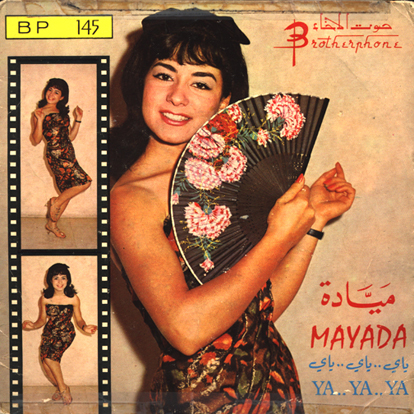
Mayada was from Lebanon.
Her sister was Taroub, who was a well known singer in both Lebanon and Turkey as well, and they both were of Turkish descent. Mayada had a very short lived career from mid to late Sixties, recording few singles and singing in night clubs in Beirut. From this single, you can hear an influence of the Yé Yé Girl movement from France.
Thanks to Hany Zaki for the information.
Catalog number BP 145 on Brotherphone of Beirut, Lebanon. No other information is available.
Filed under: Nigeria

♬ Allah Wakbarr (live in East Berlin)
Ofo The Black Company was formed in 1972 by Larry Ifediorama in Lagos, Nigeria.
That same year, he took his band to London, England to record their first for London Records. The single with “Allah Wakbarr” on the A side and “Beautiful Daddy” on the B side is highly collectable, usually fetching $100 or more per copy. Allah Wakbar has also been featured on the now defunct Afro Strut label’s Nigeria 70: The Definitive Story of 1970’s Funky Lagos compilation and recently on Luaka Bop’s World Psychedelic Classics 3: Love’s A Real Thing • The Funky Fuzzy Sounds of West Africa.
But in 1973, Ofo The Black Company was asked by the East German government to play the “World festivals of the youth and student Berlin capital of the GDR” International Folklore festival in East Berlin along with Miriam Makeba as well as other musicians from Argentina, Bulgaria, Chile and Vietnam.
As far as I know, they recorded two singles for London Records, the one mentioned above which was credited to “Ofo The Black Company” and another credited to “Ofo”. They released an album on the Afrodesia label – a subsidiary of Decca – in 1974, which has the song Eniaro that was featured on Soundway Record‘s Nigeria Rock Special: Psychedelic Afro-Rock & Fuzz Funk in 1970s Nigeria. There is also a live record by “Ofo The Rock Company” that was recorded somewhere in Europe.
Larry Ifediorama died in 2005 in Lagos, Nigeria.
Thanks to Volker Rohde for his help.
Catalog number 8 35 057 on Eterna VEB Deutsche Schallplatten, Berlin, East Germany released in 1973.
Filed under: Singapore

♬ Golden Dragon Greeting The New Year
I can’t tell you that much about The Tones, except that they were from Singapore. I had originally thought that the name of the band was The Music of White Crane & The Tones due to the cool guitar logo, but I have since seen other records by them and realized that White Crane was the name of the record lable.
In 2003, Singapore’s Media Development Authority (MDA) commissioned a six-part series documentary for televison on the Singapore music scene from the 1960s to the present day, entitled Jammin’. If anyone knows how I could get a copy of that documentary (especially the first two episodes), I would greatly appreciate it.
If you have any information, please contact me.
Catalog number PH-2067 on White Crane Records of Singapore. No other information available.
Filed under: South Korea

The records from that time are very scarce, since they did not press that many. Even today when one of these records are re-issued, there is usually only a pressing of 300 copies. Due to this, there’s not a whole lot of information available about the early days of rock ‘n’ roll in South Korea. The website for the Psyche Van Het Folk programme from Radio Centraal of Belgium has a whole section on Korean rock music (as well as other countires / regions).
Taken from liner notes on “Go Go Sound vol 2” by HE6:
Kim Hong-Tak was one of the two leading figures in the early days of “Group Sound Era”, of course with Shin Jung-Hyun. Kim Hong Tak was guitarist and naturally leader of the group. Here, it seems better to put aside the question ” Who was the first?”. Because with this question of ‘the first’ or more properly ‘the Origin’, the answers will not is the same according to the questioner’s perspectives.
For example, if we take one perspective, in this case that of ‘popularity’, it will be the Key Boys of Kim Hong Tak which was followed soon afterwards by the Add4 of Shin Jung-Hyun.
A little remark. This Key Boys is not the ‘Later’ Key Boys who sang the smash hits like “Let’s Go To The Seashore”. or “Memories of The Seaside”, but the ‘Earlier’ Keyboys. They played some ‘Package shows’, under the name of the Lock & Key in the stages of the U.S. Eighth Army which settled in South Korea. Also they played at some new venues like ‘Music Listen Rooms’, ‘Live Music Salons’, or the traditional ones like in Cinema. [At that time the concert was held frequently in Cinema Houses. It was called as ‘Cinema Show’].
With these latter acts they were known to general ‘Korean’ public. They were nicknamed as the ‘Beatles of Korea‘ – At that time this meant more similar to a ‘cover band of the Beatles’. [Because the stages in U.S Eight Army was for the Korean in the forbidden area for the evident reason of security. So generally a Korean group or artist who played there was a totally unknown figure to general Korean public].
In the mid-60s which prevailed by the worldwide phenomenon ‘Beatlemania’, the Key Boys, in molding the archetype of the Rock band (or Rock Group) who ‘sing and play’ [With the Kkokkirri Brothers, the Fools, the Kim Chies], became the pioneers of a new cultural phenomenon [we may now be able to say that it was the early days of ‘Pop culture’ in Korea]. And here lies one symbolic fact concerning the popular culture in general that 1964-1965, the period of their debuts coincides with that of the birth of the ‘Weekly Magazine’. With the time, the members of the Key Boys left the group: some Cha Jung Rak and Cha Do Gyun going to solos, some Yoon Hang Ki joining to the Korean Army‘s entertainment Unit which was sent to the Viet-Nam War, and finally Kim Hong Tak too. But Kim Hong Tak had launched his career of guitarist in a rock group. It was the He 5.
Catalog number 킹 가 1006 on Universal of Korea. No release date listed.
Filed under: Israel

David the Red Sea Singer was from Tel Aviv, Israel.
I have not been able to find out much about David, other than what was printed in the liner notes:
When David was born some 24 years ago, the Tel Aviv population was totally in aware of the fact that anew star was to rise at the bright skies of show business.
David’s love for the stage first manifested during Welfare Showprograms while he was serving his country. It was right after leaving the army that David was offered his first contract as a singer in “The End of the World Club” in Elath-on-Red Sea.
His Performance there was a smash and definitely kicked off his career. In less than no time David’s tenor voice gained tremendous popularity throughout Israel.
David specializes in folksongs and spirituals in Hebrew, English, Spanish and Greek.
Furthermore he is an expert showman on a native drum, the TOS DRUM.
During the last 8 months Davis has been touring Europe and has done television shots in Switzerland, Austria, Germany, Belgium and Holland.
“THE ORIENTAL BEAT GOES ON” is based on a Turkish melody, arranged by Ted Powder and put to lyrics by Rafi Nelson.
I read somewhere that the song this is based on is called ”Don’t Marry Abdullah”.
Catalog number: PS015 on Whamm Records, which I believe was from Holland. No release date given.
Filed under: Vietnam

Hūng Cuōng was from Vietnam.
Records from Vietnam are rare, at best. I have been unable to find hardly any information about music (outside of traditional folk music) in that country before the Eighties. Here is what little information I have been able to find about records such as this one: “Records of this nature were outlawed within days of the fall of Saigon, and most were either destroyed by the Communists or, interestingly, destroyed by their owners who did not want the communists to have them.”
Unfortunately, this record has seen better days. The cover needed a bit of Photoshop work, but the vinyl… Sound Soap can only do so much.
If you have any information, please contact me.
Catalog number M.3611.12 on Việt Nam Records. No other information is available.
Filed under: Upper Volta

L’Orchestre Afro Soul System was from Upper Volta, which is now known as Burkina Faso.
I have not been able to find any information about the band. And at first, I was unable to find anything about the singer and songwriter Compaoré Youssouf (as it is printed on the label). But, I have since found out that his name was actually Compaore Issouf, who released two albums – One with the band The Noble Kings in 1978, and a solo record in 1981. Also, L’Orchestre Afro Soul System recorded another single for the label Société Ivoirienne du Disque in Côte d’Ivoire.
Thanks to Grégoire de Villanova for the information.
If you have any further information, please contact me.
Catalog number VDB 023 on Volta Discobel, and according to the Radio Africa website, was released in 1978 and pressed in Benin.
◄●►◄●►◄●►◄●►◄●►◄●►◄●►◄●►◄●►◄●►◄●►
Since this posting, I have been contacted by Olivier Gagneux, who was briefly a member of the band in 1981. Here’s what he had to say:
The leader was singer/composer Jean-Claude “Man” Bamogo, who is pretty famous in Burkina Faso nowadays. The lead guitarist was Roger Mballa from Cameroon, who had been with Fela Kuti & Africa 70 before (under the name of Roger Effiok, because a Nigerian passport had to be ‘organised’ on short notice because of a tour to Italy). He later went on to become musical director of the Ballet National de Maurétanie (a.k.a. Mauritania).
It was a very interesting time because back then the bands with the best equipment (or with equipment, period) was the one with the best gigs. I remember that it took us more than one month to organise a guitar string. The drummer (we called him “Tumbarero”, because Cuban music was very popular back then; Most people actually thought Monguito was from the Côte d’Ivoire) had never seen real drum sticks (he would go out in the bush to cut his own before each gig) and you could not see the original rim on his cymbals.
The top band was “Desi et les Sympatiques” because their leader Desire Traore had a job at OFNACER (Office Nationale Des Cereales) where he would SELL the food donated by international relief agencies and thus made a lot of money. He was also taking guitar lessons from Roger Mballa. I think once Thomas Sankara took charge he did some time for this.
So we ended up playing a lot in little villages. We always had to organise transport (no public transport in the country back then) and a generator for one light bulb above the stage and the PA/amps. The cables did not have any plugs, they were just joined together and a stone was placed on top of it. We would sometimes play until 9 in the morning and some of the musicians would take “speed“.
Half of our repertoire consisted of songs in traditional Mossi rhythms (the rest was Reggae and Cuban Son). One of these rhythms especially (“Waraba“) is tricky to feel the beat, and the kids who had grown up in the city (Ouagadougou) would often dance it the ‘wrong’ way (they did not feel the beat correctly) while the kids in the villages danced it the way it is.
Thanks Olivier!
Filed under: Pakistan

Nisar Bazmi was born Syed Nisar Ahmed in 1924 in Bombay, India.
He did not belonged to an artistic family and nor did he have any prior musical training. Noted Indian musician, Khan Saheb Aman Ali Khan, convinced of Nisar’s musical talent, decided to teach him. Equipped only with artistic know-how, young Nisar, quickly mastered the various ragas, the musical instruments and took all music lessons to heart.
At the age of fifteen, All India Radio hired him as an artist in 1939. Five years later, he composed some songs for the drama, “Nadir Shah Durrani”, which was broadcast from the Bombay Radio Station. All of the songs that he composed for the show became hits.
Soon after, he was asked to compose music for the film “Jamana Paar”, which was released in 1946. Nisar accepted the offer and changed his name to Nisar Bazmi. He composed the music for twenty eight films before he decided to move to Pakistan in 1962.
Once permanently settled in Pakistan, he resumed his music career by simultaneously composing songs for two movies: Director Nazeer Sufi’s film “Head Constable” (released on September 25, 1964) and director Fazal Ahmed Karim Fazli’s movie “Aisa Bhi Hota Hai” (released on February 5, 1965).
He responsible for introducing Alamgir to film music in Pakistan. During his musical career he composed many hit songs for Runa Laila , Ahmed Rushdi , Noor Jehan and Mehdi Hassan. Also, the well known songwriting duo of Laxmikant-Pyarelal were musicians of Nisar Bazmi in India before he left for Pakistan, and later they became famous music composers.
Furthermore, Nisar is also an accomplished poet. His poetic collection were to be brought to the limelight by his admirer, Shamim Bazil (against his wishes).
Catalog number EMPP 5006 on EMI of Pakistan, released in 1976.
 Radiodiffusion Internasionaal Annexe