Filed under: Egypt

♬ Ali Ali / عالي عالي (Parts 1 & 2)
Fātima Ahmad Kamal Shākir / فاطمة أحمد كمال شاك – better known by her stage name Shadia / شادية (also seen transliterated as Shādiyya or, in the case of this record, Chadia) – was born February 8th, 1931 in in Cairo, Egypt.
Besides starring in over 100 films during the golden age of Egyptian cinema, Shadia is remembered for her many patriotic songs – earning her the nickname as ”The Voice of Egypt”.
This track was written by Baligh Hamdi / بليغ حمدي. Although uncredited, I suspect that the guitar on this track is Omar Khorshid / عمر خورشيد.
PLEASE NOTE: I have edited Side One and Side Two into one track, attempting to make the transition from Part One and Part Two as seamless as possible.
Catalog number ESOA 150 on Soutelphan of Cairo, Egypt. No release date listed.
Filed under: Egypt

I was thinking about posting Hany Mehanna‘s cassette only release Rawayie al Musiqaa Altaswirih / روائع الموسيقى التصويريه (cover pictured above) for the 400th post, but then Souma Records released Music for Airplanes – which contains seven the twelve song from that cassette. So, I ended up posted the Magdy el Hosseini record and tapes instead.
But then I found a whole bunch more of Mehanna’s cassette only releases. And yes, many of the best tracks off of those are also on Music for Airplanes. But there is still A LOT of great music on those tapes. You can find that music HERE.
Catalog numbers TC3 and TC6 on Golden Cassette of Cairo, Egypt, HEC 1372 on H.E.C. from the United Arab Emirates, 2859 on Quttus and WE 304 on WAV from… Who knows? No release dates listed.

Filed under: Egypt
 ♬ Musiqaa Li’aghanaa Earabia / موسيقى لأغانى عربية
400th post? Seems like just yesterday I hit 300. And much like the 300th post, I’m going to post a cassette by a keyboard player that I’ve already covered before. This time, it’s Magdy el Hosseini.
With the recent releases of Sublime Frequencies’ Baligh Hamdi compilation and Souma Records’ Hany Mehanna compilation – plus reissue of Omar el Shariyi’s first album. from We Want Sounds – there has been an abundance of Egyptian organ music. But for some reason, other than the lone “Music de Carnaval” track, nothing by Magdy el Hosseini has been reissued. So to rectify that, I decided to post a whole bunch of his stuff. First up is the cassette only release Musiqaa Li’aghanaa Earabia / موسيقى لأغانى عربية which translated in English is “Music for Arabic Songs”. There’s an amazing live version of “‘Ayuwh” / “أيوه” that you can find HERE.
Catalog number ٤٠۳۸٠ on Randaphone / راندافون of Cairo, Egypt. No release date listed.

Next up is Magdy’s first album: Malik Alawrgh / ملك الاورغ – AKA “King of the Organ”. I posted two tracks from this album way back in post #36. You can find an insane clip of Magdy playing the first track “Ya Salat al Zein” / “يا صلاة الزين-z” live HERE. Even though I don’t know Arabic, I knew something was not right with this record. There are 9 songs listed, but only 7 tracks on the album. I asked other people who own this record – as well as other pressings of it – and they said the same thing. I recently got a cassette version of this album that I am pretty sure is from Saudi Arabia. According to Discogs, there are supposed to be 14 songs on the tape. There are only 11 – the 7 songs from the album plus 4 of those songs that are repeated twice. If you know where I could find the two missing tracks – “Ya Bur Dinaa” / “يا بور دنى” and “Ya Eayn Mulitayn” / “يا عين موليتين” – please let me know.
Catalog number 87-74083 on Moriphon Records of Egypt, recorded in 1974.
But wait! There’s more!

♬ Sahat Mae Magdy El Hosseini / سهرة مع مجدى الحسينى
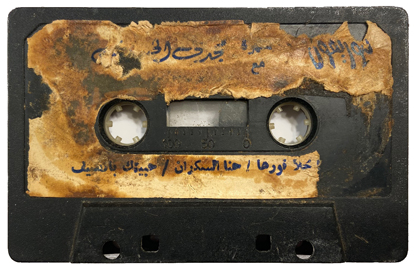
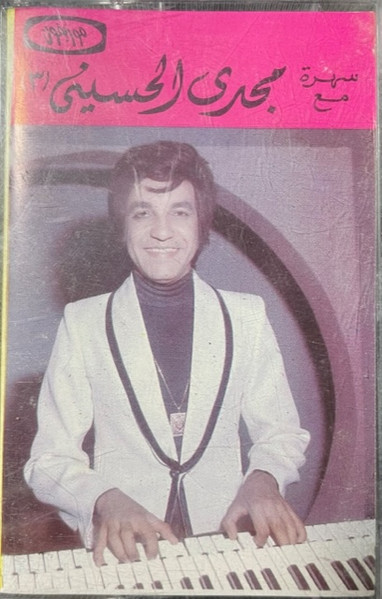
Here is what’s left of a ‘well lived’ copy of Sahat Mae Magdy El Hosseini / سهرة مع مجدى الحسينى – AKA “A Night with Magdy El Hosseini”. If you think that A side looks rough, you should check out the B side. The best photo of the cover for this tape that I have been able to find online is not the best, but a great photo nonetheless. The previous owner must have had part of the tape eaten and edited it back together. So, the first song on side A is completely missing, as is the intro for the second song and all but about a minute and twenty seconds of the last track on side B.
Many thanks Sebastien Ledys and Marthy Coumans.
Also released on Moriphon of Cairo, Egypt. No catalog number or release date listed.
◄●►◄●►◄●►◄●►◄●►◄●►◄●►◄●►◄●►◄●►◄●►
UPDATE: 01/11/26
I have finally gotten around to uploading another cassette by Magdy el Hosseini that I picked up a while back – also titled Sahat Mae Magdy El Hosseini / سهرة مع مجدى الحسينى – AKA “A Night with Magdy El Hosseini”.

♬ Sahat Mae Magdy El Hosseini / سهرة مع مجدى الحسينى
Like the cassette above, released on Moriphon of Cairo, Egypt. No catalog number or release date listed.
Filed under: Egypt

The Jets / الچيتس were founded in Cairo by musician, composer and arranger Samir Habib / سمير حبيب in 1975.
The best source of information that I have been able to find is a biography on the band that you can find over at ƮᏲҾ дևծιστøρία. You can also find their discography over at Arab Tunes.
Catalog number SP 210 on Super Cassettes of Egypt, released 1978.
Filed under: Egypt

Tawfika Ahmed Nada – better known as Sharifa Fadel / شريفة فاضل – was born in Cairo on January 7, 1938. She started acting at age 9, with her first film The Father / الأب in 1947 after being discovered by director Omar Gomai / عمر جامعي at the Institute of Performing Arts of Cairo. Soon after, she started her recording career. Her first big hit was “Amana Ya Bokra” / “أمانه يا بكرة “.
You can read more about Sharifa Fadel – as well as find more songs by her – over at the wonderful Arab Tunes blog.
The music for this track was composed by Baligh Hamdi / بليغ حمدي. Sublime Frequencies has recently released an overview of his music entitled Instrumental Modal Pop of 1970’s Egypt. Although he is not credited, that fuzz guitar is most likely Omar Khorshid / عمر خورشيد.
Catalog number 45 S 139 on Soutelphan of Cairo, Egypt. No release date listed.
Filed under: Egypt

♬ De Alomr
Hany Mehanna – also seen spelled: Hani Mahani, Hani Mehanna, Hani Mhana, Hani Mhanna, Hanni Mehanna and Hani Muhanna – is an Egyptian composer, organist and a player of the accordion. He is also a producer and in 1977 he established his own record company, – Golden Cassette for Art Production. In 1988 he established his own studio, Golden Sound Studios in Cairo.
These two songs are from the soundtrack to the 1973 film titled الدوامه / Al Dawama – which translates to The Whirlpool. The song titles are not listed on the single, but these songs appeared on other releases by Hany Mehana. “Rawaeaa El Mossika 15” was on his cassette entitled Rawaeaa El Mossika Part One and “Ala Waraq Solefan” was on Rawaeaa El Mossika Part Two. The B side is “بدوية” / “Badaouiah” and can also be found on the recently reissued The Miracles Of The Seven Dances.
Catalog number 31-74146 / ٧٤١٤٦-٣١ on Sout El Hob of Cairo, Egypt, released 1974
◄●►◄●►◄●►◄●►◄●►◄●►◄●►◄●►◄●►◄●►◄●►
UPDATE: 11/09/21 Souma Records has released a compilation of Hany Mehanna’s recordings entitled “Music For Airplanes – A collection of instrumental showpieces and scores for Egyptian films and TV-series (1973-1980)“. Also, the first track I had previously listed as “Rawaeaa El Mossika 15” in error.
Filed under: Egypt

♬ El Kamh
This post has been written by Hany Zaki – my man in Cairo. Besides being an encyclopedia of Egyptian music, he has been a very helpful resource for other North African and Middle Eastern music. He also runs a website dedicated to Omar Khorshid.
As young man he emerged at the sunset of the grand artists of the Middle East, Omar El Shariyi did not depend much on his family’s wealth through his struggles in the music scene – even though he was blind. His tools were his talent that made him earn studies from various musical institutions worldwide.
Omar got start as a musician playing accordion before switching to keyboard, playing with small bands and artists in night clubs and weddings. He eventually made the move to composition in 1975.
He got his big breakthrough when he collaborated with the music superstar Shadia to compose music for her 1979 film “Suspicion My Love”. That opened many doors for him to work with numerous artists in Egypt, and soon afterwards, the rest of Middle East.
In the early 80s, El Shariyi began work with the Roland keyboard company to produce an ‘Oriental keyboard‘. The venture was so successful that it was used a trademark in the music scene in Egypt throughout the 80s and 90s.
Omar had a fruitful career producing tribute albums in his own style of the departed giants of the Middle Eastern music – such as Umm Kulthum, Abdel Halim Hafez, Farid al-Atrash and Laila Mourad, to name a few. In 1980, he formed a group by the name of ‘Al Asdekaa’ – or ‘Friends’ – with three singers, which was a popular trend in Egyptian music in the mid 70s and lasted until mid 80s.
In the 1990s, El Shariyi would take standard Egyptian songs from radio programs and transform them to a larger sound production for television programs. Omar’s love for the musical history of Egypt was evident in his compositions for radio, television and film – most of which were recorded in his ‘Omar Sound’ studio.
Catalog number MT 4868 on Soutelphan Records of Cairo, Egypt. Released 1977.
Filed under: Egypt

♬ Umm Kulthum • Amber of the Nile
♬ Saïd Darwish • Arabesque
There’s been more than a few records that I have posted on this site that have made me question who the intended audience was when it was released. This one is right up front about it. It’s says it right there on the cover: “a holiday souvenir”.
But one of the most annoying things about this record is that there are no artists listed. I have seen another version of this release that did list who did what songs, and I happened to have written down that Saïd Darwish was credited for the version or Arabesque… But the other track – which did not write down – required a bit more research
Eventually, I had Hany Zaki play name that tune for me. On the record, the track is listed as Amber of the Nile, but it is actually an excerpt from a much longer piece by Umm Kulthum called Lelit Hob, or Night of Love. Kulthum – who has almost as many variations on her name as Muammar al-Gaddafi – was know as the Star of the East (kawkab el-sharq). More than three decades after her death, she is still recognized as one of the Arab world‘s most famous and distinguished singers of the 20th century. But also of note was that the legendary Egyptian guitarist Omar Khorshid – who I believe is the guitarist on this track – got his start playing in her orchestra.
Catalog number 18-75171 on Sono Cairo records of Cairo, Egypt, released 1975.
Filed under: Egypt

♬ Abdel Monim Madboly / طيب يا صبر طيب • Tayeb Ya Sabr Tayeb /عبد المنعم مدبولي
♬ Mounir Mourad / موسيقى المصنع • The Factory Theme / منير مراد
The guest post for this week is by Hany Zaki – my man in Cairo. I am not quite sure how I originally got in touch with Hany. I think it may have been that Baligh Hamdi single. But once I mentioned Omar Khorshid, we hit it off and have been in contact ever since. Besides being an encyclopedia of Egyptian music, he runs a website dedicated to Omar Khorshid.
The simple concept of friends stealing for an evil boss who meet someone who wants to straighten them out and make a musical show about their lives. This was the basic idea of the last quality musical of the 70s titled Mold Ya Donia (What A Bewildered World) that was a box office smash in 1976.
The film, which stared the singer Afaf Rady, was highly produced by Baligh Hamdy, who had a number of hit singles a few years earlier. They were joined by a comic actor, Abdel Monim Madboly, who ironically performs a melancholic song moaning and crying about the good old times of being a carriage driver. The title name is Tayeb Ya Sabr Tayeb, and he appears in his stable drunk and whipping all over the place while he sadly sings… Surprisingly, it was a big hit for a soundtrack and deserved a single release and was filmed for TV later.
On the other side two themes appear, titled The Factory Theme and Train Whistle Theme, adding cheerful unmistaken 70s beat of organ and percussion. Both were composed by Mounir Mourad, who was a pretty underrated multi-talented artist coming from a Jewish background with an artistic family of singers. Mounir Mourad was also a singer, as well as an actor and director but was most famous as a composer who made a new happy sound to the Middle Eastern ears thanks to his talents plus his wide knowledge of international music. He composed to almost every singer from the 50s till he died in 1980.
Catalog number XSP 460 / 31-76009 – 45 S 230 on Soutelfan of Cairo, Egypt. Released 1976.
Filed under: Egypt

Belly Dance is a Western name for an Arabic style of dance developed in the Middle East. In Europe, it is sometimes called “Oriental Dance”. Similarly, In Turkish it is referred to as “Oryantal Dansı” (“Dance of the East”). Some American devotees refer to it simply as “Middle Eastern Dance”. In the Arabic language it is known as Raqs Sharqi رقص شرقي (“Eastern Dance”) or sometimes Raqs Baladi رقص بلدي (“National” or “Folk” Dance). The term “Raqs Sharqi” may have originated in Egypt.
Hassan Abou Seoud was from Egypt. Like many other Egyptian musicians of the time, he left for Lebanon in the early Seventies. There, he got his start playing accordion with Omar Khorshid at a night club in Beirut. He also was known to have done some recording with Farid al-Atrash, as well as others.
He moved back to Egypt after the beginning of the Lebanese civil war in 1975 , where he started writing compositions for Sha’abi singer Ahmed Adaweyah. Shortly thereafter, he moved to Paris and formed his own orchestra, working in Arab night clubs there. He eventually moved into management, discovering and encouraged many artists.
Once again returning to Egypt in the late Eighties, he began composing music for films. He then became the president of the Egyptian Musicians Syndicate in mid Nineties, which he held that position until his death in 2006.
Thanks to Hany Zaki for the information.
Catalog number VOS 10015 on Voice of Stars of Lebanon, pressed in Greece. No release date listed.
 Radiodiffusion Internasionaal Annexe