Filed under: Pakistan

Master Manzoor – who’s real name was Manzoor Hussain – was from Lahore, Pakistan.
His father was Fazal Hussain, who was a renowned sarangi player. He had four sons. Manzoor was the eldest. The youngest was Altaf Hussain – not to be confused by the politician of the same name – was better know as Ustad Tafo of the Tafo Brothers.
NOTE: The A side of my copy of the single has a huge gash in the vinyl. I edited another recording I was able to find online. So the last 42 seconds of the track “Title Music” is unfortunately a much poorer sound quality.
Catalog number 7KCE 5002 on Columbia of Pakistan. Released 1972.
Filed under: Pakistan

♬ Sanoon Wi Lai Chai / سانون وائی لائی چائی
♬ Bhul Gaee Main Bhul Gaee / بھول گئی میں بھول گئی
Lollywood Steel Guitar? Not really… But since they are many similarities with the music of Bollywood and Lollywood, I theorized that a record like this would be out there, somewhere.
Ghulam Ahmed Chishti / غُلام احمد چِشتی is most likely not the performer on this recording. Chishti was a film composer with almost 5,000 songs to his credit and scored the music to somewhere between 140 to 150 films. But, there is practically zero information on what is left of the record sleeve.
If you have any further information about who the actual artist is or anything else about this recording, please leave it in the comment section below.
Catalog number EMPM 5002 on EMI Pakistan. No release date listed.
Filed under: Pakistan

Azam Shaikh was, to the best of my knowledge, a film composer from Pakistan. But he apparently only wrote music for one film entitled Naam Ke Nawab. But I have been unable to find anything about him or the film, anywhere.
If you have any further information about this artist or anything else about this recording or the film that it is from, please leave it in the comment section below.
Catalog number 7KDA 5328 on His Master’s Voice of Pakistan. Released 1973.
Filed under: Pakistan

♬ A Song Produced on The Occasion of The Islamic Summit Lahore February 1974 Orchestra Version
Sohail Rana should need no introduction. I have covered him once before.
This record was produced by the Pakistan Television Corporation for the second Islamic Summit – which is a principal organ of the Organisation of Islamic Cooperation focused on formulation, development, and implementation of decisions made by 57 member states.
Catalog number EDKA 20057 on Angel Records, released 1974.
Filed under: Pakistan

Back in the first post when I restarted this mess, I mentioned how being ignorant of an artist’s / band’s other releases was bliss. And that once I did know that those records did exist, then I would start to obsess.
The Blue Birds were the band I was referring to when I wrote that. When I compiled the Pakistan: Instrumental Folk & Pop Sounds 1966-1976 compilation, I thought there was only one album by The Blue Birds. Once again, I was wrong. They actually have four singles as well. This is one of them. But none of their records provide any information about the band. The only information is that their music was composed by Sanesra Mohd. Ayub – who was the lead guitarist for 20th Century Deterioration.
If you have any further information about The Blue Birds, please leave it in the comment section below.
Catalog number EKDE 20009 on His Master’s Voice of Pakistan. Released 1973.
Filed under: Pakistan

When I was working on the Pakistan: Instrumental Folk & Pop Sounds 1966-1976 compilation, I remember seeing the name of this band listed on a website somewhere. At that point, I had not seen a record by them and just assumed that there was no way that EMI Pakistan would have released anything by a band with a name like that. I was dead wrong. They released three.
The band was led by Mohammed Yousuf who also played organ in The Mods as well as being the principle composer and arranger for The Abstracts.
Catalog number EKDE-20008 on His Master’s Voice of Pakistan. Released 1972.
Filed under: Pakistan

I first came across the Tafo Brothers while working on the Pakistan • Folk and Pop Instrumentals 1966 – 1976 compilation. The master tape for The Blue Birds’ version of “Sun We Bilou Waliya” had been damaged. So, EMI Pakistan sent us the Tafo Brothers’ version instead.
The song “Bura Honda Juwariyan Da” can be found on the first volume of Finders Keepers‘ ‘Disposable Music’ series – The Tafo Brothers • Plugged In Pakistani Pops. Also, the song “Karye Pyar” (featuring Nahid Akhtar) – which was sampled by the Wu Tang Clan‘s Ghostface Killah on the track “Black Tequila” – can be found on the Sound of Wonder compilation. There are five more tracks by the Tafo Brothers on that compilation’s follow up – Life is Dance.
There are two albums of their versions of M. Ashraf tunes – Great Love Songs of M. Ashraf Volume 1 Instrumental and M. Ashraf at His Best Instrumental Volume 2 that you can find on most major online digital media outlets.
Lastly, there are a number of singles that have been uploaded over at the Hindustani Vinyl blog that are worth checking out.
If you have any information about the Tafo Brothers, please contact me or leave a comment.
Thanks to Milan Hulsing for his help on this post.
Catalog number EMCP-5023 on EMI Pakistan, released 1976.
Filed under: Pakistan

“Why do you like this stuff?”
“How did you find out about this?”
“Why do you care?”
I get asked those questions all the time. Just about every musician from Pakistan that I corresponded with over the last few yeas has asked that.
I have always been a big fan of instrumental guitar music. I took – um, I mean borrowed – my mother’s Ventures records when I went away to college. When you add in the cultural influences in Pakistan – being situated between Afghanistan, India and Iran – you end up with a sound that was, and still is, unlike anything heard anywhere else on the planet.
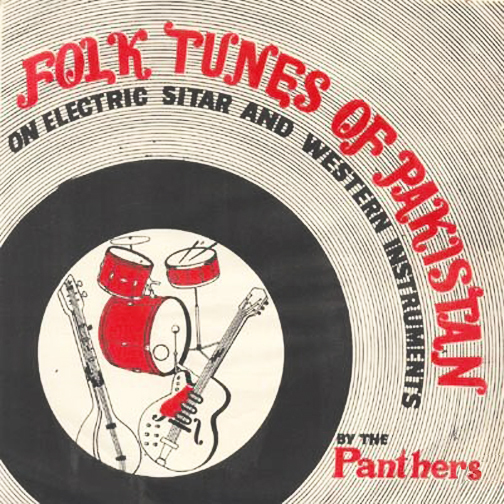
But I had no idea any of this even existed a few years ago, not until I got a CD-R from a guy named Henri in Holland. On that disc, were three of the four tracks from The Panthers‘ Folk Tunes of Pakistan on Electric Sitar and Western Instruments e.p. Not too much later, I stumbled upon 4 Folk Tunes of Pakistan by The Fore Thoughts. By about the time I got my paws on The Mods‘ Folk Instrumentals of Pakistan, I knew I was on to something. But I am sure you are wondering – Why folk tunes? I never did get an answer to that one…
Very little is known about The Aay Jays. This single was the band’s only release. The band was featured on the first two volumes of Pakistan International Airlines‘ In Flight Music series, the second of which included the song “Balley Balley”, which was does not appear on this single. The Aay Jays – as well as The Abstracts, The Blue Birds, The Bugs, The Fore Thoughts, The Mods and The Panthers, Nisar Bazmi and Sohail Rana – are featured on Sublime Frequencies‘ latest release: Pakistan • Folk and Pop Instrumentals 1966 – 1976. The double gatefold LP features 22 tracks, sourced straight from the original EMI Pakistan masters. For information on the record release party, you can go HERE.
Many thanks to Marthy Coumans for the vinyl transfer and cover scan of this single.
Catalog number EKCE 20023 on EMI Pakistan, released 1973.
Filed under: Pakistan

♬ Mahiya
The history of 60s and 70s Rock and Roll in Pakistan – at least within the focus of this site – is quite brief. The mix of influences that created the music of that time and place are unlike anything to be heard anywhere else on earth. And luckily, just when I think I have found the last piece to the puzzle, another record finds it way into my hands – or, in this case – my e-mail inbox.
The first pop song of Pakistan was “Ko Ko Ko Reena” from the Urdu film Armaan in 1966. The song, which was sung by Ahmed Rushdi and composed by Sohail Rana, is a mix of bubblegum pop and Pakistani filmi music. Not too long after, Zulfikar Ali Bhutto’s Socialist Pakistan Peoples Party began a countrywide movement against Ayub Khan’s decade long dictatorship, which he eventually defeated. By 1969, bands that were playing American and British pop covers became popular in Karachi’s burgeoning night club scene as well as at hotels and private dance parties. Long hair came into fashion among young men and hashish became popular drug of choice on college campuses across Pakistan. And hippies from America and Europe flocked to Karachi, Lahore and Peshawar.
That all ended in June 1977, when Bhutto’s Military Chief General Zia-ul-Haq – backed by the Jamaat-e-Islami – toppled Bhutto in a coup d’état and declared Martial Law. Zia-ul-Haq denounces the Bhutto regime’s “un-Islamic” ways and declares Nizam-e-Mustafa or Sharia law. This marked the end of the “Swinging ‘70s” in Pakistan, as night clubs and alcohol were banned throughout the country. Television and cinema, as well as popular music, were now subjected to government censorship. After the clamp down, most musicians moved away – many moving to America, Canada and England.
As for The Abstracts, I do know that composer / songwriter Mohammed Yousuf also worked with The Mods. But beyond that, I have not been able to fins anything further information about the band.
If anyone has contact information for EMI Pakistan, please get in touch.
Many thanks to Milan Hulsing for contributing this selection.
Catalog number EMPP 5006 on EMI of Pakistan, released in 1976.
Filed under: Pakistan

♬ Malkaus
♬ Bihag
When researching the music that is featured on this site, there are usually many more questions than answers. As I type this in an airport in Indonesia – having spent the last four days fruitlessly searching for someone who even knows what a record is – information, even more so than the records themselves, is hard to find.
But over the years, I have occasionally heard from a number of the artists that I have written about. In those rare instances, there are moments of clarity and a few more pieces of the puzzle fall into place… Of course they usually ask me, how did you find out about this stuff and why do you care?
Back in December of 2008 when I posted a song by The Bugs from Pakistan, the floodgates opened. O.K., that’s a bit of an exaggeration, but I was contacted by a handful of musicians who had been in bands in Pakistan during the late 60s into the early 70s. Two of them – Ahsan Sajjad and Fasahat Hussein Syed – were in The Panthers.
Radiodiffusion Internasionaal: Most people don’t realize that Pakistan had such a great scene with quite a few bands. Besides The Bugs, The Fore Thoughts, The Mods, The Slihouettes and The Thunders, do you recall any other bands from that time?
Ahsan Sajjad: The bands were The Black Pirates, Talismen, In Crowd, Moonglows and an older band called The Keynotes before the surge.
RI: When and where did the band get together?
AS: We got together in the year of ‘67 in Karachi. It started with Norman and myself and then we went looking for other members. We had played around with different players but the two of us stuck together. When we released Folk Tunes and had a sit in, Javaid Allahditta, play the sitar we realized we had to go get a sitar player and make him a member. I had known Eric (bass player) for a while and had jammed with him. So I invited him to join us and to switch from lead to bass and then met Fasahat who played the sitar and was versatile on the keyboard. There was the formation of “The Panthers”.
RI: Who was in the band, and what instruments did they play?
AS: Norman Braganza on lead guitar and vocals, Fasahat Hussein on sitar, keyboard and tabla, Eric Fernandes on bass and Ahsan Sajjad on drums and lead vocals.
RI: Which record was recorded first, Folk Tunes of Pakistan on Electric Sitar and Western Instruments or East Goes West? Do you recall which years those records were released?
AS: Folk Tunes first and then in June 1969 EMI released East Goes West. East Goes West shows the versatility of the band. This was a well thought out record where local instruments and ragas were utilized as a modern day tune and to show the meeting of the East tunes and West beats/tempo. The bands ability and creativity also comes forth as they employ different beats in sync with the ragas. Sarangi is utilized an instrument that is a very much into the Indo/Pak culture as the intro to each of the three ragas has a very Eastern tone and creates a haunting melody.

RI: What type of venues did The Panthers perform in Pakistan? Was there a night club scene?
Fasahat Hussein Syed: The first performance of The Panthers was at “Mahapara” outdoors lounge at the swimming pool of Midway Hotel near the airport. We got a contract in the same hotel ballroom afterward. We also played at the Metropolitan Hotel, with some other bands (do not remember the occasion), played at San Patrick’s High School.
AS: Venues were limited… So most bands played at house parties and at the limited outlets.
RI: I recently saw a copy of The Fore Thoughts first single that was pressed in Iran. Did The Panthers ever perfrom outside of Pakistan?
AS: Never made it out of Pakistan. But performed and recorded for Radio Pakistan a tune that was used for their foreign broadcast. The music had to be danceable as that is how the public understood its fancy. But this was also in its infancy and was being perfected as it was being performed or as the target to learn harder songs grew.
RI: Fasahat, you said that The Panthers broke up when Ahsan left for America. That’s when you and Eric joined The Black Pirates with Bashir Balouch from The Fore Thoughts. How long were The Black Pirates together?
FHS: After Ahsan left for United States, Eric and myself joined The Black Pirates, we played for a fashion show in Metropolitan Hotel, we played at Adamji Auditorium at the Marine Engineers Graduation Party in 1970. I joined the Merchant Marines and left the country, group was broken up. After four years, I signed off from Merchant Marines and joined The Black Pirates again with some new members and played in Horse Shoe Restaurant Lounge on a contract. After the contract expired, group broke up again. I left the group to pursue a Marine Engineering Career and eventually migrated to United States in 1979.
RI: What have the members been up to lately? Are you still involved in music?
AS: Norman lives in Mississauga, Canada and is very much into Rhythm and Blues, performs guitar and sings at invitational parties and has put out a CD for friends, doing cover tunes. Fasahat plays keyboard and tabla with a fusion band called Tulsi out of Chattanooga, TN. Me, I am still honing my skills on the guitar. Have performed locally at invitations. Very much into Folk/Blues. Working on putting a performing band.
Thanks to Ahsan Sajjad and Fasahat Hussein Syed for their help.
Catalog number EKCE-20016 on EMI / Columbia Records of Pakistan, released 1969.
 Radiodiffusion Internasionaal Annexe