Filed under: Algeria

♬ Si Moh’
I reached out to my Algerian sources and neither one of them could find anything on this record.
If you have any further information about this artist or anything else about this recording, please leave it in the comment section below.
Catalog number KO 77.1010 on Le Kiosque d’Orphée of Paris, France. Released 1977.
Filed under: Eritrea

This one is a mystery.
I have not been able to find any other information about Ibrahim Mahmoud / ኢብራሂም ማሕሙድ nor the arranger Ghermaine Solomon / ገርማዬ ሰሎሞን. The record label – Tesfa Records – released only one other single by Munaie Menberu / በሙናዬ መንበሩ who was, to the best of my knowledge, Ethiopian. Neither record lists an address where the label was based, just that they were pressed in Greece.
But, if I had to guess just by listening to the music on this record, I would say it sounds like it was from Eritrea.
If you have any further information about this artist, the label or anything else about this recording, please leave it in the comment section below.
Catalog number TG 101 on Tesfa Records. No other information available..
Filed under: Cambodia

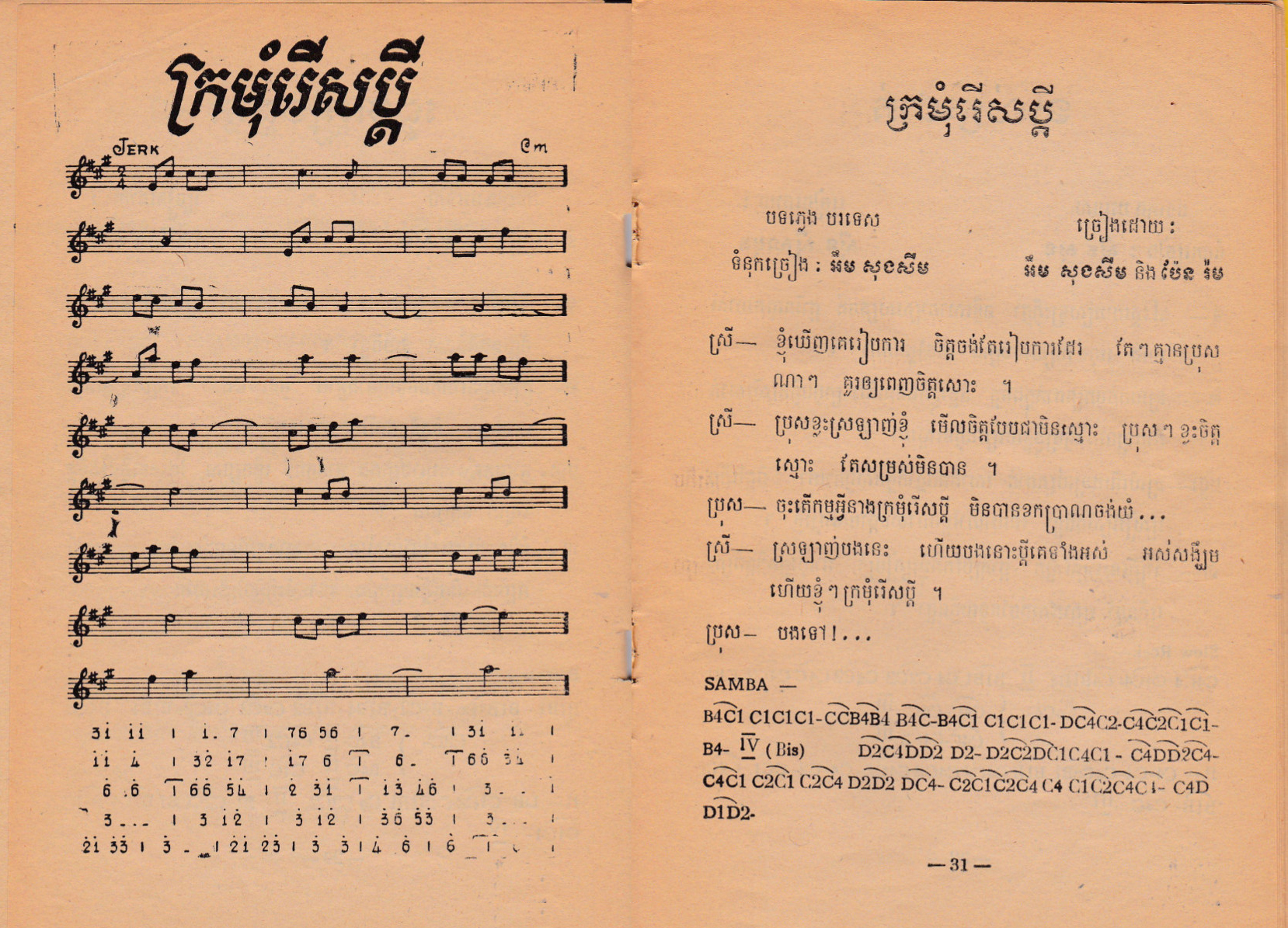
Pen Ram / ប៉ែន-រ៉ម – not her more well known sister Pen Ran (also seen as Pan Ron) / ប៉ែន រ៉ន as originally posted – was born in Battambang, Cambodia. Little is known of her personal history. Like many Cambodian musicians of the time, Pen Ran disappeared during the Khmer Rouge genocide.
Im Songserm (also seen Im Song Seum) / អ៊ឹម សុងសឺម was born in 1943 in Kampong Preah, Cambodia. He was discovered by Mey Thirith / ម៉ី-ធីរិទ្ធិ, an employee of the Ministry of Information and a recording artist in his own right, while still in secondary school. Im Song Seum died on March 16th of 1972 at the age of 29 reportedly of stomach cancer. He never saw the devastation of the Pol Pot years that followed a few years later.
If you would like to find out more about Cambodian Rock and Roll, you should check out John Pirozzi‘s film “Don’t Think I’ve Forgotten: Cambodia’s Lost Rock and Roll” or previous Cambodian posts.
Many thanks to Nate Hun of the Cambodian Vintage Music Archive for catching error in the original post. He has also sent the sheet music and lyrics for the song above.
Catalog number ERP2 on Heng Heng Records Co. of France. A previous owner wrote the date 09/03/81 on the inside of the sleeve. Apparently, Heng Heng repressed many Khmer records for the Cambodian diaspora. This original single was released on Olympic around 1971.
Filed under: El Salvador

Los Junior’s de Santa Tecla formed in September of 1970 in San Salvador, El Salvador. The band consisted of: Alirio Guerra (leader and singer), Romeo Segovia (drums), Rafael López (bass), Alfredo Granados (guitar), Roberto Molares (keyboard) and Raúl Andino (second singer). After five albums and a dozen singles, they broke up in 1978.
Catalog number 10686 A on CBS of Costa Rica. No release date listed.
Filed under: India

Contrary to what the cover may convey, this is not a Bollywood Bluegrass album. Regrettably, that genre has yet to materialize. The banjo is only featured on one song on this album.
The only information I have been able to find about Jayanti & Honey, is that they released one other album – “Hits of 1987” – that was only available on cassette.
If you have any further information about these artists or anything else about this recording, please leave it in the comment section below.
Catalog number VBLP 1002 on Venus Records & Tapes Mfg. Co. of India. Released 1985.
Filed under: Libya

♬ Sultan Zamaini / سلطان زماني (Parts I & II)
What little I have been able to find about Faraj al-Arabi / فرج العربي is that he was originally from Libya, before moving to Egypt. Besides singing, he was also an actor. This single was from the 1969 film ” الشيطان” / “The Devil” which he starred in along with فريد شوقي / Farid Shawqi and سهير زكي / Suhair Zaki.
If you have any further information about this artist or anything else about this recording, please leave it in the comment section below.
PLEASE NOTE: I have edited Side One and Side Two into one track, attempting to make the transition from Part One and Part Two as seamless as possible.
Catalog number 31-73012 on Moriphon of Egypt. Release 1973.
Filed under: Malaysia

Somehow this single has even less information than the last single I posted from Malaysia. Other than a listing on Discogs, there no information available about the band or it’s members and nothing about the record label that released it.
If you have any further information about this artist or anything else about this recording, please leave it in the comment section below.
Catalog number S. B. 101 on Suara Baru Record of Malaysia. Released 1967.
Filed under: Nigeria

Daniel Ian Mbaezue was born in the village of Umuezeawala, Nigeria. In 1966 he started his first musical project, called The Spades. The following year, the governor of the Eastern Region Biafra declared independence from Nigeria. During this period, Dan Ian often played for soldiers and the band was renamed Biafran Air Force Wings – later shortened to The Wings.
In 1971 Dan Ian moved to Lagos to play with Sonny Okosun’s backing band Paperback Limited. By following year, he had left and formed his own band Wrinkar Experience. The band only lasted six months and recorded three singles – one being “Sound Way” which Miles Cleret would later adopt for the name of his record label.
After leaving Wrinkar Experience, Dan Ian went back to playing with Sonny Okosun as well as forming Dan Ian & The Spades.. This single was most likely recorded during this period.
Catalog number HNS 1552 on His Master’s Voice of Nigeria. No release date listed.
Filed under: Venezuela

About a year or so ago, I stumbled on the reissue of Chelique Sarabia‘s Revolución Electrónica en Música Venezolana album – and it blew me away.
José Enrique “Chelique” Sarabia was born in La Asunción, Isla Margarita, Venezuela on 13 March 1940. In 1971, Chelique recorded an album of traditional and folkloric songs but giving them a modern touch, using specially developed equipment based on the principles of the Moog synthesizer. He employed traditional instruments like the cuatro and the bandola llanera, filtered these instruments through oscillators, playing with feedback, tape delay, synthesized frequencies, echoing sounds. Originally, the album was sponsored by the Shell Company in Venezuela, given away to customers, employees and friends of the company as a Christmas gift in 1973. It was titled 4 Fases del Cuatro – Música Venezolana desarrollada Electrónicamente por Chelique Sarabia / 4 Phases of Four – Venezuelan Music Electronically Developed by Chelique Sarabia. Once the exclusivity period with the petrol company was over, Chelique did a commercial release, this time under the name of Revolución Electrónica en Música Venezolana / Electronic Revolution in Venezuelan Music.
This single was a co-release between the C.A. La Electricidad De Caracas and C.A. Luz Electrica De Venezuela. No catalog number or release date listed.

Boussoir Maghnaoui (also seen as Boussouar el Maghnaoui) was from… Hmm. Here’s where things get a little fuzzy. Most sources that say he was from Maghnia, Algeria. But I also have other sources that say he was from Oujda, Morocco. Those two cities are roughly 28 kilometers / 17 miles apart.
Unlike most of the Raï / Proto Raï that I have heard, the organ is very prominent on this track. The song starts off with a “stwanat” – where the artist announces the record label his name as well as the name of the performers. That is followed a sort of poem – or mawwal – that doesn’t have anything to do with the usual intros and tributes to other artists or football players or cities. This song features Messaoud Bellemou – known as “The Father of Raï” – on trumpet.
Thanks to Hicham Chadly, Jonathon Ward and Loïc Guillaume for input on this post.
Catalog number N· 496 on Sawt-Hilali of Algeria. No release date listed.