Filed under: Tanzania

Taarab is a music genre popular in Tanzania, as well as neighboring Kenya. Much like Dangdut music of Indonesia, you can hear the Arabic and Indian influences that are a result of the cross-pollination with trade routes across the Indian Ocean.
Taarab is believed to have originated in Egypt, with their film orchestras provided an important model in the ’50s. More recently, Egyptian and Lebanese pop and especially Hindi film music have influenced the music’s melodies and vocal styles. Taarab songs explore romance and marriage, though their stylized Swahili poetry can suggest political interpretations. The instrumentation can include African drums, tablas, dumbek, riq, oud, qanun, taishōgoto, as well as organ and accordion. There is also usually guitar and bass, but often get lost in the mix with the violins and cellos.
The only information that I have been able to find on J. K. T. Taarab, is that they were from Tanzania’s capitol, Dar es Salaam. For more information on Taarab music, check out Likembe – where you can find some tracks by Jasmin Musical Club and Shani Musical Club, as well as a few others – and Afropop.org.
Catalog number AHD (MC) 034 on FLATIM Records / Ahadi Productions of Nairobi, Kenya. No release date listed.
Note: The song Mcheza Bao is cut short due to the fact that the side of the cassette ends before the song does.
Filed under: Mongolia

Soyol-Erdene (Соёл-Эрдэнэ) were, and apparently still are, the first rock band of Mongolia.
The Mongol Empire was founded by Genghis Khan in 1206. Following the collapse of the Yuan Dynasty, the Mongols returned to their earlier pattern of constant internal conflict and raiding of the Chinese borderlands. By the end of the 17th century, all of Mongolia had been incorporated into the area ruled by the Qing Dynasty. After the collapse of the Qing Dynasty in 1911, Mongolia declared independence, but had to struggle until 1921 to firmly establish independence from the Republic of China. As a consequence, it came under strong Russian and Soviet influence. In 1924, the Mongolian People’s Republic was declared, and Mongolian politics began to fall in line with the Soviet politics of the day. After the fall of the Iron Curtain in late 1989, Mongolia saw its own Democratic Revolution in early 1990.
Soyol-Erdene was established in late 1971. The Minister of Culture of that time, famous novelist Chadraabaliin Lodoidamba called four young musicians and said: “England has a band The Beatles of four young men. Why shouldn’t we have a similar band?” The four young musicians, who had recently graduated the School of Music and Dance in Ulaanbaatar (now called College of Music and Dance) as yatga (ятга) players, established a rock band. The members were Tserenbat (drums), Erdenekhuyag (guitar), Batsaihan Jamyan (bass) and Naranbaatar Badamgarav (keyboard). The first compositions of the band were Mongolian folk songs in a rock style arrangement. They often used poems of famous Mongolian writers. In fact, the name “Soyol Erdene” – which roughly translates as “cultural jewel” – is the title of a melodious popular song of 1920s which the band played on an electric guitar. During Soviet rule, the band worked under the administration of the State Philarmony which also supervised the Mogolian symphony orchestra as well as Mongolia’s other rock band – Bayan Mongol Variety Group. The band was often criticized by the MPRP Censorship Board for the promotion of the Western musical style and Western fashion.
Soyol-Erdene are supposedly still active. They have a MySpace page, although it has not been updated in sometime.
Catalog number C90-15961-2 on the Soviet state-owned and operated Μелодия (Melodiya) label, released in 1981.
Filed under: Kuwait

Wow. A year later. Sorry for the long delay…
The traditional music of Kuwait had been well documented up until the Persian Gulf War, when Iraq invaded the country and destroyed much of their archives. Nevertheless, Kuwait has retained a vital music industry, both long before the war and after. Kuwaiti music reflects the diverse influences of many peoples on the culture of Kuwait, including East African and Indian music.
Most of the citizens of Kuwait know Firqat Al-Telvizyon as “The TV Band”. They are the official band of Kuwait Television, in conjunction with the Ministry of Information. Their purpose is to record and perform all genres of folk music in order to preserve Kuwait’s musical traditions. Although the band members have changed over the years, they are currently still active and have a vast discography.
Thanks to Fatima Al Qadiri for the translation and information.
Catalog Number 03 BUZ 26 on Bou Zaid Phone of Kuwait. Released 1980.
Filed under: Ethiopia

♬ Tezeta
Five years ago, I decided to purchase the domain radiodiffusion.net after my old site got mentioned on Boing Boing and crashed from the traffic. I had no idea what I was getting myself into. A good friend of mine even tried to talk me out of it. But here we are, and I still am pretty clueless as to what I am doing or where I am going with this unruly beast of a site. What started out as a little web page for a handful of friends, now gets about 400 to 500 hits a day.
The original intent, or should I say the inspiration, was just that there were practically no web sites out there where you could hear this stuff. And it seemed like the few that did exist, only used RealPlayer – and who wants that headache? I started this because there were, and still are, hundreds of records that I just wanted to hear. I didn’t need to hear the whole thing – just enough to get an idea of whether or not it was worth tracking down.
At the time, there were only a handful of compilations and reissues available. There was nothing from Iran. Since then, there’s a whole label dedicated to music from that time period as well as a few other great compilations. Angola, Burma, Iraq, Pakistan and Vietnam were all completely off the radar. Now those countries’ – as well as many others’ – musical histories have been unearthed and are now readily available to be heard. This – plus the many other amazing music sites that have sprouted up since – has turned many fellow music fiends into collectors, seeking out these records.
But what else is there to say that has not already been written about Ethiopian Jazz or Khmer Pop? And more eloquently than my own ramblings, I might add. Both of those countries have compilation series whose volumes number up into the twenty some odds now. Or how about Thailand? How may compilations have been issued? I can name at least fourteen just off the top of my head. Add in the mind boggling Monrakplengthai, and you pretty much have what seems like the entire recorded history of that country. And Turkey? Nigeria? Indonesia? Benin? It goes on and on.
Unfortunately, one thing has become clear – Radiodiffusion Internasionaal can not continue on as it has. I’ve painted myself into a corner, metaphorically. I mean, there are plenty of records – and cassettes – that are left to post. But the ones that I really want to write about, I have not been able to get my hands on. So, I have been tying to figure out how to take this site in a slightly different direction. I just have not figured out what that direction is… Yet.
In the meantime, got any suggestions?
For information on Menelik Wossenachew, please see the previous posting HERE.
Catalog Number AE 350 on Amha Records of Addis Ababa, Ethiopia. Released 1972.
Filed under: Burma

♬ Salt Bottle and The Three Mangosteens [side one]
♬ Salt Bottle and The Three Mangosteens [side two]
When most people think of radio dramas, black and white images of families sitting around a huge old radio come to mind. In regions were televisions were not readily available and movie theaters were few and far between, these programs were the main source of entertainment – outside of music. But whereas their production here in the States has just about become non-existent, they still are produced in many other countries across the globe to this day.
In Burma, one of the most popular characters was, and still is, detective “SarPalin” Hnin Maung – who was created by Min Thain Kha / မင်းသိင်္. The detective was given the nickname “SarPalin” – meaning “Salt Bottle” – because it was essential that he be assigned to every case to solve as salt is essential to every dish to make it taste right. The character has been featured not only in radio dramas, but also in books and at least one film.
Many thanks to Ni Ni Aye for the information and translation.
Catalog number and label unknown.
Warning: These tracks have been converted to mono to reduce the file size, but are still quite large and may take some time to download.
Filed under: Pakistan

“Why do you like this stuff?”
“How did you find out about this?”
“Why do you care?”
I get asked those questions all the time. Just about every musician from Pakistan that I corresponded with over the last few yeas has asked that.
I have always been a big fan of instrumental guitar music. I took – um, I mean borrowed – my mother’s Ventures records when I went away to college. When you add in the cultural influences in Pakistan – being situated between Afghanistan, India and Iran – you end up with a sound that was, and still is, unlike anything heard anywhere else on the planet.
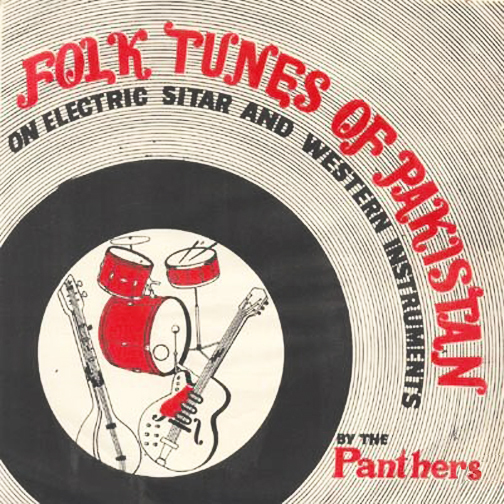
But I had no idea any of this even existed a few years ago, not until I got a CD-R from a guy named Henri in Holland. On that disc, were three of the four tracks from The Panthers‘ Folk Tunes of Pakistan on Electric Sitar and Western Instruments e.p. Not too much later, I stumbled upon 4 Folk Tunes of Pakistan by The Fore Thoughts. By about the time I got my paws on The Mods‘ Folk Instrumentals of Pakistan, I knew I was on to something. But I am sure you are wondering – Why folk tunes? I never did get an answer to that one…
Very little is known about The Aay Jays. This single was the band’s only release. The band was featured on the first two volumes of Pakistan International Airlines‘ In Flight Music series, the second of which included the song “Balley Balley”, which was does not appear on this single. The Aay Jays – as well as The Abstracts, The Blue Birds, The Bugs, The Fore Thoughts, The Mods and The Panthers, Nisar Bazmi and Sohail Rana – are featured on Sublime Frequencies‘ latest release: Pakistan • Folk and Pop Instrumentals 1966 – 1976. The double gatefold LP features 22 tracks, sourced straight from the original EMI Pakistan masters. For information on the record release party, you can go HERE.
Many thanks to Marthy Coumans for the vinyl transfer and cover scan of this single.
Catalog number EKCE 20023 on EMI Pakistan, released 1973.
Filed under: Iran

♬ گل مریم
Giti Pashaei (گیتی پاشایی ) was born on June 13, 1948 in Tehran, Iran. She apparently inherited her passion for music from her grandfather, Jafar Mansoori, who was a well known poet and musician. Her early life was spent attending the master-classes of such musicians as Faramarz Paywar, Mahdi Foroogh and Mahmoud Karimi. Giti continued her education in New York, where she earned a degree in architecture from CUNY. She also studied “orchestration and harmony” while in Seattle, Washington.
Giti would go on to become one of the most popular Iranian singers. Her biggest hit was the song “گل مریم” – “Gol-e Maryam” or “Maryam Flower” – which was released in 1971. But the Iranian Revolution put an end to her singing career in 1979, since women were now forbidden to sing in public. She made the transition to composer, and scored soundtracks for a number of Iranian movies – many of which were directed by her husband, Masoud Kimiai. She also acted in a handful of films as well. In the late 1980s she moved to Hamburg, Germany where she researched Western Religion and Baroque Music. After moving back to Tehran, Giti died of cancer on May, 7th of 1995. She was buried at Behesht-e Zahra.
Thanks to Ramin and Jesse Kaminsky for helping with the translation and information.
Catalog number ۱۵٢٧٧۴ on Apolon of Iran, released 1971.
Filed under: Côte d'Ivoire

♬ Vla
One of West Africa‘s first recording studios, as well as first record pressing plants, was established in Côte d’Ivoire‘s capital city of Abidjan in the early 1970s. Abidjan quickly became West Africa’s musical hub, with musicians coming from all over the region to record. Côte d’Ivoire had always been receptive to musical styles from outside its borders, as well as being a melting pot of peoples and cultures. Since the country did not go through a war for independence like many other West African nations, the local musicians did not have the same national awakening of pride – which in other countries led to the mix of traditional indigenous music and more urban sounds born out of revolutionary defiance. As a result Côte d’Ivoire did not really develop an internationally recognized signature style of music. But that all changed once Amédée Pierre came along.
Vital Nahounou Digbeu Amédée was born on March 30, 1937 to Pierre and Wassa Nahounou Doudou Séry Bitta in the town of Tabou in south-western Côte d’Ivoire. He was christened Pierre after we was baptized Catholic. The first recorded history of him playing is in an account by René Babi, who wrote: “Ce jeune homme qui ne se séparait jamais de sa guitare, allait agréablement surprendre les couche-tard d’un soir de l’année 1958” – which translates as “This young man who never parted with his guitar, was a pleasant surprise the night owls for an evening of the year 1958.” On August 7th of 1960, Amédée Pierre performed his first concert with his backing band l’ Ivoiro Star at Avenue 3 in Treichville, a neighborhood of Abidjan. Having sung French variety tunes for several years, Pierre decided to rebel against the former colonial power and started composing in the Bété language.
Amédée Pierre became known as “Le Dopé National” – or “The National Nightingale”. He recorded at least 19 singles for the Ivoirienne Safie Deen label, as well as three singles for the Société Ivoirienne du Disque label. He was also featured on the second volume of Antilles Records‘ Assalam Aleikoum Africa series and another compilation called Ivoire Retro. His backing band – l’ Ivoiro Star – also recorded singles for Société Ivoirienne du Disque with singers Armand Pascal Lido and Martial Droubly. One song by of each can be found on the first volume of Assalam Aleikoum Africa. More recently, three tracks were included on Syllart Records‘ African Pearls Vol. 5: Côte D’Ivoire: West African Crossroads. In 2000 he was decorated by Mr. Laurent Gbagbo, President of the Republic of Côte d’Ivoire.
Catalog number NAP.004 on NAP. No further information about this single, or the label that released it, is available.
Filed under: Hong Kong

♬ 一吻定情
♬ 偸心的人
Wait. Where was I? Oh yeah… I was going to make some kind of tenuous connection between studio musicians and elevator music and tie in the fact that I just started reading Joseph Lanza’s “Elevator Music: A Surreal History of Muzak, Easy-Listening, and Other Moodsong” (Which, so far, is much more entertaining than the last book I read: Simon Reynolds’ “Rip It Up and Start Again: Postpunk 1978-1984” [Spoiler Alert: Gang of Four were apparently responsible for everything] and way more enjoyable than anything by the coma inducing Peter Manuel¹ {Sorry to wander off in to Rev. Nørb territory here… (And yes, I do realize that 98% of the people who are reading this will not get that reference [And for that 2% of you who were reading MMR in the early 90s – Huzzah and kudos to you.].).}.). But instead, you get this:
Moon Stars were – like their label mates The New Wave – most likely a studio creation of their record label – New Wave Recording Company. If you have any further information, please contact me or leave a comment.
Catalog number NWLP 9, released by the New Wave Recording Company of Hong Kong. No other information available.
¹ Please see Mack Hagood’s comment regarding Peter Manuel below.
Filed under: Algeria

Recently, I was asked: With all of the compilations and blogs out there, do you think that you will run out of music to find? The short answer is ‘Yes’. As it stands now, it is getting more and more difficult. There are only a finite number of records from that time period that were pressed. But what that number is, nobody really knows.
A good example is the Bollywood Steel records. When I put together the compilation for Sublime Frequencies, I thought I had found pretty much all there was to find. I knew that I was missing a record or two, but I think at the time I had maybe 25-30 records. Since then I’ve found at least 60 more – and counting. I bought three yesterday!
Another thing to consider, is that as collectors – I mean archivists – accumulate these records, they hear stuff outside of their original focus. In the process of searching for Thai Beat records, people have stumbled onto Shadow Music, Molam, Luk Thung and the many other wonderful mutations from Thailand. So the number of records out there is not exactly static.
But as more and more folks get clued into these recordings, there are now more people hunting down the original vinyl. And it has gotten quite competitive. When I started this site, there were only a dozen or two compilations and maybe a handful of websites. Now? I cannot even keep track of what’s become available.
The good news is that we are probably going to get to hear those records… Eventually.
Both of these songs were featured on the first volume of the Waking Up Scheherazade compilations. For further information on Les Abranis, as they were to be known after this single – which was their first, please check out the previous post.
Catalog number 11102 on Oasis Disques of Paris, France, released 1973.
 Radiodiffusion Internasionaal Annexe