Filed under: Cameroon

I have to admit, it is a wonderful time to be alive for music freaks like myself. Only a mere ten years ago, I had very little clue of what was out there. I had only really focused on the music of America and Europe. But thanks to a handful of compilations and reissues – and the Forced Exposure website – I was slowly led down the rabbit whole that resulted into the convoluted mess you see before you.
Now, there are plenty of arguments over royalties and copyrights… And yeah, that is a touchy subject – one I am not going to get into here. I will admit that trying to go thru the proper channels in reissuing this stuff, you would probably never get to hear this stuff – unless you were lucky enough to find a copy of the original vinyl yourself. And for that you have to accept that the rules do get bent a tad now and again.
But, I do take issue with someone taking material directly from this site. Yeah, I have been known to – oh, let’s say borrow – a phrase or two from other websites in my ramblings, but I try to at least link back to the original source. Where as it’s nice to be quoted, it’s an entirely different thing to have something you wrote printed as the liner notes of an album – and not properly credited, much less even being asked. I also suspect that a particular record company has taken audio files from this site and used them on their releases… But that is only a hunch.
Sorry. Just had to get that off my chest.
If you would like to find out more information about Pierre Didy Tchakounte, please check out this previous posting.
Catalog number SAF 1533 on Sonafric Records of Paris, France. No release date given.
Filed under: Pakistan

♬ Mahiya
The history of 60s and 70s Rock and Roll in Pakistan – at least within the focus of this site – is quite brief. The mix of influences that created the music of that time and place are unlike anything to be heard anywhere else on earth. And luckily, just when I think I have found the last piece to the puzzle, another record finds it way into my hands – or, in this case – my e-mail inbox.
The first pop song of Pakistan was “Ko Ko Ko Reena” from the Urdu film Armaan in 1966. The song, which was sung by Ahmed Rushdi and composed by Sohail Rana, is a mix of bubblegum pop and Pakistani filmi music. Not too long after, Zulfikar Ali Bhutto’s Socialist Pakistan Peoples Party began a countrywide movement against Ayub Khan’s decade long dictatorship, which he eventually defeated. By 1969, bands that were playing American and British pop covers became popular in Karachi’s burgeoning night club scene as well as at hotels and private dance parties. Long hair came into fashion among young men and hashish became popular drug of choice on college campuses across Pakistan. And hippies from America and Europe flocked to Karachi, Lahore and Peshawar.
That all ended in June 1977, when Bhutto’s Military Chief General Zia-ul-Haq – backed by the Jamaat-e-Islami – toppled Bhutto in a coup d’état and declared Martial Law. Zia-ul-Haq denounces the Bhutto regime’s “un-Islamic” ways and declares Nizam-e-Mustafa or Sharia law. This marked the end of the “Swinging ‘70s” in Pakistan, as night clubs and alcohol were banned throughout the country. Television and cinema, as well as popular music, were now subjected to government censorship. After the clamp down, most musicians moved away – many moving to America, Canada and England.
As for The Abstracts, I do know that composer / songwriter Mohammed Yousuf also worked with The Mods. But beyond that, I have not been able to fins anything further information about the band.
If anyone has contact information for EMI Pakistan, please get in touch.
Many thanks to Milan Hulsing for contributing this selection.
Catalog number EMPP 5006 on EMI of Pakistan, released in 1976.
Filed under: Brunei

I’ve been meaning to update the previous post on Kugiran Irama Perindu for some time now, but I figured I’d just do a whole new post. Over the past year or so, I’ve been corresponding with Merv Espina – my contact for Brunei. Merv has been researching Gema Dari Menara (Voice from the Minaret) – the only motion picture produced in Brunei. In the process, our research has overlapped uncovering Brunei’s lost rock and roll history.
In 1962, A. M. Azahari was the leader of the Parti Rakyat Brunei – or Brunei People’s Party. PRB rejected the proposed federation with Malaysia. This opposition led to the failed Brunei Rebellion, which resulted in a strict curfew period from 1962 to 1965. During that time, many musicians moved to Singapore – which would explain why almost all of the earlier records from Brunei were on the Olympic label. But between lifting of the curfew in 1965 and Pengiran Kamaluddin, who was also responsible for initiating Gema Dari Menara‘s production, stepping down as the head of Department of Religious Affairs in the 1970s, there was a small window. It was during that brief period that rock and roll happened in Brunei.
There were only two bands in Brunei: Dendang Teruna and Kugiran Irama Perindu. There were also a few musicians who recorded with bands from Malaysia and Singapore – like Hussen Hj Tuah. But Dendang Teruna – to the best of anyone’s knowledge – never recorded. They did perform regularly on Brunei Radio and were featured in the film Gema Dari Menara (as seen in this still from the video transfer). But, Kugiran Irama Perindu recorded three singles before Dayangku Aminah left the band to go solo.
The personnel of Kugiran Irama Perindu – as seen on the cover of their first single – is as follows: Standing up, wearing the white jackets is Jafar – whose last name or title is unknown (bass) and Sari Hj Besar (guitar). Seated is Norsiah A. Hamid (vocals), Awangku Tajuddin (vocals), Awangku Yussof (drums) and Dayangku Aminah (vocals). A quick note about Brunei honorific titles: Awangku (Ak), for the men, and Dayangku (Dk), for the women, are titles bestowed on unmarried individuals connected to the royal bloodline. Once married, they adopt the title Pengiran (Pg). All of the members of the band were all single when the first Kugiran Irama Perindu EP came out, but soon after Pg Tajuddin married Norsiah A. Hamid. They both recorded – together and separately – with The Sandpipers, The Sand Blues and Kugiran Irama Perindu. The couple are featured on the cover on this single.
Catalog number T.R.C. 1051 on Olympic Records of Singapore. No release date given.
Filed under: Iraq

This week’s guest post is by Jeremy Toomey. Jeremy heeded the call in an earlier post for submissions from places we have yet to cover, or needed to be covered more. And he delivered Iraq. If you have any interesting records or cassettes that you wish to share from some of the countries that we have yet to hear from – say like Bangladesh, Central African Republic, Kazakhstan, Libya, Somalia or Tanzania – or countries that we need to hear more from – like Laos, Sudan or Syria – please get in touch.
Born July 2, 1949 in Baghdad, Ashur Bet Sargis began playing music as a teenager on the organ at the local Assyrian church. Under the influence of established Assyrian musicians such as Evin Aghassi and King Biba (Edward Yousif), as well as western artists, in the late 1960s Ashur began composing nationalistic songs that have since become classics of modern Assyrian music. As Ashur recalls of his early days in the biography written for his 4-CD set “So far” (2003):
“Music was being redefined out in the rest of the world, and stars like Elvis, Paul Anka, and of course The Beatles were shining all over the place. I wanted to be a part of this transformation, and offer its fruition to my people.”
In 1969, Ashur fled the unstable political situation in Iraq, ending up in Chicago, IL in September 1970. In 1971, he formed his first band, “East Bird Band”, which released its first recording in 1973. In 1976, after relocating to Los Angeles, Ashur became the first Assyrian artist in history to tour overseas when he and his band played three sold-out shows in Australia. Soon afterwards he would travel to Iran, which at that time had the second largest population of Assyrians in the Middle East, and had long been a large producer of Assyrian music on the record labels that flourished in Tehran in the days before the Islamic revolution such as Irangram and Monogram. After two weeks of performances there, he returned to Los Angeles to record his second album, “Ashur Sargis Sings for Ancient Assyria”, which included re-recordings of hits from the first album like “Tanilee Ly-Ly” (“Sing Me A Lullaby”, with lyrics by Assyrian nationalist martyr Dr. Freydun Atturaya) and “Bet Nahren”, as well as several other songs that have since become staples of his catalogue and concerts. The version of “Bet Nahren” posted here comes from this LP, released in 1978.
Ashur Bet Sargis continues to tour (including a two week tour of northern Iraq in 1997 during which he gave five concerts which were attended by thousands of Assyrians from all over Iraq) and release albums from his current home in Phoenix, Arizona.
For more on the life and career of Ashur Bet Sargis (including the biography from which this information is taken), please see the artist’s official website at http://www.ashurbetsargis.com/.
For more information and examples of Assyrian music, past and present, visit the largest archive of Assyrian music on the internet at http://www.qeenatha.com/.
Catalog number NIN-109 on Nineveh Records of San Francisco, California. No release date listed.
Filed under: Mali

I just got to get this off my chest: The Goldmine Rating System is for idiots and liars.
Record collectors are a nefarious bunch. It’s a moniker that I have generally shied away from, preferring music nerd. I am no vinyl purist. The only reason that I have return to the vinyl wonderland is that was the only way to find what I was looking for – which was something that was not available anywhere else. And I will admit that vinyl does sound the better than any of the other options – that is, if the vinyl is in good shape. But since I do not have to resources to travel the world scouring flea markets from Tokyo to Timbuktu, I have to rely on record dealers…
Now don’t get me wrong, there are some honorable dealers out there. In fact, the person who sold me this record has been known to throw an extra record or two in with my orders. But more than a few records have fallen short of their description. This record was listed as Very Good Plus, which is: “Cover suffers from folding, scuffing of edges, spine splits, discoloration… Now the signs of age and handling are starting to show. You can notice some clear wear on the surface, there is some noise (pops and crackles) but no skips or major warps”. Here’s the criteria of what classifies as Bad: “The cover and contents are badly damaged or partly missing. Cover can also be missing. The record does not play properly due to scratches, bad surface noise, etc… Unless it is something very rare it is not worth listing in this condition”. And there’s the catch – this record is rare. And due to the scarcity of the records like this one, I have learned to live with some fairly noisy recordings.
As for Tentemba Jazz du Mali, I do know that the band consisted of members Sékou Kanté – who later joined the Rail Band – Ousmane Diabaté and Amadou Touré. They released two albums in 1977 and one more in 1978. As far as I know, this was the second of only two singles that the band recorded.
If you have any information, please contact me.
Catalog number B B 229 on Badmos Records of Côte d’Ivoire, released 1977.
Filed under: Malaysia

The film songs of Bollywood are the pop music of India. It is only in the last couple of decades that the film industry of India has come to the attention of the Western World, and even more recently – Hollywood. But those films – and the songs contain there in – have influence music around the world for many years. The films have been popular in Africa, Asia and the Middle East dating back to the 1950s. Besides being popular with Indians who have migrated around the world, millions of non-Indians enjoy Bollywood films for many years.
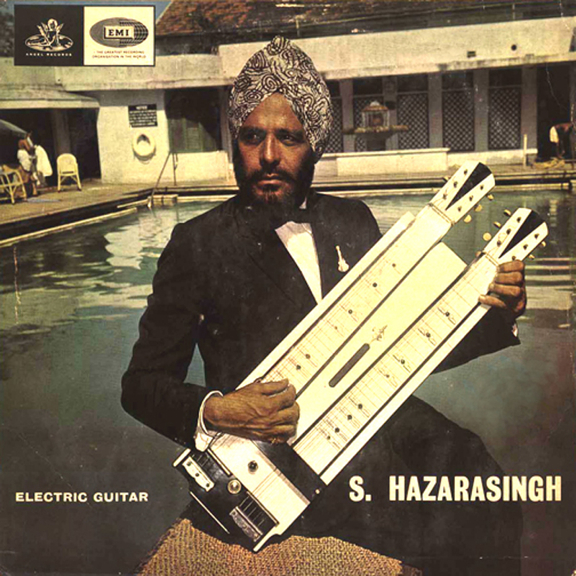
I have seen an Israeli album of filmi songs in Hebrew. Then there is a live album by Usha Uthup that was recorded in Nairobi. I have a Malay pressing of S. Hazarasingh album and a South African pressing of Van Shipley album. As for M. Shariff, I have seen one other single by him performing songs from the film Bobby, on what is apparently his own label.
If you have any further information about M. Shariff, or his Bombay Orchestra, please contact me or leave a comment.
Catalog number MSF 5020 on M. Shariff Scope Trading of Kuala Lumpur, Malaysia. No release date listed
Filed under: Iran

This week’s post comes to us from Jesse Kaminsky. His weekly radio show – The Intercontinental – can be heard on WMBR in Cambridge, Massachusetts. For those of us who do not live within range, the show is available as a podcast. He also has a rather extensive collection of Iranian singles.
Information on the popular music of pre-revolutionary Iran is hard to come by if you don’t read Farsi. Most reissues of the music are in Farsi and have little to no liner notes, save for Göhkan Aya’s well researched essay for the Raks Raks Raks compilation released last year on Raks Discos. This is perhaps due in part to the political situation surrounding the music and culture, much of what was recorded prior to the 1978 revolution became illegal with the new regime and was destroyed when found by the police. Performers who had substantial careers prior to the revolution had to flee the country or risk persecution as even the simple act of a woman performing as a soloist became illegal, not to mention the performance of westernized Persian music that had become increasingly popular under the last years of the Shah. Records that you find now from that period in Iran have likely survived many hardships and they almost always show it in one way or another.
Stuart has already covered much of the cultural history of Iran in his previous posts so I’ll leave that for now and say that this track from the singer Pouran. She began singing in 1951 at the age of 18, using the stage name of “Unknown Lady” or “Lady Anonymous Singer, ” depending on how you translate the Farsi. She married her vocal instructor, violinist Abbas Shapouri, and altered her stage name first to “Lady Shapouri, ” then to the simpler “Pouran, ” collaborating with Shapouri for the duration of their seven-year marriage to produce some of her most popular songs. At the height of her career, she was well regarded as an actress and singer, possibly recording as many as 2000 songs, although that’s really an impossible number to confirm. After her divorce, she continued to perform and record, often appearing on Iranian National Radio, until the late 70’s, when the revolution forced her to stop performing and flee the country. She died in 1991 during a visit to Iran and is buried in the Imamzadeh Taaher cemetery in the city of Karaj.
As an example of the difficulty in finding information on this era of recorded music, this line from the Google translation of her Wikipedia page jumped out at me: “Art said his toe in Salt Lady nephew heartsome other is born of that era” in reference to her musical association with her first husband.
Without much of a discography available, I’d guess that this record is from the later part of her career. It’s released on Ahang Rooz, the first and largest of pre-revolutionary Iranian record labels, and has the analog synthesizer sound that seems to have enjoyed some popularity in the later 70’s. The single includes the two songs: “Shahr-e Paeez” (The City of Autumn) and “Ye Roozam Maa Ra Faramoosh Mikoni” (One Day You Will Forget Me).
Thanks to Hamineh, Kourosh and Ramin for their help on this post as well as for all the other information that they’ve helped me with. Any factual errors or misunderstandings are mine.
Catalog number AR-2519 on Ahang Rooz of Iran. No release date listed.
Filed under: Ethiopia

Tilahoun Gessesse was one of the most popular singers of Ethiopia‘s “Golden Age” in the 1960s – nicknamed “The Voice”. There are four posts (so far) that cover the legendary musician over at the mighty Likembe blog.
Here is Tilahun’s biography from Ethio LA3:
Artist Dr. Tilahun Gessesse was born to Woizero Gete Gurmu and Ato Gessesse Wolde Kidan on Sunday, September 27, 1942, in Addis Ababa, Ethiopia. When he was fourteen years old, he was taken by his grandfather to Woliso. While he was in Woliso, he began attending Ras Gobena Elementary School. As time went by, his interest in music became so clear that his grandfather urged him to concentrate in his school studies instead of music. On the other hand, the Ras Gobena School Principal Mr. Shedad (Sudanian) who realized Tilahun’s interest in music urged him to go to Sudan to pursue his interest in music. Even though young Tilahun did not go to Sudan to pursue his music career, he took Mr. Shedad’s advice very seriously. When artists form Hager Feker Theater, Woizro Negatwa Kelkai, Ato Eyoel Yohanes and others came to Ras Gobena Elementary School to perform, Tilahun grabbed this opportunity to discuss his interest in music with Ato Eyoel. Young Tialhun was told to go to Addis Ababa if he wanted to pursue his career in music. […]
Once Tilahun arrived in Addis Ababa, he immediately began to show his talent. He was first hired by the Hager Feker Association, which is nowadays known as Hager Feker Theater.
After a few years at the Hager Feker Theater, Tilahun joined the Imperial Body Guard Band where he became a leading star singer. He then moved to the National Theater where he became famous and successful with his wonderful voice. Tilahun was so famous that he appeared three times in front of His Majesty, Emperor Haile Selassie I. During his visit with his Majesty, His Majesty advised Tilahun not to abuse his gifted talent. Tilahun kept his majesty’s advice and has become the king of Ethiopian music and his name has also become a household name among all Ethiopians.
Tilahoun Gessesse passed away on April 19th of 2009. A state funeral was held on three days later in Addis Ababa.
Catalog number PH 7-224 on Philips Records Ethiopia. No release date listed.
Filed under: India

[Note: This is a re-print of a guest post that I wrote for Jonathon Ward’s amazing Excavated Shellac back in September of last year. For that post there is a song from one of Van Shipley’s earliest 78, where as here you have a song from the 70s.]
The earliest known report of anyone playing slide guitar was Gabriel Davion, a native of India who had been kidnapped by Portuguese sailors and was brought to Hawaii in 1876. Of course, Indian string instruments, like the gottuvadhyam and the vichitra veena, use a slide are known to have existed since the 11th century. But it was not until Ernest Ka’ai and his Royal Hawaiian Troubadours’ toured in 1919 that the slide guitar was introduced to India.
Most people agree that Van Shipley was the first electric guitarist in India and the first to record instrumental versions of film songs beginning sometime in the early 1950s. Van was born in the city of Lucknow in Indian state of Uttar Pradesh. When most people hear his name, they say “But that’s not an Indian name!”. Well, that’s because not everyone in India is Hindu. Shipley was Methodist.
Inspired by his mother, who played the sitar, Shipley took to music at a young age. His first instrument was the violin. He attended Saharanpur to study Indian Classical music. There, he studied under Ustad Bande Hassan Khan and his son Ustad Zinda Hassan Khan, who were both famous Khyal singers from Northern India. At the same time, he took lessons in western music from an American identified as Dr. Wizer.
Shipley then returned to Lucknow to attend college, where he became involved with All India Radio. After college, we went to the city of Pune to work for the Prabhat Film Company before moving to the center of India’s film industry, Bombay (Mumbai). It was there that he caught the attention of producer and director Raj Kapoor, who spotted him performing on stage. Kapoor enlisted Shipley to play violin on the soundtrack for Barsaat (Rain) in 1949. The following year, Shipley added his electric guitar to a dream sequence in Awaara (The Tramp), which brought him to the attention of The Gramophone Co. of India. In 1955, Shipley teamed up with accordionist Enoch Daniels, who he had met while working for the Prabhat Film Company in Pune. This musical partnership ultimately lasted for many years.
Shipley set off the steel guitar craze in India. Other steel guitar players from the 78 era include Batuk Nandy, Brij Bhushan Kabra, Kazi Aniruddha, Mohon Bhattacharya, Nalin Mazumdar, Robin Paul, S. Hazarasingh, Sujit Nath and Sunil Ganguly. But most of these guitarists only recorded Tagore songs, with only a few (Kazi Aniruddha and S. Hazarasingh) recording Filmi tunes (Sunil Ganguly and Batuk Nandy would start doing film songs in the 60s and the 70s, respectively).
One of the most distinct things that set Shipley apart was that he played an eight string guitar, which he had designed and built to give him the drone sound that was more common in Indian Classical music than in the Film songs. Almost all of the other Indian steel guitarists played a National Dual Six Console guitar. Shipley also designed his own electric violin as well, which he dubbed the ‘Gypsy Violin’ and used on many of his later records.
Shipley’s first album, The Man with The Golden Guitar, a title that stuck with him the rest of his career, was released in 1962. He would go on to release an album every year until 1982, as well as a dozen or so EPs. He also tour the world, playing shows in Europe, the Middle East, the Caribbean Islands, Suriname, Guyana and the U.S., including the cities of New York, Washington D.C., Los Angeles, San Francisco, Chicago, Buffalo and Detroit. Besides recording, Shipley acted in a few films as well, including 1964s Cha Cha Cha.
Shipley died on March 8, 2008 of a heart attack at his home in Mumbia. His daughter Ingrid is an artist and musician who lives in New York, and his nephew Valentine is a singer/songwriter in India.
Thanks to Derek Taylor at Bagatellen for the information.
Catalog number TAEC. 1648 on Odeon / EMI for The Gramophone Co. of India, released 1970.
Filed under: Cambodia

As I have mentioned before, I sometimes regret having omitted Latin Music from the scope of this site. At the time I decided to start doing this, I thought that I was pretty sure I knew all that I needed to know about the subject. And I have since been proven wrong. There’s a vast amount of amazing material out there. But I really do not need an excuse to buy more records than I already do. Maybe one of these days when I feel that I’ve got the rest of the world taken care of, I will turn my attention to that region.
But the influence of Latin Music on the rest of the world is very evident. You can hear it in the Middle East in the music of Egypt‘s Salah Ragab and Iran‘s Manouchehr to South East Asia with Phoem Khlaibanleng & His International Mixed Mahori Orchestra of Thailand and the Non-Stop Dancing bands of Singapore with their cowbells and timbales… And of course, it can be heard in certain passages of Bollywood film songs (Really, what musical style has Bollywood not incorporated? Maybe Black Metal… But I’m not 100% sure on that.). But the biggest influence can be heard in Africa.
Congolese Rumba – or Soukous – was the most popular music for he majority of Sub-Saharan Africa. But you can hear elements of Latin Music in Nigerian Highlife, Guinean and Malian Manding Jazz, Ethiopian jazz…
And would be remiss in not mentioning Santana… I think I’ve heard versions of either Black Magic Woman, Evil Woman or Oye Como Va from just about every corner of the globe.
There are two sites (That I know of – I’m willing to bet there’s a few more out there.) that cover the Latin Music that this site would cover – Garage Latino and Super Sonido.
You can find information on Sinn Sisamouth here.
Catalog number 45-5012 on Wat Phnom Disques of Cambodia. No release date listed.
 Radiodiffusion Internasionaal Annexe