Filed under: Madagascar

Our latest guest post is by Gwynne Margaret Bruck, who is a fan of the site. She recently traveled to Madagascar to attend a Famadihana ceremony, but was unsuccessful. So, instead she came back with a stack of Malagasy singles. If you have any interesting records or cassettes that you wish to share from some of the countries that we have yet to hear from – say like Bangladesh, Central African Republic, Kazakhstan, Libya, Somalia or Tanzania – or countries that we need to hear more from – like Laos, Sudan or Syria – please get in touch.
Inspired by the collections of this site and Sublime Frequencies I decided on my recent trip to Madagascar to do a little record hunting. A co-worker from Ghana had suggested I bring a record with me to show people in case I should run into any language barriers. I followed his advice and it worked far better than I expected. Outside my hotel in Antanarivo were people selling local crafts and one day I showed the valiha (Malagasy bamboo zither) salesman a 45 and asked if he knew where I could find a Malagasy version. He didn’t have any but he took me to the tin can toy car salesman who asked me to wait twenty minutes and he’d be right back. He literally ran down the street and the valiha salesman explained he had some records at home. Twenty minutes later he returned with a stack of about ten of the filthiest cracked and scratched 45s I’d ever seen. He told me they were all Malagasy but as I looked through them I found a few Boney M‘s. I told him I would buy the Malagsy stuff only and he tried to persuade me on the greatness of Boney M even though I told him I could get those back home. I bought all the local stuff for around $5 each although I suspected they would be impossible to play. The price seemed steep and I actually did talk him down a little but in the end I figured he needed the money more than me. For the next couple of days until I left Antanarivo I could not leave the hotel without men chasing me down to sell me their records. We would go behind this gate in a kind of a shady back alley sort of spot for the transactions as though it was drug deal. As I would shuffle through their records to sift out the Boney M’s they would look at the disc, sing a bit of the song it contained and show me the corresponding dance. In the end they threw in the Boney M’s for free and I ended up with around forty Malagasy 45s.
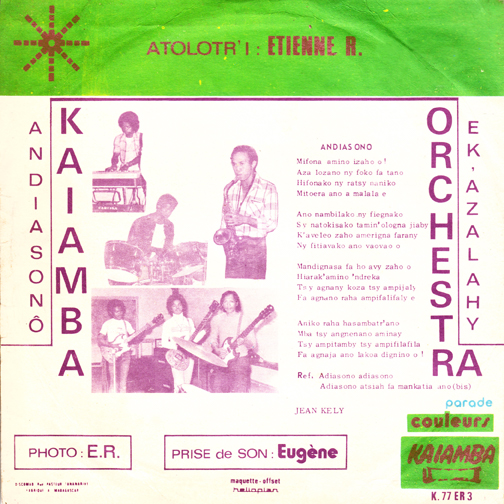
The two main record labels I found were Discomad and Kaiamba. I could be wrong but I suspect the Kaiamba Orchestra might have been made up of various popular musicians on the label. I found some of the Orchestra members’ names on other records I had obtained, most notably Jean Kely. Here is a link to a video of a Jean Kely and Basth performance from 1999.
Catalog number K.77 ER 3 on Kaiamba Records of Madagascar. No release date listed.
Filed under: Algeria

Every now and then, I stumble upon a record that’s a complete mystery. Anyone out there ever heard Arabic Zouk before? I know I sure have not.
The single was released on a French label called Antilles Musique Diffusion. The liner notes – which according to the Google translator read “Mr. Mallek young composer, still unknown to you, has 45 cm in this attractive entry you” – were written by Tinou Lavital. But Lavital was a well known manager, musician and producer from Guadeloupe… I am assuming that Mallek and Lavital must have crossed paths in France, since Algeria had been and Guadeloupe still is part of the French colonial empire. But beyond that, I got nothing.
If you have any further information on the band, please contact me or leave a comment.
Note: The song title Rohi Ya Hafida is listed as Rouhi Rouhi Ya Hafida on the label of the actual record.
Thanks to Anis Bousbia for helping me at least figure out where Mallek Mohamed was from…
Catalog number AMD 008 on Antilles Musique Diffusion of France. No other information available.
Filed under: Hong Kong

♬ 小拜年
♬ 大拜年
There were two different music scenes in Hong Kong in the late Sixties. First were the garage bands like Teddy Robin & The Playboys, The Mystics, Joe Jr. & The Side Effects, Menace, Lotus, and the like. These bands generally sung in English and covered the latest songs from the UK or the US. And then there were recording artists from the Shaw Brothers film studio, like Nancy Sit and Chan Po Chu (a. k. a. Connie Chan) who recorded Chinese versions of international hits. At the same time, there were also a handful of studio musicians churning out instrumental versions of not only Western songs, but Westernized Chinese songs as well.
Much like their label mates The New Wave, The Apollo Guitar Band were apparently one of these studio bands. I have seen a few other releases by the band, but none of them feature any pictures or credits of musicians. The band’s name may have been taken from the Teisco / Kawai manufactured Apollo model guitar from that time period.
If you have any further information on the band, please contact me or leave a comment.
Thanks to Mack Hagood for translating the titles for me.
Catalog number NWLP 8035 on New Wave Record of Hong Kong, manufactured in Malaysia by Life Records. No release date listed.
Filed under: Taiwan

This week, we have a guest post by my good friend Mack Hagood. Mack and I go way back – all the way to high school (which was a very long time ago). Every few years or so, we’ll lose touch, and then somehow our paths cross again. Besides his Far East Audio Review and managing the mysterious masked Asian A Go Go band Red Chamber, as well as occasionally touring with Pine Top Seven, he is working on his doctorate for Ethnomusicology at Indiana University.
Here’s a Christmas gift to Radiodiffusion listeners: two yuletide tracks from the Taiwanese 60s instro album X’mas A GO GO. I found this LP on a Taipei vinyl hunting trip I that chronicled on my now-defunct website, the Far Eastern Audio Review.
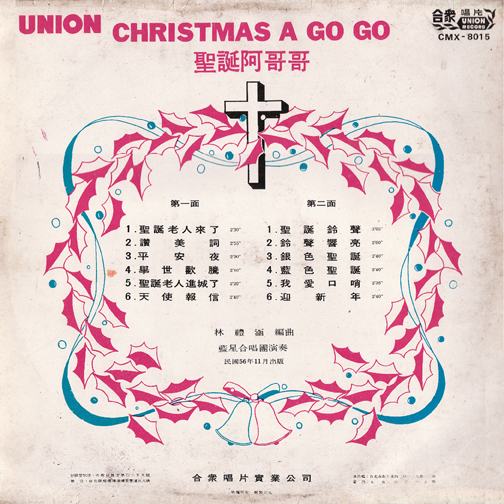
There are several outstanding features of this record, the first being the cover, which has become an integral part of my annual holiday decorations. Damn, these cats look sharp. The back cover features a cross emerging from a jolly wreath of holly and silver bells—nothing like celebrating a kid’s birthday with a foreshadowing of his eventual execution. Also interesting is the name of this band, the Blue Star Chorus–quite an odd name for a Ventures-inspired instrumental rock band. (I am certain that my translation of lan xing he chang tuan is at least literally correct, though the album doesn’t provide its own English translation of the band name.)
As for the Christmas music, we’ve got one standard and one curveball. First off is a sassy chug-a-chug take on “Silent Night, ” complete with slide guitar and vibraphone. Nothing silent or holy about this one.
Next, we’ve got “I Love to Whistle.” What is a 1930s show tune made famous by the likes of Fats Waller and Deanna Durbin doing on a Christmas album? Well, listen to the first four bars—sounds a lot like “Frosty the Snowman, ” right? Methinks we’re hearing the result of a little cross-cultural confusion. Perhaps one of the boys briefly heard “Frosty” in a Christmas context and assumed it was actually the older tune. Can’t say for sure, but really, who cares? Blue Star lays down some cool dueling guitar action, with one of the guitarists making a “stinger” sound that seems to be a Blue Star trademark.
This album was released in November of the 56th year of the Minguo calendar— better-known to Gregorian calendar fans as 1967–on Union Record (sic), a label probably best known in the West for its counterfeit Ronnie James Dio records.
Catalog number CMX-8015 on Union Record of Taiwan, released 1967.
Filed under: Dahomey

As I have mentioned before in previous posts on music from Benin – or Dahomey as it was known back then – for such a small country, they sure did have a whole bunch of amazing singles from there. And if you have been following this site with any regularity, you probably are aware of the amazing releases on the Analog Africa label – especially the African Scream Contest compilation. Besides the incredible sounds contained on that disc, are the very informative interviews with all of the artists included – not to mention the great layout and design of the whole package. Orchestre Super Borgou de Parakou were included on that compilation, and Samy Ben Redjeb interviewed lead guitarist Moussa Mama Djima
“The history of modern music in Parakou is directly connected to my father. In the 40s my dad traveled to Accra to become a goldsmith but he returned to the Borgou with something even more important – modern music. In Ghana my father fell in love with Highlife music and studied it intensively after work. When he arrived here he formed the first modern musical group of Northern Benin; it was called L’Orchestre Sinpam. When the adolescents of the region heard about it, many of them came to Parakou asking if they could get a musical education. So we had people staying here for few weeks, sometimes months, getting lessons from my dad, who was known in the area as “Mousse President”. Many of them returned to their villages to form their own bands. That’s how modern music started here in the Borgou. My older sister was the first of our family to take advantage of those classes. She learned how to play the flute and later became one of the most popular singers in northern Benin. Her name was Leha Nato. She was a rebel and the first woman in Parakou to wear trousers, and despite being a Moslem, my father encouraged this attitude. He wanted to modernize the behavior and the thinking of the people.
I was born in 1947; I don’t know the exact date but it was on a Friday, which is why people know me as Moussa “Djima” (Djima is Arabic for Friday). I grew up just watching all those musical things happening around me and I could literally feel music entering my soul. In my early teens, electric guitars started to appear in Parakou, especially during festivities: weddings, circumcision rituals, etc. The first guitarist to perform at our house was Waidy, my brother discovered him in Togo. He would entertain the folks for the whole period of Ramadan, Waidy would sleep end eat at our house, end I watched him practice every day. Then we found another guitarist in Ouidah named Aaron; he was cheaper. We did that for few years until around ’62-63. Throughout those years I never took lessons; I just watched those guys play and tried to copy them on a guitar I built using fishing line and some other tools. In ’63 for some reason we didn’t manage to find a musician to entertain the town, and Ramadan was approaching rapidly. The elders were panicking. I told them not to worry – I would play. They wondered, “When did you learn to play?”, “I will play!” I replied. On the first evening of Ramadan it happened. I performed using just two strings. The next morning people came to see my father to ask him if I was a genius or possessed by evil spirits. Soon youngsters started knocking on my door asking for guitar lessons. They would stay here for two, sometimes three months. We would discuss the price for accommodation, food and beverage. Most of my students used to pay with rice or meat; the ones who had money would pay 50.000 CFA for one month and 100.000 CFA for three months. That’s how I used to earn my living. My first band at that time was named Alafia Jazz. We covered Rumba songs by Franco – that’s where I got the artist name Mama Franco from. I changed the name of the band to OK Jazz later in ’64. A few years later we started to develop our own musical identity based on traditional rhythms and songs from the region. At some point I started thinking, We are the best band from northern Benin singing in Dindi and Bareba, but we have a Congolese name – not good! I decided to choose a name that would show our origins, so we renamed the band Super Borgou de Parakou. Ousman Amoussa handled backing vocal and gon, Sidi Alassane was on the toumba and kit drum, Sidi Seidou played traditional percussions, Soulaima Karim sang lead, Mama Biogado played the bass, Menou Roch was our rhythm guitarist and I was on lead guitar and vocals. We started touring Niger in ’69. We found a job at a bar called Congolaise; the owner was a former Guinean military man who disagreed with the politics of Sékou Touré and had fled the country with his Vietnamese wife. They were a very sweet couple, so we dedicated this song to them. All the money we managed to earn working in Niamey was invested into better equipment, amps, guitars and other stuff. One day I remember entering a music shop to buy a flute back in ’71 when I heard someone playing an instrument I had never even seen before. The sound was absolutely gorgeous. I asked the seller what kind of instrument that is, to which he replied, “It’s an organ“. I asked for the price. He told me 140.000 CFA. We had saved 300.000 CFA, so I bought that organ on the spot. That was on a Monday; by Saturday I played the whole set using it. It took me a day or two to understand it, but it wasn’t really a problem. On the third or so day I used our new acquisition to compose a hugely successful Afrobeat song called Da Doga Bouyo Inin Be. The first musical competition we did was in ’72 in Cotonou. At that time the government would choose one band from each state. Poly-Rythmo, Echos du Zou and many others were all competing. We won and consequently were invited to the International Music Festival in Berlin, Germany“.
Catalog number ASB175 on Albarika Store of Lagos, Nigeria. No release date listed.
Filed under: Indonesia

Kroncong (also seen spelled: Keroncong, Kerontjong, Kronchong, Krontjong) is the name of a ukulele-type instrument and an Indonesian musical style that typically makes use of the kroncong, a flute, and a female singer. The small kroncong guitar itself is related to the Portuguese cavaquinho, as is the Hawaiian ukulele. The roots of Kroncong music can be traced to Portuguese Fado, having originated in the communities of freed Portuguese slaves in the 16th in Batavia – now known as Jakarta, Indonesia.
During the 1960s, Pop Keroncong emerged in an attempt to modernize the genre by adding electric guitars, keyboards and drums. The most popular singers of that time were Hetty Koes Endang and Mus Mulyadi. Meanwhile, backing bands like The Steps and Band 4 Nada – who were already recording Instrumentalia albums – started making instrumental Kroncong records.
Eka Sapta formed as an instrumental backing band in 1963. From the beginning, they were influenced by The Shadows and The Ventures. Their first album was released the following year, baking up a number of singers, including Lilis Suryani and Elly Kasim. The band became one of the most sought after backing bands, recording albums with Inneke Kusumawati, Sitompul Bersaudara and others. Their last record was released in 1975.
While the band had many members over the years – there are nine people credited as being in the band on this album – two of which were guitarists Jopie Item and Entang. Jopie Item was in Trio Bintang and may or may not have been in Band 4 Nada. Entang had a solo career, backing up the Pattie Bersaudara, as well as others.
The band supposedly reformed in 2007. Other than a lone article, I have not been able to find any other evidence to support that fact.
Catalog number CLP 17003 on Canary Records of Indonesia, released 1970.
Filed under: Israel

Military service in the Israel Defense Forces (IDF) is mandatory, with some exceptions, for all Israeli citizens over the age of 18. But unlike most other countries’ armies, the IDF has had performing groups called Lehakot Tsva’iyot (Army Ensembles) since the 1950s. These groups, comprising soldiers with talent or performing experience, tour bases and field positions to entertain the troops. Every Israeli musician of the 1960s was a product of this system, including Arik Einstein, Shula Chen, and Shalom Hanoch, to name a few.
Shalom Hanoch (also seen spelled Chanoch and Hanokh) was born in Mishmarot, and stared writing and performing at a young age. By the time he was 19, he had a song recorded by folk duo Hedva and David. In 1966, he began his compulsory military service and joined the Infantry Brigade troupe, the Nahal Band. It was during his time with the Nahal Band that he caught the attention of Arik Einstein, who asked Shalom to write for him.
Around this time, Shalom formed The Three’ngers – or Three Singers – with Benny Amdursky and Hanan Yovel. Their only album from 1969, featured Danny Sandersson of Kaveret (a.k.a. Poogy) on guitar and Aharale Kaminsky on drums. The album also showcased a roster of who’s who of Israeli song writers: Dani Litani, Shimrith Or, Ya’akov Rotblit, Yair Rosenblum, Yaron London and Yehonatan Geffen.
The following year, Hanoch teamed up with Einstein to write two albums – Shablul (Snail) and Plastelina (Plasticine). The former was billed as an Arik Einstein album, with all compositions by Hanoch; the latter was credited to both. The next year, Shalom moved to England “without connections or a firm grasp of the English language“. He soon found management with Dick James, and recorded the album Shalom with Elton John‘s backing band. In 1973, he returned to Israel to form the band Tamouz. Although that band also only release one album, it was considered a milestone of Israeli Rock and Roll.
After the demise of Tamouz, Shalom Hanoch has remained a solo artist. He continues to record and perform to this day.
Catalog number BAN 14100 on Hed Arzi Ltd. of Israel, released 1969.
Filed under: Guinea

♬ Sibida
On 28 September 1958, the French government held a referendum on a new constitution. The colonies of the French colonial empire – except Algeria, which was legally a direct part of France – were given the choice between immediate independence or retaining their colonial status. Guinea chose independence, the only colony to do so. Thus, Guinea became the first French African colony to gain independence, on October 2nd 1958.
The first state orchestra to form after the country’s independence was Orchestré de la Garde Républicaine. Under the new government’s Authenticité policy, the group was “instructed to drop their European march tunes for music befitting the new nation”. The orchestra eventually split into two groups – Orchestré de la Garde Républicaine 1ère and Orchestré de la Garde Républicaine 2ème – whose only recorded output was a split album released in 1967. Orchestré de la Garde Républicaine 1ère later changed their name to Super Boiro Band.
The band took their name from the Camp Boiro prison, where may of the members had been guards. Members of the band included trumpeter and manger Mamadou Niaissa, vocalist Sane Camara and guitarists Karan Mady Diawara and Mamady Kouyaté. Mamady Kouyaté would later go on to resurrect Bembeya Jazz in the 1990s, and recently he formed Mamady Kouyaté & The Ambassadors.
Super Boiro Band’s first album was released in 1972, and their first single was released the following year. They released two more singles as well as their second album in 1975, and one more album in 1976 as well as appearing on the compilations Discothèque 73, Discothèque 74 and Discothèque 75. The band later changed their name to Super Flambeau, but never released any recordings. The single featured here was the last single that Syliphone released.
Catalog number SYL 574 on Editions Syliphone Conakry of Guinea, released 1975.
Filed under: Burma

♬ 
To: Mack Hagood
Subject: The Burmese Enclave
So we went to the Peninsula Plaza. We had read that there is a Burmese restaurant there, and a few shops near by… What we found was a bit more.
Peninsula Plaza is essentially a five story shopping mall. But I would say that more than half the shops / internet cafes / restaurants were Burmese. Apparently this is THE place for Burmese people to hang out in Singapore. So the place was PACKED. And they were all looking at the tall white guy and his pasty female companion wondering what the hell they were doing there.
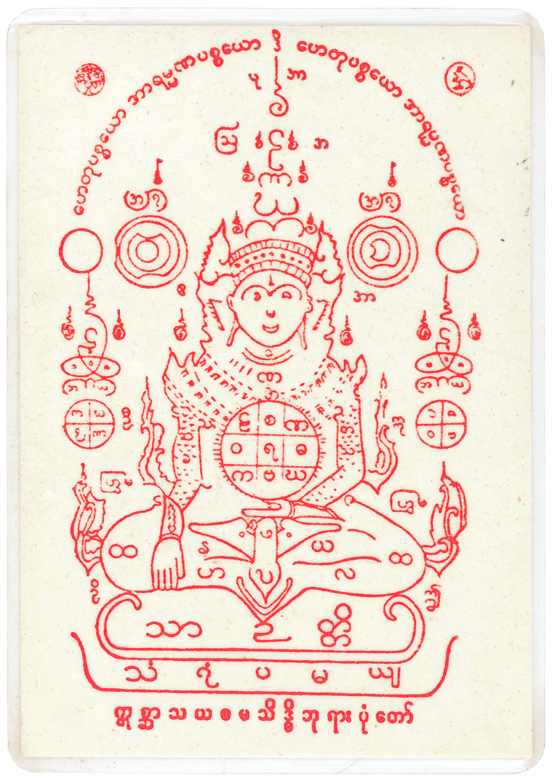
Most of the shops had food items and textiles, plus a lot of books and weird little homemade looking prayer cards (or, at least that’s what I think they are since they have pictures of either monks or Buddha on them). A number of the shops had a desk up front with a stack of leaves, with a mortar and pestle with some kind of white paste. At first I thought maybe it was Betel nut leaves… But now that I’ve looked up what those look like, that wasn’t it. Any idea what’s going on?
A few of the shops had CDs and cassettes. One place had just stacks of tapes. I dug thru them for a while, and had to stop myself. I could have easily been there all day. And since I don’t know Burmese, I’m just going by cover art. But I got six tapes for S$10.
After that, we went to the restaurant we saw online. It’s called Inle (www.inlemyanmar.com.sg). Even though it looks kinda fancy (i.e. “tourist-y”), most of the patrons were Burmese. Actually, there was a wedding reception in half of the place, and I noticed that some people had a different menu than what we got that was entirely in Burmese (and no pictures of the food). I always figured that the country between Thailand and India would have amazing food. And I was right. The food was great.
Singapore
10:58 AM, May 17th, 2009
I wish I had written down the name of that shop…
Catalog number and label unknown.
Filed under: Turkey

Mavi Çocuklar, or Blue Boys, were the winners of 1967’s Altin Mikrofon contest. The contest, which translates as Golden Microphone, was held by Hürriyet – the largest newspaper in Istanbul. The contest was held from 1965 to 1968, and the records that were released as a result of the competition is one of the reasons why the Turkish Rock / Beat scene flourished and has also been so well documented.
The winning song for Mavi Çocuklar was Develi Daylar. The title was in reference to the phrase “cek deveci develeri”, which translates as “cameldriver get the camels out of here”. So the story goes, the band built a large wooden camel to put on stage for their performance in the contest. But they had to take a taxi to where the concert was to be held, which was in the suburb of Bakırköy. So they strapped the camel to the top of their cab and off they went.
The band was more known as a dance band, playing “Samba-swing-oriental” music at the Istanbul Hilton. Their first single was released in 1965, and after their win of the Altin Mikrofon contest in 1967, the band “quietly disappeared”. During their brief existence, they had two singers – Okan Dincer and Marthen Yorgantz. Of the other members, the drummer went by the name “Tirtil” – which means new born butterfly – and the piano / organ player went by “Garbo”… Beyond that, not much is know about the band.
Catalog number H-020 on Altin Mikrofon of Turkey, released 1967.
 Radiodiffusion Internasionaal Annexe