

Filed under: Mali

<p>
Much like the country itself, the music of Mali is very expansive. Most of the country’s 479,000 square miles lies in the southern Sahara. So there’s lots of space to wander and get lost. This geography has influenced the Mandé people who make up most of the country’s population, and their musicians, professional performers known as griots. Over the years, other influences have been incorporated to produce a uncommon sonic blend specific to this unique landscape.
At the end of World War II, the guitar become common throughout Africa, partially resulting from the intermingling of African, American and British soldiers. Dance bands soon became popular in Mali, especially the town of Kita‘s orchestra led by Boureima Keita and Afro-Jazz de S´gou. Imported European dances were popular, especially rumbas, waltzes and Argentine-derived tangos. But by the 1960s, the influence of Cuban music began to rise – and has remained popular to this day.
After independence in 1960, Malians saw new opportunities for cultural expression in the burgeoning media of radio, television and recorded music. Under President Modibo Keita, orchestras were state-supported, including the first electric dance band, Orchestre Nationale A, as well as the Ensemble Instrumental National, comprising 40 traditional musicians from around the country and still in operation today. Other influential dance bands included Rail Band du Buffet Hôtel de la Gare and Pioneer Jazz.
Le Kéné-Star De Sikasso were, as you might have guessed, from the southern most region of Mali known as Sikasso. They originally started out as Orchestre Regional de Sikasso, and released two albums, the first one in 1968 on Republic du Mali Radiodiffusion Nationale, and the second in 1970 on Bärenreiter-Musicaphon. They also were included on a 1973 compilation called Panorama du Mali on Mali Music.
The album that is posted here, their only release credited as Le Kéné-Star De Sikasso, was later re-issued on cassette in the Eighties, and was entitled Lala. The members of the band for this recording were François Ballo, Cheick Sabibou Diabaté, Mamadou Diakité and Mamadou Touré among others who are uncredited, and was produced by Boubakar Traoré. Also, the first song on this record, “Hodi Hu Yenyan”, as well as the two songs from the Panorama du Mali compilation – along with songs by Orchestre Régional de Kayes and Super Djata Band – were included on the Mali 70 – Electric Revolution compilation released by Discograph / Syllart Productions.
Catalog number KO 77.04.16 on Mali Kunkan, released 1977.
<p>
Filed under: Philippines

<p>
<p>
For our second guest post here at Radiodiffusion Internasionaal, we have an entry by Greg McWhorter. Besides being a collector of records and ephemera, Greg founded Artifix Records – dubbed “the archaeologists of punk” by Johnny Stingray of The Controllers. Artifix Records mission is to reintroduce bands (a few I remember quite well) like The Bags, Catholic Discipline and White Flag to a new generation.
During the early 1960’s the instrumental bands reigned supreme throughout the Philippines club scene. Clubs with names like Wack-Wack, The Sky Room, Circuit, and Rufino Building Penthouse were host to events that featured these new instrumental groups. As mentioned in a prior post, these bands were heavily influenced by The Ventures and The Shadows and often did covers by those groups while working their own originals into their sets. The Hi-Jacks were no different, but perhaps were one of the more energetic of this new breed.
The Hi-Jacks started at the beginning of the 1960s and began releasing vinyl almost immediately. They were managed by Eddie Mesa, who was known as the Filipino Elvis. Mesa had huge success in a string of rock’n’roll records and movie appearances during the 1950s and 1960s. When he first managed the Hi-Jacks, the band mostly played and recorded covers of popular instrumental rock as well as their originals in the same vein. After The Beatles penetrated Asian radio in 1963, Mesa started using the band as his personal backing band for his recordings of Beatles songs and similar originals.
The band was fronted by Rudy “Nonoy” Jereza who played bass. Jereza is deceased now, which has prevented the band from doing reunions; although the other existing members rally around legendary Pinoy guitarist for the group, Ben Tesoro, to play sets of the group’s music at revivals. Other members throughout the years included Eddie Dizon on drums, Jesse Manahan on keyboard, Eddie Nicolas as a later vocalist (deceased), and Bert Buencamino as a second guitar. Buencamino was originally with The Moonstrucks during the 1960’s and joined the Hi-Jacks in the early 1970’s. The Hi-Jacks lasted until 1974.
Although the band released records on several different labels like Top Tunes, Alpha, and ANS; their first single was on the Dyna Records imprint. Dyna was the independent label that also broke other notable acts from the time like The Electromaniacs and Ramon Jacinto and the Riots.
Catalog number DN-7302 on Dyna Records, manufactured by Dyna Products, Ltd. in the Philippines. No release date listed.
Filed under: Morocco

Chaabi (popular) is a music consisting of numerous varieties which are descended from the multifarious forms of Moroccan folk music. Chaabi was originally performed in markets, but is now found at any celebration or meeting. Chaabi songs typically end with a leseb, or swift rhythmic section accompanied by syncopated clapping.
A sophisticated form of chaabi evolved in the 1970s competing with popular Egyptian and Lebanese music. These chaabi groups consisted of a lute and a hadjuj, with some form of drum. Eventually, new instruments like buzuks and electric guitars were added. The three most important early groups were Lemchaheb, Nass El Ghiwane and Jil Jilala. All three bands featured politicized lyrics that got the songwriters in trouble with the government.
As for Jil Jdid… They were apparently based in Belgium at the time of this recording. But other than that, I have not been able to find any information. If you know anything about the band, please contact me.
Catalog number ST-454501 on Atlas International of Belgium, manufacture and distribution by R. C. P. Int. No release date listed.
Filed under: Sri Lanka

The Gypsies were formed in 1970 by Anton Perera in Sri Lanka. The band was comprised of Perera’s five sons (Sunil, Nihal, Piyal, Nimal, Lal) – all of whom had recently completed high school. Lead singer Sunil Perera, schooled at St Peter’s College in Colombo, renovated a portion of his house in Ratmalana into a recording studio and began recording their first album.
Their early success was due to a series of albums they released in the 1970s entitled “Dance With the Gypsies”. In the 1980s the group released their first audio cassette containing their novelty hit “Kurumitto” (“Dwarves”), which is a cover version of Dutch musician Father Abraham‘s “The Smurf Song”.
Their first performance out of Sri Lanka, as the resident band at the Delhi Taj in New Deli was for three months, was followed by successful tours in foreign countries where many Sri Lankans now reside, such as the U.K., U.S., Australia and Canada. They are still active to this day.
Thanks to Upendra Samaranayake for translating the Sinhalese.
Catalog number G T -08 on Guththila of Sri Lanka. No release date listed.
Filed under: Rwanda

♬ Ururabo
The Republic of Rwanda is a small landlocked country in the Great Lakes region of east-central Africa, bordered by Uganda, Burundi, the Democratic Republic of the Congo and Tanzania. Home to approximately 10.1 million people, Rwanda supports the densest population in continental Africa, most of whom engage in subsistence agriculture. A verdant country of fertile and hilly terrain, the small republic bears the title “Land of a Thousand Hills”.
The country has received considerable international attention on account of its 1994 genocide, in which between 800,000 and one million people were killed. In 2008, Rwanda became the first country in history to elect a national legislature in which a majority of members were women.
As for Rossisendi & His Group… There is no information available. The only clue to the origin of the band, is that the song is in Kinyarwanda (also known simply as Rwanda). Kinyarwanda is a Bantu language spoken primarily in Rwanda, where it is one of the official language of the country, as well as in southern Uganda and in the east of the Democratic Republic of the Congo.
If you any information about the band, please contact me.
Catalog number PEA 226 on Pathé Records, manufactured in Kenya. No other information available.
Filed under: Burma

♬ 
♬ 
This week’s post is the first in a series of guest posts. I recently came to the realization, that if there was ever going to be a post on the music of Burma, I would have to turn to Alan Bishop. Alan is best known as one third of the Sun City Girls and co-founder of Sublime Frequencies. Also, this post is the first to feature music from cassette.
After hunting all over Myanmar (Burma) during my many trips there, I’ve never come face to face with a Burmese vinyl LP. Nor have I heard of one or seen a photo of one. I also have a feeling there were few 45s although I have two children’s song recordings on 7” vinyl. Every Burmese musician or music fan I have ever spoken to claim LPs and 45’s didn’t exist between the 78 and cassette formats. Since Burma’s independence in the late 1940’s, the government has kept a fair distance from the rest of the International community and the regime discouraged western-influenced music until things loosened up a bit in the 1970’s. During the 1960’s, the local music scene wouldn’t have been allowed to work above ground as a “western-styled” record producing pop industry and it’s a truly sketchy period with hardly a spec of info. I’ve searched far and wide for anything coherent from the 1960’s and come up frustrated thus far. There are tales about how reel to reel tapes were transferred to cassette for sale in the early 1970’s. The kids would go to the shop and choose specific songs and the shop would dub a custom cassette from reels and charge accordingly per track. And the reels were apparently from copies of the master studio reels from popular groups at the time. One of the most popular, the Playboy Group, was a Burmese rock band formed in the early 1970’s by guitarist/vocalist Than Naing (often referred to as “Playboy Than Naing”) Other members of the group included Ko Kyaw Min (guitar), Ko Kyaw Naing (bass), Zaw Win Shein (drums), Tin Oo Thaung (keyboards) and Than Naing’s wife Pearl (vocalist). The band specialized in western-styled cover songs and helped turn on Burmese society to a wide variety of foreign artists including The Beatles, The Doors, CCR, The Youngbloods, and many others. The band was active into the 1980’s and recorded many cassette-only releases during their career. A few years ago, they reformed and began recording and performing again. Than Naing now owns a construction company in Yangon and in 2005, became committee secretary for the newly founded Myanmar Music Association.
 / “Flower With Only a Night Time Scent” – This track is Than Naing’s clever way of describing a prostitute. He sings the story of a woman (flower) who is only sweet to him in the evenings (has a night time scent only).
Alan Bishop (March 2009)
No catalog number, record label or release date listed. Distributed by Tapyi Thu A Twat of Myanmar.
Filed under: Georgia

♬ Aдaндaли
Georgia (Georgian:  , Sakartvelo) is a transcontinental country in the Caucasus region, located at the dividing line between Europe and Asia. It is bordered by the Russian Federation to the north, Azerbaijan to the east, Armenia to the south, and Turkey to the southwest.
Founded in the capitol city of Tbilisi in 1958 by lead vocalist and guitarist Robert Bardzimashvili, Oрэрa became a Soviet sensation on the scale of Beatlemania. The group, which included several male voices and sometimes a female one, grew out of the Georgian musical tradition of polyphonic choirs. They fused many styles – choral pop, jazz, Georgian and Russian folk music into their own sound. The band also launched the careers of Vakhtang “Buba” Kikabidze and Nani Bregvadze.
Oрэрa reached a peak of thier popularity by 1967 when they represented the USSR at the World EXPO in Canada. The band was one of a few Soviet groups that were allowed to tour around the world. Their repertoire included popular Soviet songs as well as folk songs from different countries and renowned international hits.
In 1975, Bardzimashvili left Oрэрa to form one of the first Soviet rock bands – Via-75, who were popular throughout the Soviet Union as one of the first and officially sanctioned rock bands in the country. In the post-Soviet years, Bardzimashvili headed the Tbilisi Opera and established the Lakhti Studio music school for children. Bardzimashvili was awarded the highest official honor of the National Artist of the Georgian SSR, and in 2000 Oрэрa received a star on the Plozhad Zvezd in Moscow. He passed away passed away in 2003.
Catalog number ГOCT – 5289 – 61 / ЦEHA 1 – 30 on Dolgoigrayuschaya of Tbilisi, Georgia. No release date listed.
Filed under: Mauritius
Mauritius is an island nation off the coast of the African continent in the southwest Indian Ocean, about 900 kilometres east of Madagascar. First settled by the Dutch who then abandoned it, the island was taken by the French who lost it the English in the Napoleonic Wars in 1810. Over a century and a half later, Mauritius gained independence in 1968.
The island of Mauritius – as well as the islands of Réunion, Seychelles, Comoros, Mayotte and Rodrigues, along with parts of Madagascar – are best known for Sega music. Sega evolved out of the culture of the Western Indian Ocean islands, in the mid-18th century that were influenced by an influx of polka and quadrilles from Europe. The music’s traditional form was largely improvised and intensely emotional and expressed the tribulations of a subjugated, initially enslaved, people. It was also used as a dirge and as part of traditional exorcisms.
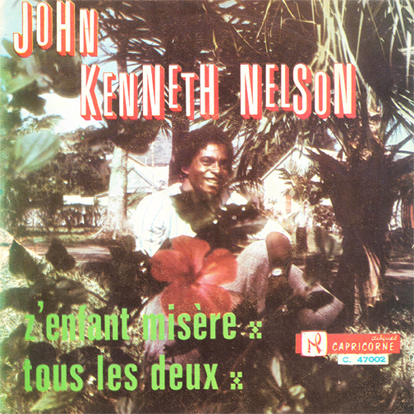
Although John Kenneth Nelson is considered one of the first big names in Sega, there is very little information available about him. He was included on Playasound’s Air Mail Music series compilation “Les Mascareignes” that was released in 2002. He also is credited as playing on Harold Nelson’s album “L’Amitié des Îles” that was released in 2007, which was the same year that he passed away at the age of 57. A street in the capital city of Port Louis, where he and his family has lived for over forty years, now bears his name.
Catalog number C. 47002 on Disques Capricorne of Madagascar. No release date listed.
Filed under: North Korea

♬We Always Look Up to The Central Committee of The Party
There are places that I thought I would never find records from, like Brunei or Iraq. Then, there were countries that I didn’t know what I would find… Let’s say, Eritrea. And then there are places that I thought I would have no problem finding records from, but haven’t had any luck… For instance, Burma. Of course some of these countries have had Civil Wars or Cultural Revolutions, where most of the recordings were destroyed. But then there are other regions that just never had a recording industry, or the musicians did not venture out to other countries.
The best weapon for hunting records, is information. That was one of the reasons I started this whole mess. The more you know, the easier it is to find what you are looking for in the endless depths of the vinyl jungle. And, where you can find one band or artist… You can usually find another. Where I have discovered the more interesting music scenes, there tended to be a handful of musicians, a record label or two, and a studio to record. Studio being a somewhat loose term, for example most of the great music from Benin was recorded live to two track on a portable reel to reel tape machine.
On the other hand, be it governmental control, religious restrictions or what have you, some places you just aren’t going to find anything. North Korea is a prime example of that. Since the government controls all aspects of the media, any recordings would have to be approved. The only real “band” from that country would be the state sponsored Pochonbo Electronic Ensemble, who make Tangerine Dream sound like Black Sabbath. Only recently has what Westerners would consider Modern Pop Music has been exposed to the outside world as heard on the Sublime Frequencies’ Radio Pyongyang disc.
But with compilations popping up like The Roots of Chicha: Psychedelic Cumbias from Peru, 1970’s Algerian Proto-Raï Underground, and bands like Konono N°1 coming to light after being in existence for a quarter century, it makes you wonder: What else is out there? What have I missed? Maybe there were some kids in a basement somewhere with an electric guitar, or keyboard or even some kind of electrified gayageum making some unholy racket. And maybe, just maybe, there’s reel to reel, cassette recordings or possibly even some bootleg X-Ray records floating around with those unimaginable sounds. That is what keeps people like me, and other obsessive types like myself, constantly searching.
Catalog number ㄱ – 809804 ᄆ– 28015 / ᄆ– 28016 on the Korean Gramophone Record label of Pyongyang, in the Democratic People’s Republic of Korea. No release date listed.
Filed under: Tunisia

♬ Yendam
Writing about music, at least for me, is a somewhat laborious process. It is definitely much less enjoyable than actually just listening to it. Even though in high school I was voted most likely to write for Rolling Stone, I’ve always thought that my writing skills were… Well, let’s just say it could use some work. But I keep slugging away at it, like a monkey with a typewriter.
For the most part, in these posts I try not to pass judgment on the music. I usually try to find as much information as I can, slap it all together, and voila – another post is hurled into cyberspace. Although I do think that the historical and geographical context is important and can temper the listener’s opinion, I believe that the music pretty much speaks for itself. But there are many times when I get a record and have nothing to go on. I start searching the interwebs, e-mailing a few contacts… Nothing. What then?
Unlike the record that I thought was from there, I am pretty sure that these guys were actually from Tunisia. The record was self released with no information about where the songs were recorded, or the address of the label that released it – only a phone number. On the back, it lists the musicians including the principle singer / songwriter “Mahjoub H.”, who also released the record. The only real clue, is that it says “Presse Ennagham” on the bottom of the back cover. Disques Ennagham was a Tunisian label that had their own pressing plant. Other than that, I know the band’s name, Omnya, translates as “Hope”, but song title “Yendam” means “Regret”.
Thanks to Alan Bishop, Anis Bousbia and Hicham Chadly for their help. If you any information about the band, please contact me.
Catalog number A. 77 001 on Omnya, pressed by Disques Ennagham of Tunisia, released 1977.

