Filed under: Brunei

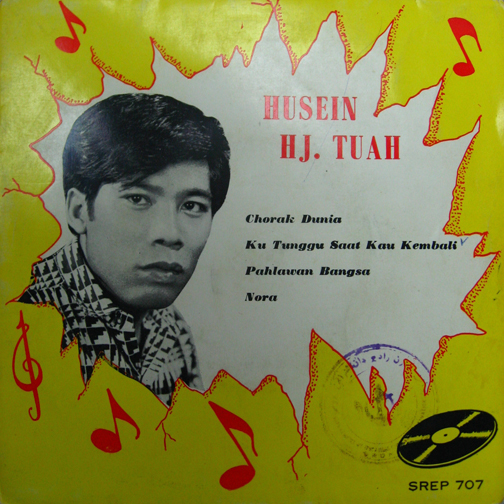
Hussein J. Tuah was from Brunei.
According to Merv Espina, Brunei was “one happening joint” back in the Sixties, and was very cosmopolitan. Merv has been researching the sole product of Brunei’s film industry, Gema Dari Menara (Voice from the Minaret), which was produced in 1968. Apparently the film features a few bands and exotic dancers. But much like that film, the music scene is Brunei has almost no information…
From what I have been able to find, it appears that all of the musicians from Brunei went to Singapore to record, and there was only one label that issued records by Bruneian artists. I did manage to find a little bit about Hussein J. Tuah & D’Acrobats’ J. B.’s is Management / Label: Times Record Company:
Around 1960’s in Singapore, Times Record was a record company which released Malaysian EP’s and LP’s, on labels such as Olympic, Eagle, Sea Lion, etc. There record labels had competition with international recording companies such as EMI and Philips. In the 1960’s there were many artists and singers and records under Times management, so audience can listen them.
D’Acrobats’ J. B. were from Johor Baharu, Malaysia. They released a handful of other singles as the backing band for other Malaysian singers such as Yusoff Ahmad and H. Anuar for the Universal Label.
If you have any information, please contact me.
Catalog number T.R.C. 1032 on Olympic Records of Singapore. No release date given.
◄●►◄●►◄●►◄●►◄●►◄●►◄●►◄●►◄●►◄●►◄●►
I recently received some more information from Merv Espina. His name is actually Hj. Tuah, and not J. Tuah. The big H in on the cover was a stylistic graphic design choice. You can see it on his first single, which was released on the SOR Records label of Singapore. Hussein worked as a teacher, and one of the subjects that he taught was English. He continued singing, and became a popular patriotic singer.
Filed under: Uzbekistan

BИA «Ялла», which translates to Yalla (also seen as Jalla), was from Tashkent, which is the capital of Uzbekistan.
Officially known as the Republic of Uzbekistan (Uzbek: O‘zbekiston Respublikas orЎзбeкиcтoн Pecпyблиacи), it is one of only two countries in the world that are doubly landlocked. Located in Central Asia, Uzbekistan was formerly part of the Soviet Union, and it shares borders with Kazakhstan to the west and to the north, Kyrgyzstan and Tajikistan to the east, and Afghanistan and Turkmenistan to the south.
Formed in the early 1970’s, the members of Yalla are graduates of the Ostrovsky Theatrical Art Institute and the Ashrafi State Conservatory in Tashkent. They are not Russian but Uzbek, a Turkic nationality from the crossroads of the ancient Silk Road. The group, whose name is an Uzbek word for a song accompanied by dancing, has become a popular icon in Uzbekistan, frequently serving as cultural ambassadors to international festivals or meetings abroad. Their music incorporates traditional ethnic folk tunes and poetry of Uzbekistan and other Central Asian and Middle Eastern cultures, along with contemporary pop and dance influences. They perform songs in more than 10 languages, including Arabic, Farsi, Hindi, Nepali and French as well as Uzbek and Russian.
Yalla has appeared on Soviet national television as well as performing in Moscow and elsewhere in the Soviet Union, and on concert tours in Europe, Africa, Asia and Latin America, including featured appearances at the “Voice of Asia” festival in Kazakhstan. The band has been named “State Merited Chamber-Instrumental Ensemble” (a musical equivalent to poet laureate), and winner of the Lenin Komsomol Prize of Uzbekistan. Also, Farrukh Zakirov, artistic director of Yalla and composer of many of their songs, was elected to Uzbekistan’s national parliament.
Members of Yalla:
Farrukh Zakirov – artistic director, composer, vocal
Rustam Iliasov – arranger, vocal, bass guitar
Abbos Aliyev – arranger, tan-buzuk, rubab, oud, vocal, keyboards
Javlon Tokhtayev – vocal, guitar
Alishier Tulyaganov – vocal, percussion, doira, tabla
Ibraghim Aliyev – percussion, darbuka, kairok-tosh
In 2000, Yalla released Beard of the Camel on the Seattle based Imagina Productions.
Catalog number ГOCT 5289-80 C62-17473 on the Soviet state-owned and operated Μелодия (Melodiya) label. No release date listed, but I believe that “Зaпись 1981” may be the copyright date…
Filed under: Mali

♬ Wara
Les Ambassadeurs Du Motel were from Mali.
Present-day Mali was once part of three West African empires that controlled trans-Saharan trade: the Ghana Empire, the Mali Empire (from which Mali is named), and the Songhai Empire. In the late 1800s, Mali fell under French control, becoming part of French Sudan. Mali gained independence in 1959 with Senegal, as the Mali Federation in 1959. A year later, the Mali Federation became the independent nation of Mali in 1960. After a long period of one-party rule, a 1991 coup led to the writing of a new constitution and the establishment of Mali as a democratic, multi-party state.
With the coming to power of Mali’s second president, Moussa Traoré, however, Cuban music was discouraged in favor of Malian traditional music. Biennale festivals were held to encourage folk music. Old dance bands reformed in many cases, under new names, as part of this roots revival. Especially influential bands included Tidiane Koné‘s Rail Band du Buffet Hôtel de la Gare, which launched the careers of future stars Salif Keita and Mory Kanté.
Not all bands took part in Traoré’s roots revival, however. Les Ambassadeurs du Motel formed in 1971, playing popular songs imported from Senegal, Cuba and France. Les Ambassadeurs and Rail Band were the two biggest bands in the country, and a fierce rivalry developed. Salif Keita, perhaps the most popular singer of the time, defected from the Rail Band to join Les Ambassadeur in 1972.
In 1974, a “battle of the bands” concert between Les Ambassadeurs and Rail Band was held in Bamako to decide who was the most popular group. A concert was organised and both bands were instructed to write a new song for the event. The Ambassadeurs du Motel performed “Kibaru” (which promoted a literacy campaign organized by the national government), and by all accounts the audience went wild. The concert produced no clear winner on the day and it was officially declared a draw. Salif and Kanté Manfila recorded a further two LPs with Les Ambassadeurs du Motel before forming Les Ambassadeurs Internationaux.
Catalog number SAF 50014on Sonafric of France, released 1976.
Filed under: Taiwan

Cai Mi Mi & Five Petals Guitar Band were from Taiwan.
Taiwan is also commonly used to refer to the territories governed by the Republic of China (ROC) and to ROC itself, which governs the island of Taiwan. Taiwan is also currently claimed by the People’s Republic of China (PRC) as a PRC province, though the government of the PRC has never controlled any of the current ROC territory commonly referred to as Taiwan.
There is little information about Pop music in Taiwan, especially anything that predates the 1980s. But, judging by records from the likes of The Telstar Combo, there was obviously something going on there. Although it does appears that many of the artists may have moved to Singapore, where they released records on labels that were based there.
According to mod-ifed music:
Cai Mi Mi, a Taiwanese singer, was a bright star in the late Sixties. In 1968, she led The Five Petal Group (an authentic girl band who apparently played all their own instruments!). “Mama Guitar” (also know as “Mama Get Me A Guitar”, which was covered by The Telstar Combo) was their biggest hit, and the group won instant fame when appeared on a popular television variety show singing the song. Interestingly, the original singer of this song was supposed to be Teresa Teng, but as she was overseas, Mi Mi and The Five Petals had the opportunity to record it.
I have seen Cai Mi Mi translated into English as Bai Mi Mi, Cai Mei Mei, Chai Mi Mi, Mi Mi Tsai and even Wai Wai Pai…
Thanks to Ho Chui-wa for the translation.
Catalog number LFLP 130 on Life Records of Singapore. No release date listed.
Filed under: Armenia

♬ Nune
Adiss Harmandyan was from Armenia.
There are not that many records from Armenian other than the traditional classical and / or folk music. This is mainly due to the fact that Armenia was part of the Soviet Union until 1991. And what little pop music that was recorded there was recorded in Russian.
Armenia had a strong influence on the Ethiopian music scene. Most of the state sanctioned bands were comprised of Armenian refugees who had been invited by Emperor Haile Selassie during the Armenian Genocide. But many others left soon after, and setteled in other countries.
Many popular musicans from around the world are of Armenian descent. Most notable being Sylvie Vartan and Charles Aznavour who were popular in France, and Cherilyn Sarkisian (better known as Cher)…
I have not been able to find much information about Adiss Harmandyan, except that he apparently owns a pastry shop in Los Angeles, California and occasionally performs weddings and Armenian cultural festivals around the U.S. and Canada.
Catalog number YD. 45 on Dedefon of Turkey. No other information available.
Filed under: Ethiopia

Seyoum Gèbrèyès was from Ethiopia.
If one were to pick a specific point that marked the birth of the distinctive Ethiopian soul music, one could do worse than choose the late Emperor Haile Sellassie’s visit to Jerusalem in 1923. During his stay he heard European brass instruments, which made such an impression on him that he hired a group of Armenian players to become official musicians of the empire. One of these players, Kevork Nalbandian, even composed the current Ethiopian National Anthem in 1926 (Although, according to Wikipedia, it was Solomon Lulu Mitiku).
Thus a distinctly European flavour of brass band music was brought into a country whose traditional music bore heavy influence from Muslim forms, and its own modal pentatonic scale. Additionally, because it was actually impossible to buy saxophones, drums or other musical instruments under the Selassie regime, only the marching bands had access to them, giving the subsequently played music a foreboding, militaristic ambience.
Meanwhile in Europe, a new generation became that baby boomers started the cultural revolution of rock ’n’ roll, R ’n’ B and pop music in the 1960s. The same generation in Ethiopia, in their 20s during the early 60s, wanted to change the country and get connected with the world. But where Ethiopia was different was that they had about 6,000 Peace Corps from America. President Kennedy invented this civil service for youngsters in order to work in third world countries, so these people brought with them a lot of American flavours: long hair, bell-bottom trousers and plenty of vinyl records.
Thanks to the newly acquired influences from the West, the sound emanating from the clubs Addis Ababa was a heady stew of deep, hypnotic rhythms, distinctly Western guitar licks and soulful eastern melodies and vocals. The sound bore the unmistakable badge of American records (Stax and Motown artists in particular) plus something distinctly African and new.
Soon labels such as Amha Records and Kaifa Records sprung up around the city to capture the sounds produced by the more popular singers and performers. Mahmoud Ahmed, Mulatu Astatke, Tlahoun Gèssèssè, as well as others all brought their soulful sound to the clubs and cut records.
Not much is known about Seyoum Gèbrèyès, except that he played saxophone. Some of his songs have appeared on volumes 1 and 13 of the Éthiopiques series with the Wallias Band. He also apparently played with Lèmma Dèmissèw who was featured on Éthiopiques volume 8 and was an arranger for Alèmayehu Eshété.
The Alem-Girma band, which was the backing band on this single, was formed by Alèmayehu Eshété and Girma Bèyènè in 1972. Both supposedly shared the taste of music and clothing fashion that was coming from the United States (James Brown, Elvis Presley, and Wilson Pickett to name a few). The band retained some of the members from the All Star Band and only lasted until 1974, after Colonel Mengistu Haile Mariam’s military coup against Selassie. Under Mariam’s Dekrg, or ruling council, Addis Ababa’s nightlife died off.
Catalog Number AE 580 on Amha Records of Addis Ababa, Ethiopia. No release date listed.
Filed under: Indonesia

♬ Abunawas
Trio Bintang were from Indonesia.
The Republic of Indonesia, is a nation in Southeast Asia. Comprising of 17,508 islands, it is the world’s largest archipelagic state. It is also one of fourteen nations that the Equator runs through. With a population of almost two and a quarter million people, it is the world’s fourth most populous country and the most populous Muslim-majority nation, although officially it is not an Islamic state.
During the early 1960s, President Sukarno was under pressure from the pro-communist organization Lembaga Kebudayaan Rakyat to ban rock’n’roll. Local groups rock groups were often thrown in jail. Due to this fact, one of Indonesia’s first rock bands, Koes Bersaudara had a hit with a song called “I’m In Jail”, which was also included on their first album.
The only information that I have been able to find about Trio Bintang, is that their guitarist was Jopie Reinhard Item. He apparently had also performed with Lilis Suryani, Elly Kasim, Titiek Puspa, Ernie Djohan – to name a few. He now plays instrumental jazz. And apparently, Trio Bintang performed for a reunion show in 1999 for the Wisma Anak-Anak Harapan orphanage in Untal-Untal Dalung on the island of Bali.
Catalog number BT-102 on Bintang records. No other information available.
Filed under: Israel

♬ Al Tashir Le’af Achat Acheret
Shula Chen was born in 1947 in Palestine. Later that same year, the United Nations passed the United Nations Partition Plan for Palestine. Also known as U. N. General Assembly Resolution 181, this was an attempt to resolve the Arab-Jewish conflict by partitioning the territory into separate Jewish and Arab states, creating what is now known as Israel.
Shula got her start in the mid-Sixties with the Nahal Army Troupe, along with Shalom Hanoch (who would later go on to form The Churchills with Arik Einstien). Nahal is a youth program in Israel that allows them to combine their compulsory three-year military service with volunteer-type civilian service. Later in 1980, she apparently became an actress and in 2003 a retrospective compact disc called Come Home. But beyond that, there is almost no other information that I have been able to find.
Catalog number S 63372 on CBS Records of Israel. No release date listed.
Filed under: Dahomey

El Rego et Ses Commandos were from Dahomey, now know as Benin.
On the African Scream Contest compilation, released by on Analog Africa, Samy Ben Redjeb interviewed Theophile Do Rego, which most people know as El Rego:
I was born on May 3, 1938, in Porto Novo. My family is originally from Ouidah. After childhood in Benin I was taken to Dakar in 1945 by a wealthy friend of my father; a usual practice at that time. It was at the school Medina de Dakar in 1952 that me and some other foreigners from Togo and Benin started a school band, which we named La Jazz De Dakar. I was the harmonica player I was back in Benin in early 1953 At that time Abela music from Ghana and Asiko from Nigeria – both kinds of Highlife – had taken over our radio waves. I started looking for musicians to form a new band, which I called La Jazz Hot. G.G. Vickey, a student at that time, became my guitar player.
At the end of 19531 left for Niamey in Niger. where I encountered a band called Los Cabanos. The lead singer was excellent, especially when performing rumba classics; and as is so often the case in Africa, he was soon pinched by a producer from Ivory Coast. I was a big fan of Franco; my favorite song was “Ele Wa Bolingo”. When the Cubanos guys heard me singing that tune they realized that they had found the perfect replacement. We had gigs in Ouagadougou all the time, so we were constantly shuttling between that town and Niamey. It didn’t take too much time before the government of Burkina Faso (haute Volta in those days) asked us to join forces with L’Orchestre Voltaique, which was the national orchestra. We used to jet-set between the countries of La Conseil de l’Entente, which was a kind of United States of Africa, comprising the Ivory Coast, Burkina Faso, Niger and Benin. I stayed with that formation for quite some time, eventually deciding to return to Cotonou in 1960.
At that time the talk of the town fr, Dahomey (Republic of Benin today) was Los Panchos of Gnonnas Pedro and La Sondas of the Belair Hotel. I decided toy and soon bought some musical equipment, including an amazing Contra-Bass, an instrument I had learned to play in Niger. I formed Daho Jazz in 1962. We used to play at the Black & White Club, if I remember correctly. The owner wouldn’t let us tour; which was so important to promote the music, so I left the group and joined Gnonnas Pedro’s Los Panchos. Later in 1963, I formed another band, which I called the Jets. The Jets became Los Paras, in ‘64, then Los Commandos in ‘65, and finally El Rago at Sas Commandos in ‘66. That’s when things got really serious for us, and we decided to start touring all the neighbouring countries, inciuding Ghana. It was in Ghana that I made my first appearance on TV and more importantly, where I hired Eddy Black Power, a soul singer whom I saw performing some James Brown stuff in Accra. He would later sing on a track called – “Feeling You Got” – Albarika’s first major hit.
Also, according to Frank Gossner of amazing Voodoo Funk blog, El Rego is still alive and well in Benin. Frank interviewed him for an upcoming documentary film called “Take Me Away Fast” by Leigh Iacobucci.
Since the initial posting of this song, it has since been included on the Analog Africa “Legends of Benin” compilation from 2009, which also features Antoine Dougbé, Gnonnas Pedro and Honoré Anolonto. In 2011, Daptone Records released a compilation CD and LP of the best of El Rego’s tracks. Rolling Stone posted part of the interview from “Take Me Away Fast” for the promotion of the compilation.
Catalog number L. A. 25 on Aux Ecoutes of Cotonou, Dahomey.
Filed under: Pakistan

Sohail Rana (mispelled here as Suhail) was from Pakistan.
The name “Pakistan” means “Land of the Pure” in Urdu, as well as in Persian. It was coined in 1934 as “Pakstan” by Choudhary Rahmat Ali, who published it in the pamphlet Now or Never. The name represented, according to Ali, the “thirty million Muslims of PAKSTAN, who live in the five Northern Units of (British) India – Punjab, North-West Frontier Province. (a.k.a. Afghania), Kashmir, Sindh, and Balochistan.” The nation was founded officially as the Dominion of Pakistan in 1947 after the Partition of India, and was renamed the Islamic Republic of Pakistan in 1956.
Sohail Rana, who is the son of renowned Urdu poet Rana Akbar Abadi, was born in Agra, Uttar Pradesh province in India, in 1938. After the Partition of India, Sohail Rana’s family moved to Karachi, Pakistan. Like most parents, his father encouraged him to study science. But when Sohail realized that science was not for him, he did not have the courage to talk to his father himself. He approached him through his elder sister to get permission to change over to music.
During his primary education, he was admitted to late A.M. Qureshi’s Mary Colaso School in Karachi, where Sohail Rana and future film actor, producer and writer Waheed Murad became friends. Many years later, Waheed Murad’s first film as a producer “Insaan Badalta Hai”, was a success, but he felt that the music fell short of his expectations. For his second production, “Jab Se Dekha Hai Tumhay”, Waheed handed over the task of music to Sohail Rana. In 1966, Sohail Rana came to national attention with the film “Armaan”, for which he won the Nigar award for the best composer for the film. Due to his popularity, EMI also appointed him to compose music for Firdausi Begum and Talat Mehmood.
Sohail took a job with the Pakistan Television Corporation in 1968. Besides composing a national song “Allah-o-Akbar” for the network, he wrote over 2,000 songs for his popular morning television program called “Sang Sang Chalain”. An entire generation of Pakistani children grew up singing along to the tunes about birds, frogs, insects and farm animals. Sonail would later say that “It used to be that children in Pakistan schools would only learn the English nursery rhymes, but I wanted to give them something they could sing in their own language.”
1970 saw the release of the album, ”Khyber Mail“, for which Sohail received the prestigious Presidential Award of Excellence and the EMI Gold Disc award. He served in the Ministry of Culture as director general from 1976 to 1978 and headed the project of National Orchestra and Choral Ensemble of Pakistan. He also composed music for Pakistan International Airline’s inflight progams. In 1986, the film “Hesaab” was produced, which would be the last of the twenty five films for which he would compose music.
Sohail moved to Mississauga, Ontario in Canada in 1990 where he has openned a school for singers and musicians. As of 2005, he was starting to perform live with interactive multi-media and was planning a series of concerts in Toronto involving artists from Pakistan and India.
Catalog number EKCF-8 on Columbia Records, manufactured by the Gramaphone Company of Pakistan, Ltd.