Filed under: Sudan

Abdel Karim El Kabli (also seen as Abdel Karim Al Kabli) is from Sudan.
Sudanese music is based on the pentatonic scale: scale with five notes to the octave, like the black notes in the piano (in contrast to an heptatonic, seven note, scale like the gypsy or Egyptian scale). It is similar to the Scottish, Chinese and Puerto Rican music. Celtic folk music, American blues music also utilize the pentatonic scale music. Well, here… I’ll let Abdel Karim El Kabli explain.
Contemporary Sudanese music might be a potpourri of diverse traditions, but it has emerged as a unique blend, with a character all of its own. It is rooted in the madeeh (praising the Prophet Mohamed in song). The genre filled out into something quite irreverent in the 1930s and 1940s when Haqibah music, the madeeh’s secular successor, caught on. Haqiba, a predominantly vocal art in which the musicians accompanying the lead singer use few instruments, spread like wildfire in the urban centres of Sudan. It was the music of weddings, family gatherings and wild impromptu parties. Haqibah drew inspiration from indigenous Sudanese and other African musical traditions in which backing singers clapped along rhythmically and the audience joined in both song and dance. The lead singer’s incantations induced a trance-like experience in which spectators swayed along to the rhythm of the beat. The Sudanese music influence can also be heard in neighbouring countries such as Ethiopia, Somalia, Chad and Eritrea.
Musical instruments in Sudan vary from chordophone instrument such as tambour which is the most common instruments used throughout Sudan. Rabbabah (a stringed bowl-shaped lyre. Its strings determine the available pitches, and its tone depends on the musician playing technique. Bowing, plucking or strumming will yield a harmonious rhythm), um kiki (woodwind instrument) other kinds of such instruments used in Ingasna (now known as New Sudan) and Kassala regions. Percussion instruments such as drums are also common in the Sudan, the nuggara (west Sudan) the taar (Northern and Eastern Sudan) and the dalouka (Eastern and Central) are all names of drums. Sudanese play also other instruments such as lute or oud, as well as western instruments especially in modern Sudanese pop-music, such as accordions, saxophones, electric guitars, basses, violins, banjos are often used.
Abdel Karim El Kabli was born in 1933 in Port Sudan on the Red Sea coast, moving to Khartoum at the age of 16 to attend Khartoum Commercial Secondary School. Having taught himself first the penny-whistle and then the oud and shetern (small drum), he would eventually go on to study Sudanese folk music and Arabic poetry at the University of Khartoum. Although he took a position as a courts inspector for the clerical division of the Sudanese judiciary, following his graduation, he continued to be fascinated by music.
El Kabli first gained popularity, when he wrote Sukkar, Sukkar (Sugar, Sugar) in 1962, a take on the Twist, the dance craze he had just encountered in England, and which he claimed could be traced back to the Zār ritual in Sudan. Soon after his success, he went to live in Saudi Arabia for a few years in the late 1970s. Having found financial security but little creative impulse he returned to Sudan, his primary source of inspiration.
His role in rediscovering and collecting Sudanese folklore has since brought invitations to lecture at academic institutions and perform at cultural events in many countries. Although like most Sudanese his songs are mainly about love, his lyrics increasingly tackle issues of social and human concern. The avuncular poet, composer and folklorist, now in his mid-sixties, has become a walking encyclopaedia of the musical heritage of north, east and central Sudan. El Kabli embraces both colloquial and classical styles, and is equally beloved by academics and ordinary Sudanese. Gifted with a finely-pitched audio memory, which allows him to learn songs after hearing them only a few times, he has built a repertoire of hundreds of traditional Sudanese songs.
Abdel Karim El Kabli is still recording and performing throughout the world. He has a website and he also has a profile on Facebook.
Catalog number 1004 A_B… No record company listed. Produced by Levon Keshishian, who was an Armenian working for the United Nations as correspondent of the Sudan News Agency. No other information available.
◄●►◄●►◄●►◄●►◄●►◄●►◄●►◄●►◄●►◄●►◄●►
UPDATE: 12/16/23: Since I get asked about this record A LOT, I decided to upload the entire album. You can find it HERE.
Filed under: Sri Lanka

Lalith Mendis was from Sri Lanka.
Officially the Democratic Socialist Republic of Sri Lanka, the country was known as Ceylon before 1972. Sri Lanka is an island nation in South Asia, located less than 20 miles off the southern coast of India. It is home to around twenty million people.
Because of its location in the path of major sea routes, Sri Lanka is a strategic naval link between West Asia and South East Asia, and has been a center of Buddhist religion and culture from ancient times. Today, the country is a multi-religious and multi-ethnic nation, with more than a quarter of the population following faiths other than Buddhism, notably Hinduism, Christianity and Islam. The Sinhalese community forms the majority of the population, with Tamils, who are concentrated in the north and east of the island, forming the largest ethnic minority. Other communities include the Muslim Moors and Malays and the Burghers.
I have been unable to find any information about Lalith Mendis. He may have been related to Maxwell Mendis (who produced this single) and may have been in the Mendis Foursome. If you know anything about him please contact me.
Catalog number O.M.E. 2024 on Gemtone. No other information available.
Filed under: Liberia

J. Geron was from Liberia.
The name Liberia denotes “liberty” as freed slaves moved to Liberia in 1822, who founded the country in 1847 with the support of the Government of the United States creating a new ethnic group called the Americo-Liberians. However, this introduction of a new ethnic mix compounded ethnic tensions with the sixteen other main ethnicities. Since 1989, Liberia has been in a state of flux witnessing two civil wars, the First Liberian Civil War (1989 – 1996), and the Second Liberian Civil War (1999 – 2003).
The musical heritage of Liberia includes several genres of pop derived that from countries’ neighbors like Ghana and Nigeria, most notably Highlife. Highlife is a musical genre that originated in Ghana and spread to Sierra Leone and Nigeria in the 1920s and other West African countries. It is usually characterized by jazzy horns and multiple guitars which lead the band.
I have been unable to find any information about J. Geron. If you know anything about him please contact me.
Catalog number 45 / 1 / A on ABC Monrovia of Liberia, released 1975. No other information available.
Filed under: Brunei

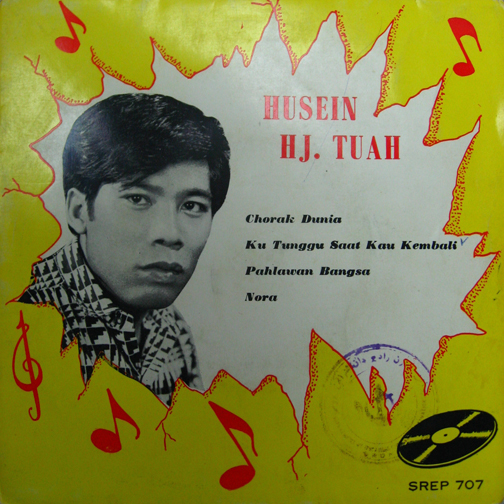
Hussein J. Tuah was from Brunei.
According to Merv Espina, Brunei was “one happening joint” back in the Sixties, and was very cosmopolitan. Merv has been researching the sole product of Brunei’s film industry, Gema Dari Menara (Voice from the Minaret), which was produced in 1968. Apparently the film features a few bands and exotic dancers. But much like that film, the music scene is Brunei has almost no information…
From what I have been able to find, it appears that all of the musicians from Brunei went to Singapore to record, and there was only one label that issued records by Bruneian artists. I did manage to find a little bit about Hussein J. Tuah & D’Acrobats’ J. B.’s is Management / Label: Times Record Company:
Around 1960’s in Singapore, Times Record was a record company which released Malaysian EP’s and LP’s, on labels such as Olympic, Eagle, Sea Lion, etc. There record labels had competition with international recording companies such as EMI and Philips. In the 1960’s there were many artists and singers and records under Times management, so audience can listen them.
D’Acrobats’ J. B. were from Johor Baharu, Malaysia. They released a handful of other singles as the backing band for other Malaysian singers such as Yusoff Ahmad and H. Anuar for the Universal Label.
If you have any information, please contact me.
Catalog number T.R.C. 1032 on Olympic Records of Singapore. No release date given.
◄●►◄●►◄●►◄●►◄●►◄●►◄●►◄●►◄●►◄●►◄●►
I recently received some more information from Merv Espina. His name is actually Hj. Tuah, and not J. Tuah. The big H in on the cover was a stylistic graphic design choice. You can see it on his first single, which was released on the SOR Records label of Singapore. Hussein worked as a teacher, and one of the subjects that he taught was English. He continued singing, and became a popular patriotic singer.
Filed under: Uzbekistan

BИA «Ялла», which translates to Yalla (also seen as Jalla), was from Tashkent, which is the capital of Uzbekistan.
Officially known as the Republic of Uzbekistan (Uzbek: O‘zbekiston Respublikas orЎзбeкиcтoн Pecпyблиacи), it is one of only two countries in the world that are doubly landlocked. Located in Central Asia, Uzbekistan was formerly part of the Soviet Union, and it shares borders with Kazakhstan to the west and to the north, Kyrgyzstan and Tajikistan to the east, and Afghanistan and Turkmenistan to the south.
Formed in the early 1970’s, the members of Yalla are graduates of the Ostrovsky Theatrical Art Institute and the Ashrafi State Conservatory in Tashkent. They are not Russian but Uzbek, a Turkic nationality from the crossroads of the ancient Silk Road. The group, whose name is an Uzbek word for a song accompanied by dancing, has become a popular icon in Uzbekistan, frequently serving as cultural ambassadors to international festivals or meetings abroad. Their music incorporates traditional ethnic folk tunes and poetry of Uzbekistan and other Central Asian and Middle Eastern cultures, along with contemporary pop and dance influences. They perform songs in more than 10 languages, including Arabic, Farsi, Hindi, Nepali and French as well as Uzbek and Russian.
Yalla has appeared on Soviet national television as well as performing in Moscow and elsewhere in the Soviet Union, and on concert tours in Europe, Africa, Asia and Latin America, including featured appearances at the “Voice of Asia” festival in Kazakhstan. The band has been named “State Merited Chamber-Instrumental Ensemble” (a musical equivalent to poet laureate), and winner of the Lenin Komsomol Prize of Uzbekistan. Also, Farrukh Zakirov, artistic director of Yalla and composer of many of their songs, was elected to Uzbekistan’s national parliament.
Members of Yalla:
Farrukh Zakirov – artistic director, composer, vocal
Rustam Iliasov – arranger, vocal, bass guitar
Abbos Aliyev – arranger, tan-buzuk, rubab, oud, vocal, keyboards
Javlon Tokhtayev – vocal, guitar
Alishier Tulyaganov – vocal, percussion, doira, tabla
Ibraghim Aliyev – percussion, darbuka, kairok-tosh
In 2000, Yalla released Beard of the Camel on the Seattle based Imagina Productions.
Catalog number ГOCT 5289-80 C62-17473 on the Soviet state-owned and operated Μелодия (Melodiya) label. No release date listed, but I believe that “Зaпись 1981” may be the copyright date…
Filed under: Mali

♬ Wara
Les Ambassadeurs Du Motel were from Mali.
Present-day Mali was once part of three West African empires that controlled trans-Saharan trade: the Ghana Empire, the Mali Empire (from which Mali is named), and the Songhai Empire. In the late 1800s, Mali fell under French control, becoming part of French Sudan. Mali gained independence in 1959 with Senegal, as the Mali Federation in 1959. A year later, the Mali Federation became the independent nation of Mali in 1960. After a long period of one-party rule, a 1991 coup led to the writing of a new constitution and the establishment of Mali as a democratic, multi-party state.
With the coming to power of Mali’s second president, Moussa Traoré, however, Cuban music was discouraged in favor of Malian traditional music. Biennale festivals were held to encourage folk music. Old dance bands reformed in many cases, under new names, as part of this roots revival. Especially influential bands included Tidiane Koné‘s Rail Band du Buffet Hôtel de la Gare, which launched the careers of future stars Salif Keita and Mory Kanté.
Not all bands took part in Traoré’s roots revival, however. Les Ambassadeurs du Motel formed in 1971, playing popular songs imported from Senegal, Cuba and France. Les Ambassadeurs and Rail Band were the two biggest bands in the country, and a fierce rivalry developed. Salif Keita, perhaps the most popular singer of the time, defected from the Rail Band to join Les Ambassadeur in 1972.
In 1974, a “battle of the bands” concert between Les Ambassadeurs and Rail Band was held in Bamako to decide who was the most popular group. A concert was organised and both bands were instructed to write a new song for the event. The Ambassadeurs du Motel performed “Kibaru” (which promoted a literacy campaign organized by the national government), and by all accounts the audience went wild. The concert produced no clear winner on the day and it was officially declared a draw. Salif and Kanté Manfila recorded a further two LPs with Les Ambassadeurs du Motel before forming Les Ambassadeurs Internationaux.
Catalog number SAF 50014on Sonafric of France, released 1976.
Filed under: Taiwan

Cai Mi Mi & Five Petals Guitar Band were from Taiwan.
Taiwan is also commonly used to refer to the territories governed by the Republic of China (ROC) and to ROC itself, which governs the island of Taiwan. Taiwan is also currently claimed by the People’s Republic of China (PRC) as a PRC province, though the government of the PRC has never controlled any of the current ROC territory commonly referred to as Taiwan.
There is little information about Pop music in Taiwan, especially anything that predates the 1980s. But, judging by records from the likes of The Telstar Combo, there was obviously something going on there. Although it does appears that many of the artists may have moved to Singapore, where they released records on labels that were based there.
According to mod-ifed music:
Cai Mi Mi, a Taiwanese singer, was a bright star in the late Sixties. In 1968, she led The Five Petal Group (an authentic girl band who apparently played all their own instruments!). “Mama Guitar” (also know as “Mama Get Me A Guitar”, which was covered by The Telstar Combo) was their biggest hit, and the group won instant fame when appeared on a popular television variety show singing the song. Interestingly, the original singer of this song was supposed to be Teresa Teng, but as she was overseas, Mi Mi and The Five Petals had the opportunity to record it.
I have seen Cai Mi Mi translated into English as Bai Mi Mi, Cai Mei Mei, Chai Mi Mi, Mi Mi Tsai and even Wai Wai Pai…
Thanks to Ho Chui-wa for the translation.
Catalog number LFLP 130 on Life Records of Singapore. No release date listed.
Filed under: Armenia

♬ Nune
Adiss Harmandyan was from Armenia.
There are not that many records from Armenian other than the traditional classical and / or folk music. This is mainly due to the fact that Armenia was part of the Soviet Union until 1991. And what little pop music that was recorded there was recorded in Russian.
Armenia had a strong influence on the Ethiopian music scene. Most of the state sanctioned bands were comprised of Armenian refugees who had been invited by Emperor Haile Selassie during the Armenian Genocide. But many others left soon after, and setteled in other countries.
Many popular musicans from around the world are of Armenian descent. Most notable being Sylvie Vartan and Charles Aznavour who were popular in France, and Cherilyn Sarkisian (better known as Cher)…
I have not been able to find much information about Adiss Harmandyan, except that he apparently owns a pastry shop in Los Angeles, California and occasionally performs weddings and Armenian cultural festivals around the U.S. and Canada.
Catalog number YD. 45 on Dedefon of Turkey. No other information available.
Filed under: Ethiopia

Seyoum Gèbrèyès was from Ethiopia.
If one were to pick a specific point that marked the birth of the distinctive Ethiopian soul music, one could do worse than choose the late Emperor Haile Sellassie’s visit to Jerusalem in 1923. During his stay he heard European brass instruments, which made such an impression on him that he hired a group of Armenian players to become official musicians of the empire. One of these players, Kevork Nalbandian, even composed the current Ethiopian National Anthem in 1926 (Although, according to Wikipedia, it was Solomon Lulu Mitiku).
Thus a distinctly European flavour of brass band music was brought into a country whose traditional music bore heavy influence from Muslim forms, and its own modal pentatonic scale. Additionally, because it was actually impossible to buy saxophones, drums or other musical instruments under the Selassie regime, only the marching bands had access to them, giving the subsequently played music a foreboding, militaristic ambience.
Meanwhile in Europe, a new generation became that baby boomers started the cultural revolution of rock ’n’ roll, R ’n’ B and pop music in the 1960s. The same generation in Ethiopia, in their 20s during the early 60s, wanted to change the country and get connected with the world. But where Ethiopia was different was that they had about 6,000 Peace Corps from America. President Kennedy invented this civil service for youngsters in order to work in third world countries, so these people brought with them a lot of American flavours: long hair, bell-bottom trousers and plenty of vinyl records.
Thanks to the newly acquired influences from the West, the sound emanating from the clubs Addis Ababa was a heady stew of deep, hypnotic rhythms, distinctly Western guitar licks and soulful eastern melodies and vocals. The sound bore the unmistakable badge of American records (Stax and Motown artists in particular) plus something distinctly African and new.
Soon labels such as Amha Records and Kaifa Records sprung up around the city to capture the sounds produced by the more popular singers and performers. Mahmoud Ahmed, Mulatu Astatke, Tlahoun Gèssèssè, as well as others all brought their soulful sound to the clubs and cut records.
Not much is known about Seyoum Gèbrèyès, except that he played saxophone. Some of his songs have appeared on volumes 1 and 13 of the Éthiopiques series with the Wallias Band. He also apparently played with Lèmma Dèmissèw who was featured on Éthiopiques volume 8 and was an arranger for Alèmayehu Eshété.
The Alem-Girma band, which was the backing band on this single, was formed by Alèmayehu Eshété and Girma Bèyènè in 1972. Both supposedly shared the taste of music and clothing fashion that was coming from the United States (James Brown, Elvis Presley, and Wilson Pickett to name a few). The band retained some of the members from the All Star Band and only lasted until 1974, after Colonel Mengistu Haile Mariam’s military coup against Selassie. Under Mariam’s Dekrg, or ruling council, Addis Ababa’s nightlife died off.
Catalog Number AE 580 on Amha Records of Addis Ababa, Ethiopia. No release date listed.
Filed under: Indonesia

♬ Abunawas
Trio Bintang were from Indonesia.
The Republic of Indonesia, is a nation in Southeast Asia. Comprising of 17,508 islands, it is the world’s largest archipelagic state. It is also one of fourteen nations that the Equator runs through. With a population of almost two and a quarter million people, it is the world’s fourth most populous country and the most populous Muslim-majority nation, although officially it is not an Islamic state.
During the early 1960s, President Sukarno was under pressure from the pro-communist organization Lembaga Kebudayaan Rakyat to ban rock’n’roll. Local groups rock groups were often thrown in jail. Due to this fact, one of Indonesia’s first rock bands, Koes Bersaudara had a hit with a song called “I’m In Jail”, which was also included on their first album.
The only information that I have been able to find about Trio Bintang, is that their guitarist was Jopie Reinhard Item. He apparently had also performed with Lilis Suryani, Elly Kasim, Titiek Puspa, Ernie Djohan – to name a few. He now plays instrumental jazz. And apparently, Trio Bintang performed for a reunion show in 1999 for the Wisma Anak-Anak Harapan orphanage in Untal-Untal Dalung on the island of Bali.
Catalog number BT-102 on Bintang records. No other information available.
 Radiodiffusion Internasionaal Annexe