Filed under: Israel

♬ Al Tashir Le’af Achat Acheret
Shula Chen was born in 1947 in Palestine. Later that same year, the United Nations passed the United Nations Partition Plan for Palestine. Also known as U. N. General Assembly Resolution 181, this was an attempt to resolve the Arab-Jewish conflict by partitioning the territory into separate Jewish and Arab states, creating what is now known as Israel.
Shula got her start in the mid-Sixties with the Nahal Army Troupe, along with Shalom Hanoch (who would later go on to form The Churchills with Arik Einstien). Nahal is a youth program in Israel that allows them to combine their compulsory three-year military service with volunteer-type civilian service. Later in 1980, she apparently became an actress and in 2003 a retrospective compact disc called Come Home. But beyond that, there is almost no other information that I have been able to find.
Catalog number S 63372 on CBS Records of Israel. No release date listed.
Filed under: Dahomey

El Rego et Ses Commandos were from Dahomey, now know as Benin.
On the African Scream Contest compilation, released by on Analog Africa, Samy Ben Redjeb interviewed Theophile Do Rego, which most people know as El Rego:
I was born on May 3, 1938, in Porto Novo. My family is originally from Ouidah. After childhood in Benin I was taken to Dakar in 1945 by a wealthy friend of my father; a usual practice at that time. It was at the school Medina de Dakar in 1952 that me and some other foreigners from Togo and Benin started a school band, which we named La Jazz De Dakar. I was the harmonica player I was back in Benin in early 1953 At that time Abela music from Ghana and Asiko from Nigeria – both kinds of Highlife – had taken over our radio waves. I started looking for musicians to form a new band, which I called La Jazz Hot. G.G. Vickey, a student at that time, became my guitar player.
At the end of 19531 left for Niamey in Niger. where I encountered a band called Los Cabanos. The lead singer was excellent, especially when performing rumba classics; and as is so often the case in Africa, he was soon pinched by a producer from Ivory Coast. I was a big fan of Franco; my favorite song was “Ele Wa Bolingo”. When the Cubanos guys heard me singing that tune they realized that they had found the perfect replacement. We had gigs in Ouagadougou all the time, so we were constantly shuttling between that town and Niamey. It didn’t take too much time before the government of Burkina Faso (haute Volta in those days) asked us to join forces with L’Orchestre Voltaique, which was the national orchestra. We used to jet-set between the countries of La Conseil de l’Entente, which was a kind of United States of Africa, comprising the Ivory Coast, Burkina Faso, Niger and Benin. I stayed with that formation for quite some time, eventually deciding to return to Cotonou in 1960.
At that time the talk of the town fr, Dahomey (Republic of Benin today) was Los Panchos of Gnonnas Pedro and La Sondas of the Belair Hotel. I decided toy and soon bought some musical equipment, including an amazing Contra-Bass, an instrument I had learned to play in Niger. I formed Daho Jazz in 1962. We used to play at the Black & White Club, if I remember correctly. The owner wouldn’t let us tour; which was so important to promote the music, so I left the group and joined Gnonnas Pedro’s Los Panchos. Later in 1963, I formed another band, which I called the Jets. The Jets became Los Paras, in ‘64, then Los Commandos in ‘65, and finally El Rago at Sas Commandos in ‘66. That’s when things got really serious for us, and we decided to start touring all the neighbouring countries, inciuding Ghana. It was in Ghana that I made my first appearance on TV and more importantly, where I hired Eddy Black Power, a soul singer whom I saw performing some James Brown stuff in Accra. He would later sing on a track called – “Feeling You Got” – Albarika’s first major hit.
Also, according to Frank Gossner of amazing Voodoo Funk blog, El Rego is still alive and well in Benin. Frank interviewed him for an upcoming documentary film called “Take Me Away Fast” by Leigh Iacobucci.
Since the initial posting of this song, it has since been included on the Analog Africa “Legends of Benin” compilation from 2009, which also features Antoine Dougbé, Gnonnas Pedro and Honoré Anolonto. In 2011, Daptone Records released a compilation CD and LP of the best of El Rego’s tracks. Rolling Stone posted part of the interview from “Take Me Away Fast” for the promotion of the compilation.
Catalog number L. A. 25 on Aux Ecoutes of Cotonou, Dahomey.
Filed under: Pakistan

Sohail Rana (mispelled here as Suhail) was from Pakistan.
The name “Pakistan” means “Land of the Pure” in Urdu, as well as in Persian. It was coined in 1934 as “Pakstan” by Choudhary Rahmat Ali, who published it in the pamphlet Now or Never. The name represented, according to Ali, the “thirty million Muslims of PAKSTAN, who live in the five Northern Units of (British) India – Punjab, North-West Frontier Province. (a.k.a. Afghania), Kashmir, Sindh, and Balochistan.” The nation was founded officially as the Dominion of Pakistan in 1947 after the Partition of India, and was renamed the Islamic Republic of Pakistan in 1956.
Sohail Rana, who is the son of renowned Urdu poet Rana Akbar Abadi, was born in Agra, Uttar Pradesh province in India, in 1938. After the Partition of India, Sohail Rana’s family moved to Karachi, Pakistan. Like most parents, his father encouraged him to study science. But when Sohail realized that science was not for him, he did not have the courage to talk to his father himself. He approached him through his elder sister to get permission to change over to music.
During his primary education, he was admitted to late A.M. Qureshi’s Mary Colaso School in Karachi, where Sohail Rana and future film actor, producer and writer Waheed Murad became friends. Many years later, Waheed Murad’s first film as a producer “Insaan Badalta Hai”, was a success, but he felt that the music fell short of his expectations. For his second production, “Jab Se Dekha Hai Tumhay”, Waheed handed over the task of music to Sohail Rana. In 1966, Sohail Rana came to national attention with the film “Armaan”, for which he won the Nigar award for the best composer for the film. Due to his popularity, EMI also appointed him to compose music for Firdausi Begum and Talat Mehmood.
Sohail took a job with the Pakistan Television Corporation in 1968. Besides composing a national song “Allah-o-Akbar” for the network, he wrote over 2,000 songs for his popular morning television program called “Sang Sang Chalain”. An entire generation of Pakistani children grew up singing along to the tunes about birds, frogs, insects and farm animals. Sonail would later say that “It used to be that children in Pakistan schools would only learn the English nursery rhymes, but I wanted to give them something they could sing in their own language.”
1970 saw the release of the album, ”Khyber Mail“, for which Sohail received the prestigious Presidential Award of Excellence and the EMI Gold Disc award. He served in the Ministry of Culture as director general from 1976 to 1978 and headed the project of National Orchestra and Choral Ensemble of Pakistan. He also composed music for Pakistan International Airline’s inflight progams. In 1986, the film “Hesaab” was produced, which would be the last of the twenty five films for which he would compose music.
Sohail moved to Mississauga, Ontario in Canada in 1990 where he has openned a school for singers and musicians. As of 2005, he was starting to perform live with interactive multi-media and was planning a series of concerts in Toronto involving artists from Pakistan and India.
Catalog number EKCF-8 on Columbia Records, manufactured by the Gramaphone Company of Pakistan, Ltd.
Filed under: Vietnam

♬ 60 Năm
Phương Tām was from Vietnam.
Records from Vietnam are rare, at best. I have been unable to find hardly any information about music (outside of tradtional folk music) in that country before the Eighties. Here is what little information I have been able to find about records such as this one: “Records of this nature were outlawed within days of the fall of Saigon, and most were either destroyed by the Communists or, interestingly, destroyed by their owners who did not want the communists to have them.”
When I first started tracking down records for what eventually became this site, I was under the impression that Vietnamese vinyl from the 60s and 70s would be the hardest to find. But, I have since been proven wrong. That’s not to say that they are easy to find… But considering the number of compilations of amazing of Thai and Cambodian rock and roll that are readily available… Why not Vietnam?
Catalog number M.3431 on Việt Nam Records. No other information available.
◄●►◄●►◄●►◄●►◄●►◄●►◄●►◄●►◄●►◄●►◄●►
UPDATE: 11/07/21 Sublime Frequencies has released a compilation of Phương Tām’s recordings entitled “Magical Nights – Saigon Surf Twist & Soul (1964-1966)“. While listening to this release, I realised that the song that I have posted here had been mislabeled “Đêm Huyēn Diệ”.
Filed under: Iran

Zia was from Iran.
The Iranian Revolution (also known as the Islamic Revolution, Persian: انقلاب اسلامی, Enghelābe Eslāmi) was the revolution that transformed Iran from a monarchy under Shah Mohammad Reza Pahlavi to an Islamic republic under Ayatollah Ruhollah Khomeini, the leader of the revolution and founder of the Islamic Republic. It has been called “the third great revolution in history,” following the French and Bolshevik revolutions, and an event that “made Islamic fundamentalism a political force… from Morocco to Malaysia”.
Although some might argue that the revolution is still ongoing, its time span can be said to have begun in January 1978 with the first major demonstrations to overthrow the Shah, and concluded with the approval of the new theocratic Constitution – whereby Khomeini became Supreme Leader of the country – in December 1979. In between, Mohammad Reza Pahlavi fled Iran in January 1979 after strikes and demonstrations paralyzed the country, and on February 1, 1979 Ayatollah Khomeini returned to Tehran to a greeting by several million Iranians. The final collapse of the Pahlavi dynasty occurred shortly after on February 11 when Iran’s military declared itself “neutral” after guerrillas and rebel troops overwhelmed troops loyal to the Shah in armed street fighting. Iran officially became an Islamic Republic on April 1, 1979 when Iranians overwhelmingly approved a national referendum to make it so.
The revolution was unique for the surprise it created throughout the world: it lacked many of the customary causes of revolution – defeat at war, a financial crisis, peasant rebellion, or disgruntled military; produced profound change at great speed; overthrew a regime thought to be heavily protected by a lavishly financed army and security services;and replaced an ancient monarchy with a theocracy based on Guardianship of the Islamic Jurists (or velayat-e faqih). Its outcome – an Islamic Republic “under the guidance of an 80-year-old exiled religious scholar from Qom” – was, as one scholar put it, “clearly an occurrence that had to be explained…”
Not so unique but more intense is the dispute over the revolution’s results. For some it was an era of heroism and sacrifice that brought forth nothing less than the nucleus of a world Islamic state – “a perfect model of splendid, humane, and divine life… for all the peoples of the world”. At the other extreme, disillusioned Iranians explain the revolution as a time when “for a few years we all lost our minds”, and as a system that, “promised us heaven, but… created a hell on earth”.
Pop music in Iran started as early as the 1950s, and is generally credited to Vigen Derderian, who was known as the “Sultan of pop”. His popularity coincided with the emergence of a new, Western-influenced middle class. By the early 70’s, using indigenous instruments and forms and adding electric guitar as well as other Western influences, artists such as Googoosh and Mehr Pooya rose to popularity. The Golden Age of Persian pop music did not last very long, though, and was banned within Iran after the 1979 revolution and many of the artists fled to other countries. In Iran, anything that was of Western influence was banned or destroyed. Due to this fact, records from this period difficult to find, and so is any information about the artists.
The only information I was able to find about Zia, is from the Iranian.com website, where there are some pictures, including three other records the he recorded.
Catalog number IR-2003 on Ahang Rooz (which means “Song Of The Day”) of Iran. No release date given.
Filed under: Eritrea

Ato Atowebrhan Seghid (also known as Ato Abirha Segid, Atoberhan Segid, Ateweberhan Seghid) was from Eritrea
Eritrea, officially the State of Eritrea, is a country situated in northern East Africa. It is bordered by Sudan in the west, Ethiopia in the south, and Djibouti in the southeast. The east and northeast of the country have an extensive coastline on the Red Sea, directly across from Saudi Arabia and Yemen.
Modern Eritrean popular music can be traced back to the late 1960s, when the Mahber Theatre Asmara began to produce stars like Yemane Ghebremichael (also known as Yemane Baria), Osman Abdurehim, Tewolde Redda, Tiberih Tesfahuney, Tsehaytu Beraki and Yonus Ibrahim. Thier music was influenced by American psychedelic rock and Motown soul music. In the 1970s, Eritrean popular music grew more similar to Ethiopian music, in its Jazz-based style.
Since then, some musicians, like kraar-player Dawit Sium have helped to incorporate Eritrean roots elements in popular music with imported styles of music from Europe, North America, and elsewhere in Africa, as well as the Caribbean.
In 2003, the Government of Eritrea banned Amharic language music. Amharic (Ethiopian) music used to be imported much like west African or western music, but none was ever produced in Eritrea. Although some can understand Amharic, no one born and raised in Eritrea speaks Amharic as their mother toungue.
I was unable to find any information about Ato Atowebrhan Seghid, nor the label Dejene, with the exception that they released a single by Alèmayehu Eshété.
Catalog number DJ-0011 on Dejene. Pressed in Greece. No release date given.
Filed under: Malaysia

♬ Setia
♬ Teroda
The Barons were from Johor Baharu, Malaysia.
Johor Baharu, also spelled Johor Bahru, Johor Baru, or Johore Bahru and abbreviated as JB, is the capital city of Johor in southern Malaysia. It is within walking distance from Singapore, and is one of the largest cities in Malaysia.
I haven’t been able to find any information about the band. As far as I know, this is their only single. I do know that the band members were: Eluna Edrus on vocals, Azmi Mohamed Khir on lead guitar, Adnan Mohamed on rhythm guitar, Mohamed Matta Abdullah on bass and Aziz Mohamed Khir on drums.
If you have any information, please contact me.
Catalog number KSEP 5002 White Horse Record of Kuala Lumpur, Malaysia. No release date listed.
Filed under: Turkey

Gökçen Kaynatan was from Turkey.
Turkey has had a long tradition of musical influence. Since Turkey is Europe’s crossroads into Asia, the whole phenomenon of East-meets-West hybridization (in this case, traditional Anatolian folk and ’60s pop) makes for some amazing music that couldn’t come from anywhere else. In just the last few years, there has been a handful of great compilations and a number of albums that have been re-issued.
Gökçen started out in the early 60’s playing in the band Kara Kediler, and then with Somer Soyata Orkestrası. He was considered to be “the greatest show musician” and had a minor hit with The Shadows inspired song “Moda”. However, due to his frustration with young band members constantly leaving and returning, resulting in a very inconsistent band, he decided “to make music without human players”.
So, he became one of the first experimental electronic pop musicians and by the late 60’s he was performing live concerts in Istanbul. Gökçen apparently had access to the latest equipment from the Maestro catalog, including the Echoplex and Rhythm’n’Sound (both effects are featured promently on this song). He eventually went on to set up the first electronic music studio in Turkey, and worked with Baris Manço.
Later in the 70’s, Gökçen produced many unreleased recordings such as “Cehennem” (“Hell”), “Lost Island”, “Doann Otesi” (“Beyond Nature”), and “Angio” which describes a surgerical operation he had in 1979. Nowadays he makes Rock’n’Roll music with his old partners and works as an architect. He also has music performed, composed and arranged on the EMS synthesizer.
The A side of this single, “Pencerenin Paerdesini”, was on the “Hava Narghile: Middle Eastern Raga Rock Ala Turquie ’66-’75” compilation released by Bacchus Archives. I recently saw a copy of his other single from 1973: “Sihirbaz” b/w “Evren” on 1 Numara. Although the titles were different, the songs were the same (Pressing plan error?). He also recorded two other singles, one in 1963 and one in 1966.
Catalog number A.K. 07 on 1 Numara Records of Turkey, released in 1973.
Filed under: Cameroon

♬ Kekeh
Uta Bella was from Cameroon.
Officially know as The Republic of Cameroon, the country is a unitary republic of central and western Africa. It borders Nigeria to the west; Chad to the northeast; the Central African Republic to the east; and Equatorial Guinea, Gabon, and the Republic of the Congo to the south. The country is called “Africa in miniature” for its geological and cultural diversity. Natural features include beaches, deserts, mountains, rainforests, and savannas. Cameroon is home to over 200 different ethnic and linguistic groups. The country is well known for its native styles of music, particularly makossa and bikutsi. English and French are the official languages.
Despite the fact that Uta Bella recently released an album in 2006, I have not been able to find hardly any information about her. Even her label’s website has no mention of her… I was able to find out that she recorded two singles for Akue label, founded by Paris-based Togolese producer Gérard Akueson, in 1968 and 1969. The label also released singles by Jo Tongo (a.k.a. Jojo L’Explosif) and Orchestre African New Sound. Other than that, there was an album titled “Nassa – Nassa” in 1980.
Catalog number 45030 on Akue Records of France, released in 1969.
Filed under: India

♬ Kazi Aniruddha • Main Hoon Pyar Tera
♬ Kazi Arindam • Fever
The term “Bollywood” originally referred to Bombay’s (now known as Mumbai) Hindi language film industry. Although there are a number of other studios that produce films in other languages, more recently the definition has been expanded in the West to describe pretty much all films produced on the sub-continent. But where in most countries a film’s soundtrack would merely be used as a promotional tool for the film, in India film music has become an industry unto itself with playback singers and dance numbers. The music is just as important as the film and lives on long after the film has left the theaters. These songs are, for the most part, the pop music of India.
As with most popular music, other artists sometimes recorded cover versions of these songs. Of these musicians, a small number specialized in instrumental arrangements and created what could be called the elevator music of India. While there were a few who used the harmonium or ‘mouth organ’, the most popular instrument used in these “instrumental favorites” was the steel guitar.
The earliest known report of anyone playing slide guitar was Gabriel Davion, a native of India who had been kidnapped by Portuguese sailors and was brought to Hawaii in 1876. Of course, there are Indian string instruments like the gotuvadyam and the vichitra vina that utilize slide known to have existed since the 11th century. But it was not until Ernest Ka’ai and his Royal Hawaiian Troubadours’ toured in 1919 before the slide guitar was introduced to India.
Not much is known about Kazi Aniruddha, except that he was the youngest son of revolutionary Bengali poet and musician Kazi Nazrul Islam. He released about two dozen songs before his death in 1974. And with the exception of a handful of film tunes in 1984, all of Kazi Arindam recordings were of Tagore songs, many of which he did with violinist Debshankar Roy. Although, he did produce a couple of records by Dipankar Sen Gupta, another steel guitarist who records Bollywood tunes. Whether or not the two Kazi’s were related is something that I’ve never been able to clear up…
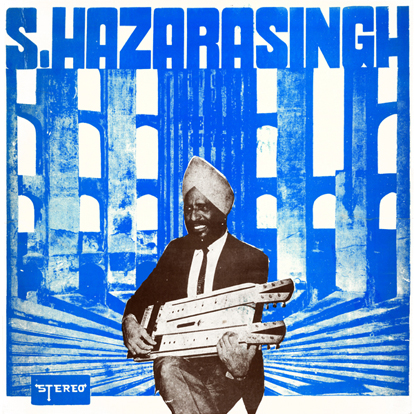
The song Main Hoon Pyar Tera by Kazi Aniruddha is included on the Bollywood Steel Guitar compilation on Sublime Frequencies. Van Shipley, S. Hazarasingh, Sunil Ganguly, Charanjit Singh, Gautam Dasgupta, as well as Kazi Arindam are also featured on the disc.
Catalog number S/MOCE 3022 EMI of India, manufactured & distributed by The Gramophone Company of India Limited in 1984.
 Radiodiffusion Internasionaal Annexe