Filed under: Thailand

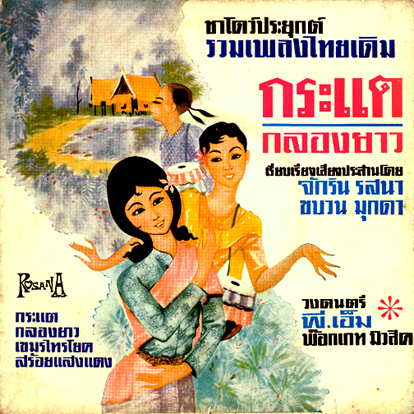
Anyone who picked up the first volume of Subliminal Sound’s Thai Beat A Go Go compilation, was most likely amazed at the wild and crazy sounds coming out of their speakers. The first track entitled “Kratae” by Johnny Guitar is truly unlike anything Western ears had heard before.
Just one problem… That song is not “Kratae”, and the artist who recorded it was not Johnny Guitar. The song is “Klong Yao”, and it was recorded by Payong Mukda, also known as Pocket Music and later known as The Son of P. M.
The music of Payong Mukda, as well as Noparatana Tipayaosot (a. k. a. Johnny Guitar), was known as “Shadow Music”. The term was in reference to the British instrumental band The Shadows, who were quite popular throughout all of Asia. Recordings of this music were often billed as “Thai Modernized Music“, taking classic Thai compositions and mxing in elements of surf guitar, a-go-go music and other styles to create an entirely new form of music. Sublime Frequencies “Shadow Music of Thailand” compilation features tunes by P.M. Pocket Music, The Son of P.M., P.M.7, Johnny Guitar and Jupiter.
In 1991, Payong Mukda was honored with the National Artist award which is presented by the Office of the National Culture Commission in Ministry of Culture of Thailand. Here is a brief biography from their website:
Lieutenant Commander Payong Mukda was born in Ratchburi Province. He was an artist who composed more than one thousand country songs, popular songs, and modern-songs as well as influencing a number of new singers. He was awarded Golden Record Awards for his musical compositions for three years in a row. Apart from writing music and lyrics, he was also a singer who sang humorous songs and owned a band called Pocket Music. Regarded as a pillar of musical circles, he was invited to perform for the general public at the Or. Sor. Station, Chitrlada Palace. He was also one of the founders of a number of associations such as the Musicians Association of Thailand under the Royal Patronage of His Majesty the King. He was a musician who could portray the messages in his music, and he liked to offer consultation and guidance to music lovers. Besides this, his songs were beautifully crafted, both in terms of language and meaning, with valuable ethical and moral messages closely intertwined. As such, he was considered a role model for people who fought through life with perseverance as well as being a master of the Thai music industry.
Catalog number S. T. 021 on Satit Tra Khon Khu Records of Bangkok, Thailand. No release date given.
Enjoy
Filed under: Syria

♬ Nadia
Damascus Music Group were from Damascus, Syria.
Officially known as the Syrian Arab Republic (Arabic: الجمهورية العربية السورية ), Syria (Arabic: سوريا) is a country in Southwest Asia, bordering Lebanon, the Mediterranean Sea to the west, Israel to the southwest, Jordan to the south, Iraq to the east, and Turkey to the north. The modern state of Syria was formerly a French mandate and attained independence in 1946, but can trace its roots to the fourth millennium BC. Its capital city, Damascus, was the seat of the Umayyad Empire and a provincial capital of the Mamluk Empire.
There is not a whole lot of information available about the music of Syria. The country has been fairly alienated by The West for quite sometime. Only recently has some music outside of the scope of traditional Classical Arab music is only just now beginning to show up on the Western radar with artists such as Hal Asmar Ellon and Omar Souleyman.
I have not been able to find any information about the Damascus Music Group, or their conductor Selim Sarwat. I do know that they released at least one other album. I was able to find a brief article on the label – Byblos:
Founded in 1966 by Mozart Chahine, the company Byblos Records specializes in traditional music of the World Near East. Long before the advent of World Music and enthusiasm of the public for this style, Byblos Records distributed throughout the world for the vocal and instrumental works by artists whose fame was largely beyond the borders, such as Munir Bashir, the teacher the oud or Nidaa Abu Mrad, the champion of Sufi music. Byblos Records do not forget the new generation less and produces regularly young composers who brings a touch of modernism to the repertoire of their elders, as Nabiha Yazbeck, Guy Manoukian or Omar Bashir. Byblos Records also continues to repeat beautiful recordings, originally on vinyl, which are moving testimony to the diversity of musical genres that prevail in Lebanon and the Arab world (classic hymns, dancing and mouachahat). Result, thirty CD, which are an invitation to discover the various facets of musical creation of the region.
If you have any information, please contact me.
Catalog number BL 904 on Byblos Records of Damascus, Syria, released 1977.
Filed under: Guinea

♬ Karangba
The National Horoya Band was from the West African nation of Guinea.
Guinea was created as a colony by France in 1890. The capital Conakry was founded on Tombo Island in the same year. In 1895 the country was incorporated into French West Africa. On 28 September 1958, under the direction of Charles de Gaulle, Metropolitan France held a referendum on a new constitution and the creation of the Fifth Republic. The colonies, except Algeria, which was legally a direct part of France, were given the choice between immediate independence or retaining their colonial status. All colonies except Guinea opted for the latter. Thus, Guinea became the first French African colony to gain independence, at the cost of the immediate cessation of all French assistance.
After independence Guinea was governed by the President Ahmed Sékou Touré. Some called Touré was considered a “Mao-style” socialist, while others called him a dictator. He applied his command-economy beliefs to the arts as well as to trade and agriculture. Under his leadership, Guinea joined the Non-Aligned Movement and pursued close ties with the Eastern Bloc.
Prior to the Guinea’s independence, most of the musicians working in Conakry’s top nightclubs and hotels were Europeans, playing French and American show tunes and dance music. Guinean musicians were found lower down the economic ladder, in neighbourhood dancehalls, but they too played a repertoire mainly made up of waltzes, foxtrots and Latin American dance tunes. The names of the leading Guinean bands – La Douce Parisette, L’Africana Swing Band, Le Harlem Jazz Band and Les Joviales Symphonies – speak for themselves.
Within months of achieving power, Sékou Touré’s Ministry of Culture disbanded all European-style bands in the country and directed their musicians to “return to authentic African rhythms and tunes”. The policy was called ‘Authenticité’ and Touré backed it up with state sponsorship of newly formed national and regional bands as well as the state owned record label Editions Syliphone Conakry. There were regular festivals at which the regional bands competed for national status. The best bands were awarded with the title Orchestre National and had the possibility to travel to Cuba to learn more about Afro-cuban music. At its peak, the state supported seven national bands.
‘Authenticité’ notwithstanding, the music played by the national and regional bands included some non-Guinean elements. Ghanaian highlife was a signifcant influence – E.T. Mensah And His Tempos Band toured Guinea within a few weeks of independence and were rapturously received – as was Cuban music, so hardwired into Guinean music, from which it largely derived, that even Touré couldn’t expunge it (and following the Cuban revolution of 1959, he probably felt he didn’t need to anyway). A little later, Congolese rumba was another heady infusion.
Woven into these imported influences was traditional Guinean music, uniquely rich in polyrhythms, mainly of the Manding and Foulah peoples. The synthesis was cool and loose-limbed, a relaxed but insistent dance style played in the main by ten-piece and bigger line-ups featuring vocals, three or four electric guitars, horn sections, balafons (xylophones), kit drums and traditional percussion.
After the death of Sékou Touré, this State support came to an end, concerts became rare and money for recording was not available anymore. Many bands eventually disintegrated as working conditions deteriorated.
Formed in 1961, the Horoya Band de Kankan won the best orchestra prize in 1967, 1968 and 1971 at the Quinzaine Artistiques Festival. They were nationalised in 1971. The band was led by Métoura Traoré (although for this single, both songs were written and conducted by Lansina Kanté). They recorded two albums and a handful of singles between 1969 and 1974, as well as a number of compilation appearances under either the name Horoya Band, Horoya Band National or National Horoya Band.
The majority of the information for this posting came from Chris May’s review of the compilation Authenticité: The Syliphone Years Guinea’s Orchestres Nationaux & Federaux 1965 to 1980 on Sterns Music which features the song “Karan-Gbegne” (which translates to ‘Maninka Whip’, the martinet of Koranic school teacher).
Catalog number SYL 546 on Editions Syliphone Conakry of Guinea, released 1972
Filed under: South Korea

♬ 안녕
Sisters Bae In Soon and Bae In Sook, were better know as The Pearl Sisters from South Korea.
South Korea, officially known as the Republic of Korea (Korean: 대한민국), is an East Asian country occupying the southern half of the Korean Peninsula. To the north, it is bordered by North Korea (Democratic People’s Republic of Korea), with which it was united until 1945. To the west, across the Yellow Sea, lies China and to the southeast, across the Korea Strait, lies Japan.
The Korean people trace their nation’s founding back to 2333 BCE by the legendary Dangun Wanggeom. Archaeological research shows that the first Korean settlers have occupied the peninsula since the Lower Paleolithic period with territories expanding as far as mainland China and eastern Russia during the Gojoseon period, the first nation established by Koreans. Korea’s history has been turbulent at times with the last emperor of Korea dating back to the age of the Korean Empire. Since the establishment of the modern republic in 1948, South Korea has struggled with the aftermath of the Japanese control (1910-1945), the Korean War (1950-1953), and decades of authoritarian governments, undergoing five major constitutional changes. While the government officially embraced Western-style democracy from its founding, it was not until the December of 1987 that direct and fair elections were held and true democracy began to solidify.
The duo were originally introduced as the Kim Sisters by their mother Yi Nanyŏng, who was an actress and singer during the Korean War. It was Bae In Soon who picked up on the idea and after winning a contest at the U.S. Eighth Army stage show managed to enthuse her sister Bae In Sook to become the Pearl Sisters around 1968.
By the early 1970s, the Pearl Sisters were fairly popular, partly because they had the genius of composer – and Korea’s father of Rock ‘n Roll – Shin Jung-Hyun behind them. The album ‘My Dear’ (친애하는 1968), named after their best selling song, also included the hit ‘A Cup of Coffee’ (커피한잔). Other albums were called ‘First Love’ (첫 사랑 1969), and ‘Goodbye Rain’ (비 안녕 1970). But, by the mid 1970s the sisters could no longer stand each other, and split.
Younger sister, Bae In Sook, continued to sing into the ‘disco‘ era of the late 1970s until 1984. Bae In Soon, re-entered singing in 2004 with a brand new set of songs on her CD ‘A Cup of Coffee with My Song’.
Catalog number JLS-120346 on Jigu Records of South Korea, released 1969.
Filed under: Lebanon

To the best of my knowledge, Fawez was from Lebanon.
Lebanon (Arabic: لبنان), officially the Republic of Lebanon, is a small, predominantly mountainous country in Western Asia, on the eastern shore of the Mediterranean Sea. It is bordered by Syria to the north and east, and Israel to the south. Due to its sectarian diversity, Lebanon evolved a peculiar political system, known as confessionalism, based on a community-based power-sharing mechanism. It was created when the ruling French mandatory powers expanded the borders of the former Maronites Christian autonomous Ottoman Mount Lebanon district.
No official census has been taken since 1932, reflecting the political sensitivity in Lebanon over religious balance. The 2006 CIA World Fact Book, Lebanon entry, gives the following distribution: Muslim 58.7% (Alawite, Druze, Nusayri, Shi’a and Sunni), Christian 40% (Armenian Catholic, Armenian Orthodox, Assyrian, Chaldean, Copt, Greek Orthodox, Melkite Catholic, Protestant, Roman Catholic, Syriac Catholic and Syriac Orthodox), and 1.3% of other religious sects.
As for Fawez, I have not been able to find any information. Both songs on this single were with the Orchestre Rahbani, and the song “Leila-Liela” on the flip side was written by Elias Rahbani. I even tried e-mailing Mr. Rahbani, but the message was returned undelivered.
If you have any information, please contact me.
Catalog number C 006-23 152 on Pathé / EMI, pressed in Belgium. No release date given.
Filed under: Gabon

Hilarion Nguema founded L’Orchestre “Afro Succes” in Gabon’s capital of Libreville in 1962.
Gabon, or the Gabonese Republic, is a country in west central Africa that gained it’s independence from France on August 17, 1960. A small population (less than two million), abundant natural resources, and foreign private investment have helped make Gabon one of the most prosperous countries in the region, with the highest HDI in Sub-Saharan Africa. But, the musical output is little-known in comparison with neighboring Cameroon and the Democratic Republic of the Congo.
The music of Gabon is heavily influenced by the rumba, both the Cuban and Congolese, that was broadcast by Radio Belgian Congo, who formed the first modern orchestra of the country. It was not until the late 1960’s until musicians would take the Afro-Cuban rumba as well as jazz, rhythm ‘n’ blues and combine them with traditional Gabonese elements like “ndjembé” and “bwiti” to define their own sound.
I have not been able to find any other information on Hilarion Nguema, except for the fact that he released a handful of albums in the 1980’s and 90’s. If you have any information, please contact me.
Catalog number SAF 1666 on Sonafric Records of France. This record was originally released on the Ngoma label. No release date given
Filed under: Singapore

The Stylers were from Singapore.
Singapore is an island nation located at the southern tip of the Malay Peninsula and is one of the few remaining city-states in the world and the smallest country in Southeast Asia.
When the main island was colonized by the British East India Company in 1819, it contained a fishing village sparsely populated by indigenous Malays and Orang Lauts at the mouth of the Singapore River. The British used the position as a strategic trading outpost along the spice route. It became one of the most important commercial and military centres of the British Empire and the site, in 1942, of what Winston Churchill called “Britain’s biggest defeat” at the hands of the Japanese. Occupied by the Japanese Empire during World War II, it reverted to British rule in 1945 and was later part of the merger which established Malasia in 1963. Less than two years later it left the federation and became an independent republic on August 9th, 1965. The new republic was admitted to the United Nations on September 21 that same year.
Although these songs are from their first single, The Stylers would eventually join the list of ‘Non-Stop Music’ bands like The Silverstones, Tony & The Polar Bear Five and The Travellers. I pestered Mack over at FarEastAudio to give me a brief history on the Non-Stop Music craze:
Non-stop instrumental dancing records go at least as for back as the 1950s orchestral work of Germany‘s James Last. Non-stop ballroom has had a lasting influence in East and Southeast Asia. (In the mid-1990s, I purchased a wonderful cassette in the Philippines called “Non-Stop Cha Cha Extravaganza,” for example.) However, it is the Asian version of the “A Go-Go” pop medley sound that has captured the imaginations of Western record collectors in recent years. Influenced by instrumental rock groups from the US and UK, the 60s teen scenes of Hong Kong, Macau and Singapore produced numerous dancing albums. These albums often retained the ballroom sensibility of listing the intended dance styles next to the track titles (A Go-Go, Blues, Fox Trot, Cha Cha, etc.), but relied on a rock line-up of bass, drums, guitar and organ. As for the songs performed, Western pop hits, regional pop hits and even traditional folk melodies were all fair game.
By the 1970s, surviving instrumental bands like The Stylers seem to have gotten more ambitious, incorporating into their albums film themes, sound effects, “hi-fi” production values, and musical elements of the emerging disco sound. By this point, non-stop instrumental albums were less a teen dance phenomenon than they were fodder for the high-end stereo equipment of Asian audiophiles.
In 2003, Singapore’s Media Development Authority (MDA) commissioned a six-part series documentary for televison on the Singapore music scene from the 1960s to the present day, entitled Jammin’. If anyone knows how I could get a copy of that documentary (especially the first two episodes), I would greatly appreciate it.
Catalog number SE 1010 on Polar Bear Record of Singapore. No release date given.
Filed under: Morocco

♬ El Harib
The four Megri brothers were popular session musicians / composers / producers from Morocco. There names were Hassan, Mahmoud, Jalila and Younès. Jalila was apparently a songwriter and producer, and Younès had a solo career. But, Hassan and Mahmoud recorded two singles singles as Les Frères Megri.
During the late 1960s and early 1970s, a new form of pop music emerged in the region of North Africa. This new form resulted from the fusion of local Arabic music with European pop music. Arab media often referred to this new style as “Progressive”. In many ways, it is an independent form of music that has strong and variable Arab, African and European influences; an expression that has branched out and evolved separately from popular traditional Cha’abi music of the region.
Darja, the Arabic dialect of North Africa, is often used as the lyrical language for songs in this genre. While the music is sometimes distinguishably Arabic, it is often not. The rhythms are mixtures of Berber, Arab, African and popular European, performed to the artists’ own recipe and vary to their interpretation.
I have seen quite a few records that they have either played on or produced, but I’ve only seen two singles (with Hassan and Mahmoud) and two albums (one with Hassan, Mahmoud and Younès, and one with just Mahmoud and Younès) by ‘Les Frères Megri’. Apparently they still run a recording studio in Morocco, and Younès released an album in 2004.
The majority of the information in the above post was taken from the Quarter Tone Fusion website, which you can find here.
Catalog Number 6269 014 on Philips Records of France. No release date given.
Filed under: Zaïre

Sebastien Marini was from Zaïre, which is now known as the Democratic Republic of the Congo.
The name ‘Zaïre’ came about from the Portuguese mispronunciation of the Kongo word nzere or nzadi, or “the river that swallows all rivers”. And while many people inaccurately refer to the Democratic Republic of the Congo even today, it was only officially called Zaïre from October 27th, 1971 to May 17th, 1997.
I haven’t been able to find any information about Sebastien Marini, except for what is written on the back of the record (originally in French):
Born on January 20, 1950 with Point-Black (Pontoon on Sea) in Congo-Brazzaville, Sebastien Marini was taken by the hand by Tino Baroza, one year before its tragedy disappearance with Yaounde, and then by Gracia former bass player of Ryco Jazz which ‘initiated it’ with the music. In 1969 it is sound arrival in Paris, after Equatorial Guinea, The Canary Islands and Spain. 1970, it is the departure in Canada and the United States of America. African access, Congolese then it is towards the dear children of Africa which it turns and dedicates its works.
“Bolingo Na Motema’ the full love my heart, I come to offer to all those which wait for a long time (friendly, buddies, comrades) this first 45 single” – Sebastien Marini
If you have any information, please contact me.
Catalog Number SAF 1668, Sonafric records of Paris, France. No release date given.
Filed under: Cambodia

♬ Grief Over Dark Night (with Sinn Sisamouth)
Ros Sereysothea was from Cambodia.
Born Ros Sothea in Battambang Province circa 1946, her family made a living by performing Khmer traditional music. Singing duets with her brother, Serey, the Serey-Sothea pair became quite well known and went to the capital Phnom Penh, where they found work performing in clubs. Ros eventually eclipsed her brother and became a solo artist, changing her name to Ros Sereysothea.
During the 60’s and early 70’s, as the war in Vietnam threatened its borders, a new music scene emerged in Cambodia that took Western rock and roll and added the unique melodies and hypnotic rhythms of their traditional music.
While these two songs are more on the tradional side, Sothea’s high, clear voice, coupled with the rock backing bands featuring prominent, distortion-laden lead guitars, pumping organ and loud, driving drums, made for an intense, sometimes haunting sound that is best described today as psychedelic or garage rock.
She was honored by King Norodom Sihanouk with the royal title, “Preah Rheich Teany Somlang Meas”, the “Golden Voice of the Royal Capital.”
On April 17, 1975, after taking over the country, the Khmer Rouge began one of the most brutal genocides in history, killing 2 million people – 1/4 of the Cambodian population. Intellectuals, artists and musicians were murdered simply for their status.
Forced out of Phnom Penh with all the other residents, Sothea lived at a worksite in Kampong Speu. When her identity was learned by Khmer Rouge leaders, she was made to write and perform songs celebrating the regime. When she wasn’t singing, she was required to work at digging irrigation ditches like everyone else in the camp. And, she was forced by the insistance of Pol Pot to marry one of his assistants in 1977.
She disappeared under mysterious circumstances during the brutal regime of the Killing Fields. Most believe that she died from being overworked in a Khmer Rouge agricultural camp, although it has also been reported that she either died of malnutrition in a hospital in Phnom Pehnh during the last weeks of the Khmer Rouge regime or that she had a fight with her husband and was sent away, never to be seen again.
There is an extensive biography, with tons of pictures and MP3’s, as well as links to an interview with Ros Sereysothea’s sister and other YouTube videos HERE. Also, there is a short film about her life called The Golden Voice. And the documentary Don’t Think I’ve Forgotten has been in production for some time, but no release date has been announced.
Thanks to Linda Saphan for the translation.
Catalog number C7135 on Chanchhaya Records of Cambodia. No release date given.
 Radiodiffusion Internasionaal Annexe