Filed under: Nigeria

Dan Satch & His Atomic 8 Dance Band of Aba were from Nigeria, presumably from the town of Aba. During that time, Aba was the capital of the short-lived secessionist state of Biafra.
Ferdinand Dan Satch Emeka Opara would eventually go on to form The Oriental Brothers band with his brothers Godwin Kabaka Opara, Kabaka Opara and Christogonous Ezebuiro “Warrior” Obinna along with Nathaniel “Mangala” Ejiogu, Hybrilious Dkwilla’ Alaraibe, and Prince Ichita.
The only information I was able to find about this band, was a mention of record by “Dan Satch & the Professional Atomic ‘8’ Band” on a webpage with a discography for the The Oriental Brothers band. That record was released in 1969, while the first Oriental Brothers record did not come out until 1974.
Since this original posting, I have been informed about the album “Ikoro’s ’70 Special”. You can find the entire album, plus an extensive biography here.
Catalog number HNS 1091 on HMV of Nigeria, no release date given.
◄●►◄●►◄●►◄●►◄●►◄●►◄●►◄●►◄●►◄●►◄●►
Update 02.16.2010 – I’ve been meaning to update this post for forever, since I have been told that just about all of the information above is incorrect. Fortunately, the folks over at Waxidermy have posted this single with the correct information. You can find it here.
Filed under: Malaysia

The Planets were apparently from Malacca, which is southern region of the Malay Peninsula, on the Straits of Malacca, in Malaysia.
I have not been able to find any information about the band.
If you have any information, please contact me.
Catalog number TWEP – 201 on Tai Wah Record Co. No other information available.
◄●►◄●►◄●►◄●►◄●►◄●►◄●►◄●►◄●►◄●►◄●►
Since this posting, I have been contacted by Leo Playa. His uncle Anton Thomas, who most people called “Sonny”, was the lead guitarist of the band. Sonny passed away in July of 2009.
Filed under: Tunisia

Mohammed Hanesh was supposedly from Tunisia.
The only information I was able to find was on a cached Dutch Wikipedia page that was not ready to be published (and that is no longer on the web)… Apparently, someone by the name of Mike Vincent played bass on this song. And since this record was originally released in Holland, there a possibility that this may be a studio creation. That may explain that fake bear that guy with the flute is wearing on the cover…
If you have any information, please contact me.
Catalog number 16 236 AT on Ariola of Munich, Germany, released 1975.
◄●►◄●►◄●►◄●►◄●►◄●►◄●►◄●►◄●►◄●►◄●►
UPDATE: I stumbled upon this discussion board the other day:
“My name is Cees Vermeulen Wind Sant, music producer. It was 1975, there raged an oil crisis. Together with my family, I was on holiday in Tunisia. We walked about a bazaar and I heard a whistle a tune playing in a so-called traditional music. The tune stayed in my mind for days and that gave me the idea to take a stab at the song in a modern way. No sooner said than done. Under the alias Mohammed Hanesh, I was with some friends, recorded the song “Sidi Mansour” produced, published and distribution by Ariola. The song hit directly and quickly became a in various countries. This was also supported by the Tunisian airline, which produced large posters. Something that today we would not get together quickly…”
Filed under: Sri Lanka

The Fabulous Moonstones started playing together in 1964, formed by Clarence Wijewardane and Annesley Malewana in Columbo, Sri Lanka.
Clarence Wijewardene is credited with being the person who first introduced the electric guitar into Sinhala music.
After the break up of the Fabulous Moonstones in 1970, Wijewardene formed the the Golden Chimes with singer Anil Bharati. This did not last long, though, because Malawana and Wijewardene could not be seperated in the pop music scene. They eventually returned together with the Super Golden Chimes in 1972.
For more music from Sri Lanka, be sure to check out Sinhala Jukebox.
Catalog number CHB 023 on Sooriya records of Columbo, Sri Lanka.
Filed under: Rhodesia

The Green Arrows were from Bulawayo, Rhodesia, which is now known as Zimbabwe.
Originally, the Green Arrows formed in 1968 to back singers and perform covers. The group was founded by Manatsa brothers Zexie and Stanley, who began playing rabi (an urban style founded on traditional songs) and Kwela together as The Mambo Jazz Band along with several other musicians. They became The Green Arrows in 1968 when they replaced Fanyana Dube on rhythm guitar with Keddias, the youngest Manatsa brother. The lineup included Zexie Manatsa on bass and lead vocals, Stanley Manatsa on lead guitar, Givas Bernard on rhythm guitar and bass, Fulton Chikwati on rhythm guitar and Raphael Mboweni on drums. Supposedly, the band picked up their name shortly before jumping into a freshly painted Volkswagen bus to tour the country in support of various vocalists.
They started out playing ‘beer music’ in bars around Bulawayo. In fact, Stanley Manatsa’s guitar style was known as “hwahwa,” which is the Shona word for beer. But they went on to become the first group to record an full length album in Zimbabwe. Their song ‘Musango Mune Hanjaiwa’ still holds the record for the longest stay at number one in Zimbabwean history, with a reign of 17 weeks. They are also recognized for forcing record companies in the region to exhibit interest in the work of local artists, which would launch the careers of Thomas Mapfumo and Oliver Mtukudzi.
The Green Arrows, despite their energetic and apparently carefree sound were at the forefront in defining the ‘Chimurenga’ style of music. ‘Chimurenga’ is the Shona word for ‘struggle ‘. The term goes back at least to the first uprising against the British in the1890s when the Shona majority of Rhodesia rose up, only to be narrowly defeated.
Zexie Manatsa remained popular in the post-independence era, producing hits such as ‘Chivaraidze’ and ‘Tii Hobvu’. The band’s popularity declined as the 1990s approached. He eventually retired to pursue religious work. But, recently he took a break from his religious duties to produce a new album, Mutungamiri Wakanaka.
In 2006, Alula Records released 4 Track Recording Session, which collects most of the bands early recordings. The disc was compiled by Samy Ben Redjeb of Analog Africa who also wrote the twenty-two page band history and detailed discography. For some reason though, this song is not included on that disc.
Catalog number FYF 113 on Farayi Farayi of Rhodesia, released 1976.
Filed under: Philippines

Ronnie Villar and The Firedons were from the Philippines
England’s Cliff Richard was one of the first Western rock ‘n’ rollers to break into the Asian pop markets. The Shadows, Richard’s backing band, recorded separately as an instrumental combo, and they, like their American counterparts The Ventures, were quite the pop phenomenon in Asia as well.
Similarly, The Firedons recorded with and without their vocalist Ronnie Villar, who is not present on this record. The Firedons included Willy Villar on lead guitar, David Llorente on rhythm guitar, Caesar Llorente on bass, and Waldy Cruz on drums. Apparently, Teresita Apolinario was the first vocalist of the band before they recorded their first single but left to be married.
I tried to contact David Llorente’s son, who is a rapper in Los Angeles and goes by the name Viddy V. Unfortunately, he did not return my e-mail.
Catalog number 1003 – S on Mahubay Records of The Phillipines. No date listed.
Filed under: Iraq

Ja’afar Hassan (also spelled Jafar Hassan) was born in the town of Khanaqin, which is in the Kurdistan Region of Iraq.
The majority of the information I was able to find about him, was from his website… Which is in Arabic:
He learned to play the oud (Google translator: “lute autonomous machine”) at a young age. He later studied violin, viola and voice at the Institute of Fine Arts in Baghdad, where he later became a professor and head of the Department of Music. He has also played in neighboring Kuwait and Syria, as well as Yemen where he is a member of the Federation of Yemeni artists.
Ja’afar Hassan was brought to my attention when I received a copy of the Sublime Frequencies’ compilation ‘Choubi Choubi! Folk and Pop Sounds from Iraq’, which features three songs from his album “Let’s Sing Together”. His music sounded unlike anything else of what little I have been able to find from Iraq during that time period (all of which was recorded in France). It is quite unusal, especially if you consider that there is no oud, for which Ja’afar Hassan is known for playing…
There is almost no mention of this album on his website, except only briefly on the biography page (Google translator: “Cylinder issued to him in Berlin entitled ‘to enrich together’.”). Also on his website, there is a page of his press clippings, but there is a 11 year gap from 1966 and 1997.
Also, there is very little information on the record itself. There is no indication of a record lable, but there is a catalog number. On the front cover, there seems to be something covering the right top corner, where the record company logo may have been and was printed over.
The record was most likely pressed in East Berlin, given that Hassan was supposedly a mouthpiece for the Iraqi Socialist movement just a few years before Saddam Hussein came to power. Also, the design of the almost all red cover and the sequence of the catalog number is similar to records from that time period.
But to make matters more puzzling, the liner notes are in Arabic and English:
Ja’afar Hassan is a progressive Iraqi singer who uses songs as a means to express people’s joyness, victories and sadnesses… He sings for the telling masses, thus giving his songs a new spirit… That is what we call political songs. He is considered to be one of the first young Iraqi singers who devoted their songs to serve the mentioned themes
Which begs the question, who was the intended audience for this record? Was it released, or at least distributed, in Iraq? Or, perhaps was this release for Iraqis living outside of Iraq?
If you have any further information, please contact me.
Thanks to Mark Gergis for his help and information.
Catalog number 8 95 012. No other information.
Filed under: Guinea

♬ Kanimba
Sextet Camayenne were from the African nation of Guinea.
Guinea, officially the Republic of Guinea (French: République de Guinée), is a nation in West Africa, formerly known as French Guinea. It borders Guinea-Bissau and Senegal on the north, Mali on the north and north-east, the Côte d’Ivoire on the south-east, Liberia on the south, and Sierra Leone on the west. Its territory encompasses the water source for the Niger, Senegal, and Gambia rivers, with a coastline facing the Atlantic Ocean. The name Guinea (geographically assigned to most of Africa’s west coast, south of the Sahara desert and north of the Gulf of Guinea) originates from Berber and roughly translates into ‘land of the blacks.’ It is sometimes called Guinea-Conakry per its capital to differentiate it from the neighboring Guinea-Bissau (whose capital is Bissau).
I have not been able to find any information, except that they released one other single and later became the 14 piece band Camayenne Sofa.
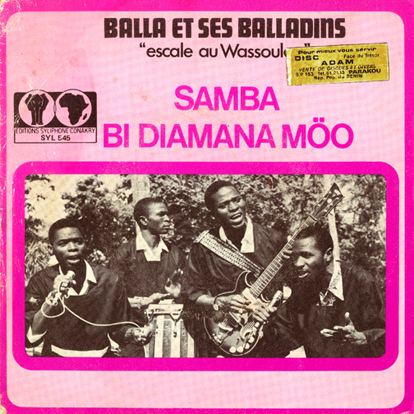
Also as I mentioned back when I posted the song by Balla et Ses Balladins, I don’t know what kind of fuzz pedals they had access to in Guinea at this time, but it doesn’t sound like anything else I’ve ever heard…
If you have any further information, please contact me.
Catalog number SYL 562 the state run Editions Syliphone Conakry, République de Guinée, released 1974.
Filed under: South Korea

♬ 외로운태양
He5 were from Korea.
The records from that time are very scarce, since they did not press that many. Even today when one of these records are re-issued, there is usually only a pressing of 300 copies. Due to this, there’s not a whole lot of information available about the early days of rock ‘n’ roll in South Korea.
One of the best sources of information is the website for the Psyche Van Het Folk programme from Radio Centraal of Belgium has a whole section on Korean rock music (as well as other countires / regions):
Kim Hong-Tak was one of the two leading figures in the early days of “Group Sound Era”, of course with Shin Jung-Hyun. Kim Hong Tak was guitarist and naturally leader of the group. Here, it seems better to put aside the question ” Who was the first?”. Because with this question of ‘the first’ or more properly ‘the Origin’, the answers will not is the same according to the questioner’s perspectives.
For example, if we take one perspective, in this case that of ‘popularity’, it will be the Key Boys of Kim Hong Tak which was followed soon afterwards by the Add4 of Shin Jung-Hyun.
A little remark. This Key Boys is not the ‘Later’ Key Boys who sang the smash hits like “Let’s Go To The Seashore”. or “Memories of The Seaside”, but the ‘Earlier’ Keyboys. They played some ‘Package shows’, under the name of the Lock & Key in the stages of the U.S. Eighth Army which settled in South Korea. Also they played at some new venues like ‘Music Listen Rooms’, ‘Live Music Salons’, or the traditional ones like in Cinema. [At that time the concert was held frequently in Cinema Houses. It was called as ‘Cinema Show’].
With these latter acts they were known to general ‘Korean’ public. They were nicknamed as the ‘Beatles of Korea’ – At that time this meant more similar to a ‘cover band of the Beatles’. [Because the stages in U.S Eight Army was for the Korean in the forbidden area for the evident reason of security. So generally a Korean group or artist who played there was a totally unknown figure to general Korean public].
In the mid-60s which prevailed by the worldwide phenomenon ‘Beatlemania’, the Key Boys, in molding the archetype of the Rock band (or Rock Group) who ‘sing and play’ [With the Kkokkirri Brothers, the Fools, the Kim Chies], became the pioneers of a new cultural phenomenon [we may now be able to say that it was the early days of ‘Pop culture’ in Korea]. And here lies one symbolic fact concerning the popular culture in general that 1964-1965, the period of their debuts coincides with that of the birth of the ‘Weekly Magazine’. With the time, the members of the Key Boys left the group: some Cha Jung Rak and Cha Do Gyun going to solos, some Yoon Hang Ki joining to the Korean Army‘s entertainment Unit which was sent to the Viet-Nam War, and finally Kim Hong Tak too. But Kim Hong Tak had launched his career of guitarist in a rock group. It was the He5.
Precisely speaking, the He5 was not launched by Kim hong Tak. According to the memories of its members, the group was found in the winter of 1967 ‘the five young guys’ all belonged to the Wha-Yange Entertainment Inc. had set up the group together; Han Woong (Rhythm guitar and vocal) issued from the Four Guys, Cho Yong Nam (lead guitar and vocal) from the Shin Jung Hyun and the Jokers, Yu Young Chun (vocal) from the Silver Coins, Han Kwang Soo (Bass) from the Kee Jin Sung’s Orchestra. For the connoisseurs, they were all ‘top-class’ musicians from the leading groups of that time.
And in this period Kim Hong Tak was still in the Key Boys. (Cf. Wha-Yang Entertainment Inc. was one of the enterprises who dealt with matters concerning the distribution of musicians and entertainers for the 8th Army of USA.- with the Universal, Dae-Young, Dong IL).
The He5 begins tis gigs at the Seven Club in I-Tae-Won (a small quarter of Seoul which is now well know even internationally for its diverse markets, restaurants and bars mainly for the foreign customers. This quarter was the bassist Han Kwang Soo soon afterwards was a challenge for the He5. Kim Hong Tak was recruited as a lead guitarist (So-called ‘first guitarist’ at that time) and Cho Yong Nam, the griginal lead guitarist of the band changes his speciality to bass guitar. The joining of Kim Hong Tak not only strengthens the group’s musical forces but also gives the occasion to the group of presenting themselves to ‘general Korean public’. So ends a ‘Boy’ period
I believe this album may have been a soundtrack, and some of the songs feature vocalist Yang Mi-Ran.
Catalog number 갸 12255 Sinsege Records of Seoul, Korea, released 1968.
Filed under: Egypt

♬ Zouba
Baligh Hamdi was from Egypt.
Born Abdul Hamid Hamdi Morsi on October 7, 1932, he showed promise as a musician, even at an early age. He had mastered the oud by age 9, and by age 12 he had applied to the Institute of Music Fuad I, but was not admitted due to his young age.
From here, the Google translator gets a little dodgy…
He apparently started his music career while he was attending law school, when an advisor from Egyptian Radio asked him to sing on a radio programme. Eventually he went on to work with Oum Kolthoum (who apparently no one can agree upon a correct spelling of her name) and Abdel Halim Hafez. He conducted and arranged the live recording of Abdel Halim Hafez’s live recording of Mawood, featuring Omar Khorshid (a portion of which was featured on the Sublime Frequencies release Radio Morocco). Baligh Hamdi also worked with Algerian born singer Warda, who he married to for several years.
He moved to Paris in 1985, where he collborated with artists from around the world, including Indian musician Magid Khan. He returned to Egypt in 1993, but died soon after on September 12, at the age of 61.
Over at the great Waxidermy site, they have two more songs from this record posted here (although the names of the songs are Gada and Sahar), as well as a track from the album with Magid Khan here.
Also, you can find a few clips of Baligh playing live, as well as songs performed by Warda, on YouTube at this link.
Thanks to Hany Zaki for the invaluable information, and the picture.
Catalog number 31-73097 Soutelphan of Cairo, Egypt. No release date given.
◄●►◄●►◄●►◄●►◄●►◄●►◄●►◄●►◄●►◄●►◄●►
UPDATE: 08/13/21 Sublime Frequencies has released a compilation of Baligh Hamdi’s recordings entitled “Baligh Hamdi: Instrumental Modal Pop of 1970’s Egypt“.
 Radiodiffusion Internasionaal Annexe