Filed under: Sudan

While many people debate the superiority of vinyl over compact disc – or vice versa, the true format in many corners of the globe is the cassette. Thought to be extinct, banished like it’s elder cousin the 8 track and replaced by the CD-R, cassettes still remain popular to this day.
Since some countries did not have record industries or pressing plants, the primary way to distribute music was by cassettes that were copied. Only recently has copying CDs has become inexpensive, but dubbing cassettes has always been easy. Also, in many other countries there was a gap between when vinyl was popular and CDs became affordable. And during that time, there is a vast amount of music that was released – some of which you can find on other sites like Awesome Tapes from Africa, Fish Stalls in the Pear River Delta and Monrakplengthai.
Another reason for the continued popularity of cassettes, is that unlike turntables and CD players, tape decks can usually take more abuse – especially while in use. They also tend to be more affordable than the other machines. And while cassettes themselves can be temperamental, they do hold up to the elements fairly well compared against other formats.
Cassettes are still available online and in shops around the world. Recently while in Singapore and Indonesia, every music shop that I visited had cassette racks – many of which were copies on blank 60 minute tapes. And online, you can find many releases, including Omar Khorshid’s first album, which has never been issued on disc.
If you have any information about Sedeek Metwaly (also seen transliterated as Sadek Metwaly) or the Munsphone label, please contact me. You can find another track (as well a couple of Alèmayehu Eshété tunes) over at Yawning and Balafon.
Catalog number MUNS 602-86075 on Munsphone of Sudan, no other information available.
Filed under: Thailand

The guest post for this week is by Angela Sawyer. If I weren’t spending all my money on the records you see here, I’d be buying up all kinds of great stuff from her Weirdo Records site. Angela is also the person behind the truly bizarre Cantonese Opera blog – Fish Stalls in the Pearl River Delta. When I asked a few folks if they wanted to write for my site, Angela had hers to me lickety split.
Although the post-it which came with this record identifies it as String Band music, Suriya Fapathum was in fact a rather obscure Luk Thung singer. Even if you’re quite familiar with the Thai language (which I’m not), information about this record is extremely scant.
Luk Thung arose after the end of WWII, blending together folk songs, classical music and folk dances, and echoing the emotional concerns of rural Thais. Luk Thung is often compared to the country music of the USA, and Suphanburi is the genre’s Nashville. Early stars include king and queen Suraphon Sombatjalern and Pongsri Woranuch. It’s usually molasses slow, and the focus is meant to be on the singer as he or she stretches vowel sounds like taffy.
As the Vietnam war sped up the urbanization and modernization of Thailand, hordes of people began to move to cities, especially Bangkok. This process both fostered and hampered Luk Thung: creating access to up to date music equipment and distribution, creating a populace with some money who missed the countryside, but also eroding the very community life the songs reflected. During the 60s and 70s the style blended over and over again with Mo Lam and Thai pop. Influences started popping up from the rest of Southeast Asia, as well as American pop like Gene Autry and Hank Williams, and even such far flung stuff as Xavier Cugat. By the 1980s Luk Thung sported an entire techno-ish subgenre meant specifically for danceclubs, and by 2000 ‘real’ 50s Luk Thung began enjoying a wave of retro hep.
Although there are some slow funk burners on this lp, I chose these two songs for their unusual use of sound effects. In one, the singer imitates a monkey, and in the other the sound of gunshots is heard. I’m especially fond of the ‘ptchoo ptchoo’ mouth sounds the singer makes, presumably to beef up the gunfire. Such gunfire would have been heard by folks in rural Thailand due to the increased involvement in the Vietnam War and growing US military presence that military dictator Thanom Kittikachorn allowed in his campaign against communist guerillas during the 1960s. The corruption of this government eventually resulted in a growing peasant’s movement, and then the October 14, 1973 student democracy uprising.
Much thanks to Peter Doolan of Monrak Pleng Thai for tranlisteration help. All helpful ideas were his, and all mistakes mine.
Catalog number T 148 on ห้างแผ่นเสียง ทองกำ จัดจำหน่าย (Haang Phaen Siiang Thaawng Gam Jat Jam Naay – which means something like ‘Grab the Golden Sound and Arrange to Distribute it’) of Thailand. No release date listed.
Filed under: Pakistan

♬ Malkaus
♬ Bihag
When researching the music that is featured on this site, there are usually many more questions than answers. As I type this in an airport in Indonesia – having spent the last four days fruitlessly searching for someone who even knows what a record is – information, even more so than the records themselves, is hard to find.
But over the years, I have occasionally heard from a number of the artists that I have written about. In those rare instances, there are moments of clarity and a few more pieces of the puzzle fall into place… Of course they usually ask me, how did you find out about this stuff and why do you care?
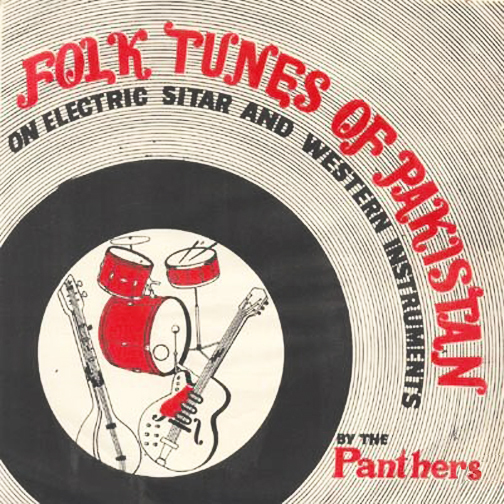
Back in December of 2008 when I posted a song by The Bugs from Pakistan, the floodgates opened. O.K., that’s a bit of an exaggeration, but I was contacted by a handful of musicians who had been in bands in Pakistan during the late 60s into the early 70s. Two of them – Ahsan Sajjad and Fasahat Hussein Syed – were in The Panthers.
Radiodiffusion Internasionaal: Most people don’t realize that Pakistan had such a great scene with quite a few bands. Besides The Bugs, The Fore Thoughts, The Mods, The Slihouettes and The Thunders, do you recall any other bands from that time?
Ahsan Sajjad: The bands were The Black Pirates, Talismen, In Crowd, Moonglows and an older band called The Keynotes before the surge.
RI: When and where did the band get together?
AS: We got together in the year of ‘67 in Karachi. It started with Norman and myself and then we went looking for other members. We had played around with different players but the two of us stuck together. When we released Folk Tunes and had a sit in, Javaid Allahditta, play the sitar we realized we had to go get a sitar player and make him a member. I had known Eric (bass player) for a while and had jammed with him. So I invited him to join us and to switch from lead to bass and then met Fasahat who played the sitar and was versatile on the keyboard. There was the formation of “The Panthers”.
RI: Who was in the band, and what instruments did they play?
AS: Norman Braganza on lead guitar and vocals, Fasahat Hussein on sitar, keyboard and tabla, Eric Fernandes on bass and Ahsan Sajjad on drums and lead vocals.
RI: Which record was recorded first, Folk Tunes of Pakistan on Electric Sitar and Western Instruments or East Goes West? Do you recall which years those records were released?
AS: Folk Tunes first and then in June 1969 EMI released East Goes West. East Goes West shows the versatility of the band. This was a well thought out record where local instruments and ragas were utilized as a modern day tune and to show the meeting of the East tunes and West beats/tempo. The bands ability and creativity also comes forth as they employ different beats in sync with the ragas. Sarangi is utilized an instrument that is a very much into the Indo/Pak culture as the intro to each of the three ragas has a very Eastern tone and creates a haunting melody.

RI: What type of venues did The Panthers perform in Pakistan? Was there a night club scene?
Fasahat Hussein Syed: The first performance of The Panthers was at “Mahapara” outdoors lounge at the swimming pool of Midway Hotel near the airport. We got a contract in the same hotel ballroom afterward. We also played at the Metropolitan Hotel, with some other bands (do not remember the occasion), played at San Patrick’s High School.
AS: Venues were limited… So most bands played at house parties and at the limited outlets.
RI: I recently saw a copy of The Fore Thoughts first single that was pressed in Iran. Did The Panthers ever perfrom outside of Pakistan?
AS: Never made it out of Pakistan. But performed and recorded for Radio Pakistan a tune that was used for their foreign broadcast. The music had to be danceable as that is how the public understood its fancy. But this was also in its infancy and was being perfected as it was being performed or as the target to learn harder songs grew.
RI: Fasahat, you said that The Panthers broke up when Ahsan left for America. That’s when you and Eric joined The Black Pirates with Bashir Balouch from The Fore Thoughts. How long were The Black Pirates together?
FHS: After Ahsan left for United States, Eric and myself joined The Black Pirates, we played for a fashion show in Metropolitan Hotel, we played at Adamji Auditorium at the Marine Engineers Graduation Party in 1970. I joined the Merchant Marines and left the country, group was broken up. After four years, I signed off from Merchant Marines and joined The Black Pirates again with some new members and played in Horse Shoe Restaurant Lounge on a contract. After the contract expired, group broke up again. I left the group to pursue a Marine Engineering Career and eventually migrated to United States in 1979.
RI: What have the members been up to lately? Are you still involved in music?
AS: Norman lives in Mississauga, Canada and is very much into Rhythm and Blues, performs guitar and sings at invitational parties and has put out a CD for friends, doing cover tunes. Fasahat plays keyboard and tabla with a fusion band called Tulsi out of Chattanooga, TN. Me, I am still honing my skills on the guitar. Have performed locally at invitations. Very much into Folk/Blues. Working on putting a performing band.
Thanks to Ahsan Sajjad and Fasahat Hussein Syed for their help.
Catalog number EKCE-20016 on EMI / Columbia Records of Pakistan, released 1969.
Filed under: Senegal
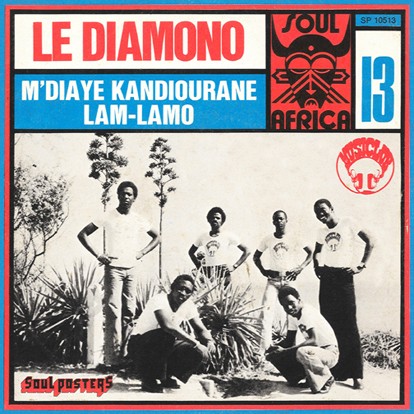
Senegalese popular music can be traced back to the 1960s, when nightclubs hosted dance bands that played Western music. Star Band was the most famous orchestre. After beginning by playing American, Cuban and French songs, Star Band gradually added more indigenous elements, including the talking tama drum and Wolof (Senegal’s predominant dialect) or Mandinka language lyrics. Star Band disintegrated into numerous groups, with Number One du Senegal being the best known of the next wave of bands, followed by the still active Orchestre Baobab.
In 1975, Omar Pene (also seen spelled Oumar Pène) formed Le Diamono in Dakar. The band fused mbalax rhythms and militant populism with blues, jazz and reggae influences. The other members at the time included Dama Faye (guitar), Baila Theophile (bass), Samba Dieng (keyboards), Almamy Bary (tenor sax, flute), Thierno Kouate (alto sax), Mamadou Mbengue (drums), Xalifa Fall (vocal, percussion), Baye Diagne (vocal), Bassirou Diagne (vocal), Papa Mboup (vocal, percussion).
Le Diamono released an album and this single in their first year, before changing their name to Super Diamono du Senegal, and then Super Diamono de Dakar. By the Eighties they had shortened it to Super Diamono, until recently when they became known as Omar Pene Et Le Super Diamono. They are still active to this day.
Catalog number SP 10513 on Musiclub/Soul Posters of France. No release date listed.
Filed under: Indonesia

Dangdut, Gamelan, Jaipongan, Krontjong, Orkes Gambus, Qasidah Modern… What is it about Indonesia that makes the music their so unique?
Indonesia is a very diverse country. Just about every one of the 17,508 islands has its own cultural and artistic history that are the result of distinct ethnic, linguistic, and religious groups. The archipelago has been an important trade region since at least the seventh century, when the Srivijaya Kingdom traded with China and India. Hindu and Buddhist kingdoms flourished, until Muslim traders brought Islam to the region.
The first Europeans arrived in Indonesia in 1512, when Portuguese traders sought to monopolize the sources of nutmeg, cloves and cubeb pepper in Maluku. Dutch and British traders soon followed. In 1602, the Dutch established the Dutch East India Company and became the dominant European power. Following bankruptcy of the Dutch East India Company in 1800, the government of the Netherlands established the Dutch East Indies as a nationalized colony.
All of these different cultures – both native and foreign – collided to produce an endless variety of amazing music. Much of it has been documented and recorded, but not all of it. Research by Indonesian and international scholars is still ongoing.
One of these variations was known as Instrumentalia, which was also popular in Malaysia and Singapore. Band 4 Nada, or “4 Tones Band”, were one of the first and more popular Instrumentalia bands in Indonesia. They took the instrumental rock sounds of The Shadows and The Ventures, and mixed it with other indigenous types of music, to create a new sound quite unlike anything else. Band 4 Nada were occasionally the backing band for singers such as Ernie Djohan, Lilis Suryani, Pattie Bersaudara and Titiek Sandhora. The main guy was A. Riyanto, who later went on to form The Favorite’s Group. Apparently, Jopie Item – of Trio Bintang – was a member at some point during the history of the band. Also, this album contains covers of several Koes Plus songs.
Catalog number SKL. 003 on Sakura Records of Indonesia Manufactured by Republic Manufacturing Co. Ltd (Remaco). No release date listed.
Filed under: Turkey

This week’s guest post is by Jonathan Ward. Much like myself, Jonathan is afflicted with a rare strain of obsessive-compulsive disorder known as “record collector-itis”. But his case is much more severe, being that he collects 78s. He has put this adversity to good use with the truly amazing Excavated Shellac. The writing on his site is consistently entertaining and well researched – and puts my barely coherent ramblings to shame. Be sure to check out his Dublab session – it’s the next best thing to having him come over to your house with a stack of 78s.
I was very happy when Stuart at Radiodiffusion asked me if I’d like to provide a guest post. First, because his blog is a fascinating source of hard to find international music, and second, because it brings me out of my little world of 78rpm records featured in my own Excavated Shellac. I thought I’d throw out an important Turkish single from the era of “Anadolu Pop” (Anatolian Pop) – the influential and groundbreaking style of Turkish rock which combined both psychedelic and progressive rock influences with traditional folkloric elements.
This genre of music has been discovered and exploited by various stateside and overseas reissue companies over the past five years or so – with good reason. It’s fantastic! I suppose the US-based craze started with three compilations, Hava Narghile (Dionysus), Turkish Delights (Grey Past), and a Turkish volume of the ongoing Love, Peace & Poetry series (Shadoks). Since then, Finders Keepers has released volumes by Mustafaz Özkent, Selda, and Ersen, Shadoks has released CDs of Bunalim and Edip Akbayram, World Psychedelic has reissued important LPs by 3 Hür-el, Bülent, Erkin Koray, and Moğollar.
But this doesn’t necessarily mean the genre is tapped out. Turkey was a singles-based music industry until the mid-70s or so, and there are lots of artists that haven’t yet gone through the hipster reissue machine (Bariş Manço, for instance, hasn’t gotten his US compilation yet – though Madlib’s brother Oh No has been sampling him for quite a while). One of these is the short-lived Ağri Daği Efsanesi.
Ağri Daği Efsanesi was an early-70s collaboration lasting just two singles, between Nejat Teksoy, a member of the garage-y rock band Mavi Işiklar, and the legendary Murat Ses, keyboardist and original member of the renowned band Moğollar (“The Mongols”), widely considered the founding fathers of Anadolu Pop (and inventors of the term itself). To understand the origins of Anadolu Pop, the first two groundbreaking LPs by Moğollar would be the place to start – and Murat Ses arranged the bulk of those songs. Moğollar ‘s first LP, released by Guilde Internationale du Disque in France and titled Les Danses et Rythmes de la Turquie d’hier á aujourd’hui under the French version of their name, “Les Mogol,” was released in Turkey under the name Anadolu Pop, in fact. On it, psychedelic rock mixed with saz and davul, keyboards and organ mixed with Anatolian fiddle playing – this was an album that helped spawn a whole movement.
Murat Ses stayed with Moğollar until about 1972. Sometime around this time he formed Ağri Daği Efsanesi, named after a track on the first Moğollar LP and meaning “The Legend of Mount Ararat,” while also contributing to singles by Bariş Manço (Lambaya Püf De) and Edip Akbayram (Kaşlarin Karasina) throughout the 70s. He eventually left Turkey in the late 1970s and moved to Linz, Austria, where he received both a Masters and a Doctorate in Economics. He continues to release music today.
Catalog number DT 5089 on Diskotur of Turkey, released 1972.
Filed under: Seychelles

The Republic of Seychelles, is an archipelago nation of 115 islands in the Indian Ocean, some 930 miles east of mainland Africa, northeast of the island of Madagascar. Other nearby island countries and territories include Zanzibar to the west, Mauritius and Réunion to the south, Comoros and Mayotte to the southwest, and the Suvadives of the Maldives to the northeast. Seychelles has the smallest population of any state in Africa.
While Austronesian seafarers or Arab traders may have been the first to visit the uninhabited Seychelles, the first recorded sighting of them took place in 1502, by the Portuguese Admiral Vasco da Gama, who passed through the Amirantes and named them after himself (islands of the Admiral). The first recorded landing and first written account was by the crew of the English East Indiaman Ascension in 1609. As a transit point for trading between Africa and Asia, they were occasionally used by pirates.
Formerly a colony of both Britain and France, The Seychelles has developed a distinct kind of music – incorporating multiple influences, including English Contredanse, Polka and Mazurka, French folk and pop, Sega from Mauritius and Réunion, Taarab, Soukous, Moutya and other pan-African genres of and Polynesian, Indian and Arcadian music. A complex form of percussion music called Contombley is popular, along with combinations of Sega and Reggae called Seggae as well as combinations of Moutya and Reggae called Mouggae and Montea which is a fusion of native folk rhythms with Kenyan Benga.
As for John Wirtz and Les Boys, there is not a whole lot of information available. They were both included on the Buda Musique compilation Music From the Seychelles – but not together. There’s one song by John Wirtz, and another by Pye (also known as Georgie Romain) & Les Boys. I have also seen Souvenir of Seychelles: The Best of John Wirtz and His New Les Boys on Ray’s Music Room. If you any information about the band, please contact me.
Catalog number TCE 1008 on Tam’s Cinema of Mahé, Seychelles. No release date listed.
Filed under: Mali

<p>
Much like the country itself, the music of Mali is very expansive. Most of the country’s 479,000 square miles lies in the southern Sahara. So there’s lots of space to wander and get lost. This geography has influenced the Mandé people who make up most of the country’s population, and their musicians, professional performers known as griots. Over the years, other influences have been incorporated to produce a uncommon sonic blend specific to this unique landscape.
At the end of World War II, the guitar become common throughout Africa, partially resulting from the intermingling of African, American and British soldiers. Dance bands soon became popular in Mali, especially the town of Kita‘s orchestra led by Boureima Keita and Afro-Jazz de S´gou. Imported European dances were popular, especially rumbas, waltzes and Argentine-derived tangos. But by the 1960s, the influence of Cuban music began to rise – and has remained popular to this day.
After independence in 1960, Malians saw new opportunities for cultural expression in the burgeoning media of radio, television and recorded music. Under President Modibo Keita, orchestras were state-supported, including the first electric dance band, Orchestre Nationale A, as well as the Ensemble Instrumental National, comprising 40 traditional musicians from around the country and still in operation today. Other influential dance bands included Rail Band du Buffet Hôtel de la Gare and Pioneer Jazz.
Le Kéné-Star De Sikasso were, as you might have guessed, from the southern most region of Mali known as Sikasso. They originally started out as Orchestre Regional de Sikasso, and released two albums, the first one in 1968 on Republic du Mali Radiodiffusion Nationale, and the second in 1970 on Bärenreiter-Musicaphon. They also were included on a 1973 compilation called Panorama du Mali on Mali Music.
The album that is posted here, their only release credited as Le Kéné-Star De Sikasso, was later re-issued on cassette in the Eighties, and was entitled Lala. The members of the band for this recording were François Ballo, Cheick Sabibou Diabaté, Mamadou Diakité and Mamadou Touré among others who are uncredited, and was produced by Boubakar Traoré. Also, the first song on this record, “Hodi Hu Yenyan”, as well as the two songs from the Panorama du Mali compilation – along with songs by Orchestre Régional de Kayes and Super Djata Band – were included on the Mali 70 – Electric Revolution compilation released by Discograph / Syllart Productions.
Catalog number KO 77.04.16 on Mali Kunkan, released 1977.
<p>
Filed under: Philippines

<p>
<p>
For our second guest post here at Radiodiffusion Internasionaal, we have an entry by Greg McWhorter. Besides being a collector of records and ephemera, Greg founded Artifix Records – dubbed “the archaeologists of punk” by Johnny Stingray of The Controllers. Artifix Records mission is to reintroduce bands (a few I remember quite well) like The Bags, Catholic Discipline and White Flag to a new generation.
During the early 1960’s the instrumental bands reigned supreme throughout the Philippines club scene. Clubs with names like Wack-Wack, The Sky Room, Circuit, and Rufino Building Penthouse were host to events that featured these new instrumental groups. As mentioned in a prior post, these bands were heavily influenced by The Ventures and The Shadows and often did covers by those groups while working their own originals into their sets. The Hi-Jacks were no different, but perhaps were one of the more energetic of this new breed.
The Hi-Jacks started at the beginning of the 1960s and began releasing vinyl almost immediately. They were managed by Eddie Mesa, who was known as the Filipino Elvis. Mesa had huge success in a string of rock’n’roll records and movie appearances during the 1950s and 1960s. When he first managed the Hi-Jacks, the band mostly played and recorded covers of popular instrumental rock as well as their originals in the same vein. After The Beatles penetrated Asian radio in 1963, Mesa started using the band as his personal backing band for his recordings of Beatles songs and similar originals.
The band was fronted by Rudy “Nonoy” Jereza who played bass. Jereza is deceased now, which has prevented the band from doing reunions; although the other existing members rally around legendary Pinoy guitarist for the group, Ben Tesoro, to play sets of the group’s music at revivals. Other members throughout the years included Eddie Dizon on drums, Jesse Manahan on keyboard, Eddie Nicolas as a later vocalist (deceased), and Bert Buencamino as a second guitar. Buencamino was originally with The Moonstrucks during the 1960’s and joined the Hi-Jacks in the early 1970’s. The Hi-Jacks lasted until 1974.
Although the band released records on several different labels like Top Tunes, Alpha, and ANS; their first single was on the Dyna Records imprint. Dyna was the independent label that also broke other notable acts from the time like The Electromaniacs and Ramon Jacinto and the Riots.
Catalog number DN-7302 on Dyna Records, manufactured by Dyna Products, Ltd. in the Philippines. No release date listed.
Filed under: Morocco

Chaabi (popular) is a music consisting of numerous varieties which are descended from the multifarious forms of Moroccan folk music. Chaabi was originally performed in markets, but is now found at any celebration or meeting. Chaabi songs typically end with a leseb, or swift rhythmic section accompanied by syncopated clapping.
A sophisticated form of chaabi evolved in the 1970s competing with popular Egyptian and Lebanese music. These chaabi groups consisted of a lute and a hadjuj, with some form of drum. Eventually, new instruments like buzuks and electric guitars were added. The three most important early groups were Lemchaheb, Nass El Ghiwane and Jil Jilala. All three bands featured politicized lyrics that got the songwriters in trouble with the government.
As for Jil Jdid… They were apparently based in Belgium at the time of this recording. But other than that, I have not been able to find any information. If you know anything about the band, please contact me.
Catalog number ST-454501 on Atlas International of Belgium, manufacture and distribution by R. C. P. Int. No release date listed.
 Radiodiffusion Internasionaal Annexe