Filed under: Ethiopia

Obsession. That is the word that describes Francis Falceto. He is the man behind the twenty three volume, and counting, Éthiopiques series on Buda Music. In April of 1984, a friend of his lent him a copy of a Mahmoud Ahmed album. A month later, he went to Ethiopia. Although it would be over a decade before the Éthiopiques discs started showing up in record shops around the world, he was responsible for the first release abroad of modern Ethiopian music with the reissue of Mahmoud Ahmed’s 1975 album “Erè Mèla Mèla” for Crammed Discs in 1986. But it is surprising, that in the span of the twenty three discs and two DVDs that have been released since 1997, that there is still plenty of territory that has yet to be covered.
The music of Ethiopia is the result of a very specific series of events. First, there is Emperor Haile Sellassie’s visit to Jerusalem in 1923. While he was there, two significant things happened: He heard brass band music for the first time and he met the “Arba Lijoch”. The “Arba Lijoch” were a group of forty Armenian orphans (Amharic “forty children”) living at the Armenian monastery in Jerusalem, who had escaped from the Armenian genocide in Turkey. They impressed Haile Selassie so much that he obtained permission from the Armenian Patriarch of Jerusalem to adopt them and bring them to Ethiopia, where he then arranged for them to receive musical instruction. They arrived in Addis Ababa on September 6, 1924, and along with their bandleader Kevork Nalbandian to become the first official orchestra of the nation. Nalbandian’s nephew, Nerses Nalbandian – who was a composer, arranger, chorus leader, and music teacher, would go on to become a core person to develop modern music in that country. Throw in Peace Corps volunteers bringing records from America, as well as the American military radio at Kagnew Station in neighboring Eritrea broadcasting the latest R & B, Soul, Rock and Pop hits, and you have a potent combination of influences that produced one of the most unique musical movements found in any country at that, or really any, point in time.
But all of that ended in 1975, when the Derg ousted Emperor Haile Selassie from power. The Derg, which means “committee” or “council” in Ge’ez, is the short name of the Coordinating Committee of the Armed Forces, Police, and Territorial Army and was a communist military junta led by a committee of military officers. Under their rule, the nightlife of Addis Ababa faded away and the record labels disappeared. The musicians were unable to leave the country, since emigration became almost impossible and they needed an exit visa to leave the country. The music may never have left Ethiopia, if it were not for the few vinyl records that managed to find their way out into the rest of the world.
The only information that I have been able to find about Tezera Haile Michael, is that he was primarily a songwriter and arranger, who’s songs that were recorded by Bezunesh Bekele, Mahmoud Ahmed (on all of his self released singles) and Tilahoun Gessesse. I have also seen him credited as a back up singer for some of the early recordings of the Imperial Body Guard Band, who are the backing band on this record. As far as I know, this was his only recording where he was the featured vocalist.
Catalog number PH 7-161 on Philips Records Ethiopia. No release date listed.
Filed under: Vietnam

One of the more frustrating things about the internet, is that sometimes there is too much information. But you can’t find the answer to your question, being led in about a billion directions at once. What you were looking for could right under you nose… But you would have no idea. Even if you are able to find a fragment of some kind of information, you may not be able to decipher it.
Researching the music of Vietnam on the web is a good example of this. There is almost no information in the way of biographies or articles from that time period (1963 – 1975). But then you can find literally hundreds of videos on YouTube and DailyMotion. And it doesn’t help that you almost have to already know Vietnamese to be able to use the online translation program.
But since the last posting on Hūng Cuōng, some information has turned up. Apparently, he is alive and well living in “Little Saigon” (not sure if that is the Orange County “Little Saigon” or the San Jose “Little Saigon”), California in the United States. His granddaughter and grandson have also started a MySpace page for him. He still performs live, occasionally with Mai Lệ Huyȇn̅ . They even have re-recorded this song, and made a video for it.
Other than that, all I have be able to find are some great songs by both Hūng Cuōng and Mai Lệ Huyȇn̅, played over footage of the South Vietnamese Military here and here.
Thanks to Greg McWhorter for the information.
Catalog number M.3671.72 on Viet Nam Records. No release date listed.
Filed under: Algeria

The Kabyle group Agraw consisted of two Algerians: Boudjema Semaouni and Hassen Zermani.
Boudjema (also spelled Boudjemâa) was born in Semaoun, Algeria in 1952. He began his career as a singer for Radio Berber Channel 2 and released a single for the Vogue label before moving to Paris in 1980.
Hassen Zermani, is better known as Takfarinas. He was born in Tixeraine in 1958. Takfarinas took his name from the Ancient warrior of North Africa – Tacfarinas (which is how his name is spelled on this record) – who fought against the presence of the Romans in Algeria. He formed first band was band in Algiers in 1976, and three years later moved to Paris to record a solo album titled “Yebwa Reman”. That same year, he met Boudjema Semaouni and the group Agraw was formed.
The band only released two albums before going their separate ways in 1984. Both records were produced by Idir, who also played flute on their recordings, and released them on his Azwaw label.
Boudjema Semaouni kept the name of the band, and became known as Boudjema Agraw. He continued recording, replacing Takfarinas with Karim Tizouiar – who went solo soon after. Boudjema currently lives in El Kseur, Algeria.
Takfarinas had a successful career in the Eighties. He became most recognized for playing the ‘takfa’, which is based on a traditional lute-like instrument which he modified by adding a second neck. He still lives in France, where he records and even has his own website.
Thanks to Anis Bousbia and Hicham Chadly for their help.
Catalog number AZW200 on Azwaw Records of Paris, France. No release date listed.
Filed under: Dahomey

♬ Se Djro
I have always been amazed by the sheer volume of great records from Benin. For a country about the size of a postage stamp (actually 43,483 square miles – but small nonetheless), the country formerly known as Dahomey produced major bands like Orchestre Poly-Rythmo (who released somewhere around 150 records) as well as many lesser known bands that released one or two singles. Unlike Nigeria and Ghana, where Highlife was the most popular form of music, the music of Benin was much more raw.
One of the best compilations to capture the sound of Benin, as well as neighboring Togo, is “African Scream Contest” on Analog Africa. In the liner notes, Samy Ben Redjeb explains how the musicians of the region integrated regional and foreign influences to produce a sound unlike anywhere else.
Like most modern music in French-speaking West African countries, the music of Benin and Togo was influenced by a few main musical currents: Cuban, Congolese and local traditional music, as well as Chanson Francaise. Additionally, the geographical location Benin and Togo – sandwiched between Ghana and Nigeria – exposed Beninese and Togolese musicians to Highlife music.
Benin’s two primary music importers – Afissoulai Lowani and Gbékin Hilaire, the founders of the labels Aux Ecoutes and Voix Africaine, respectively – were chiefly responsible for the development of the distribution channels for importing music into Benin, Highlife was imported from Accra and Lagos via the Philips and Decca record companies. Congolese rumba arrived from France via Khan (based in Marseille) and Sonodisc (based in Paris), as well as direct imports from Kinshasa and Brazzaville.
Cuban records were imported from New York and Miami via distribution plants in Abidjan. Chanson Francaise (especially Charles Aznavour and Johnny Halladay) was imported from France; French music was taught in schools and constantly played on national radio.
The cultural and spiritual riches of traditional Beninese music had an immense impact on the sound of Benin’s modern music. Benin is the birth place of Vodun (or, as it is commonly known in the West, Voodoo) and some of the rhythms used during traditional rituals – Sakpata, Sato, Agbadja, Tchenkoumé and many others – were fused to Soul and Latin music on early as the mid-60s and Later to Funk. Vodun was formally recognized by the Government of Benin in February 1996, and Ouidah remains its epicenter Ouidah is also home to a large Brazilian community – or, as they are called in Benin – Agoudas. Members of that community are descendents of slaves who returned from Brazil at the end of the 19th Century. Their dances (such as Kaléta and Buriyanii) and songs are still being preformed and fused into Beninese rituals. That, too, can be heard in modern Beninese music. Performers such as Ignace De Souza and Charles Rodriguez are Agoudas.
By 1968 a few labels – Albarika Store, Poly-Disco, Gretaissy and Aux Ecoutes – started recording local musicians using Nagra reel-to-reel recorders borrowed from the national radio station. The reels were then to Ghana, Nigeria, Belgium or France, where the matrices were manufactured and the vinyl pressed and released on such labels as Philips, Badejos Sound Studios, Songhoi, Riveria, etc. The first Benin artists who started recording were G. G. Vickey, Gnonnas Pedro, Picoby Band and Super Star de Ouidah, followed by El Rego, Sunny Blacks Band and Ignace De Souza.
In the late 60s Funk and Afrobeat started creeping into the region. In particular, the music of James Brown became immensely popular with university students. That’s when the music scene in Benin really started to take off. Most, if not all of the groups, started fusing all the genres mentioned above into a very distinctive sound that can only be found in that country, and made Benin into an incredible music melting pot unequalled in Africa. Bands combined Latin with Soul, Sakpata with Funk, Sate with Afrobeat, Punk with Break Beat – you name it and they probably tried it!
Other than the fact that Orchestre Black Dragons were from Porto-Novo, there is not a whole lot of information about them. They did release two other singles, both on the Albarika Store label. The song “E Sa F’Aiye” was included on the compilation “Off Track Vol 2 – Queens” which was put together by the crate diggers Kon & Amir.
Catalog number ASB 85 on Albarika Store of Cotonou, Dahomey, pressed in Lagos, Nigeria. No release date listed.
Filed under: Singapore

♬ a) New Year’s Greeting / 王小二拜年 b) Happy New Year / 賀新年
♬ a) Congratulations / 恭喜恭喜 b) Winter Jasmine / 迎春花
The Travellers were from Singapore. They were part of the Non-Stop Dancing Music scene that also produced The Stylers.
My first introduction to The Travellers was on the questionable compilation entitled “G. I. Funk” on the Payback Recordings label. The song was listed as “Slow Soul” (It was also included on the “Dusty Fingers Vol. 12” compilation, released by Strictly Breaks). Who ever transferred the song, did not bother to learn the real name of the song, instead only listing the track by it’s dance style. On the Non-Stop Dancing Music records, medleys of songs are group by their dance style, A Go-Go, Cha Cha, Bolero, Fox Trot, etc. But the title of the song is actually “Smiling Face, Flushing Heart”.
I have not been able to find hardly any information about the band. I do know that they, as well as The Stylers, would occasionally back singers like Chang Siao Ying on their recordings. But other than that, there is just a few sites with their records here and there.
In 2003, Singapore’s Media Development Authority (MDA) commissioned a six-part series documentary for television on the Singapore music scene from the 1960s to the present day, entitled Jammin’. If anyone knows how I could get a copy of that documentary (especially the first two episodes), I would greatly appreciate it.
If you any information about the band, please contact me.
Catalog number MEP-9048 on Victory Organisation of Singapore. No release date listed.
Filed under: India

♬ Santa Clause Is Coming To Town
Even though it is sometimes referred to as Hindustan, not everyone in India is Hindu. Granted, over eighty percent is Hindu, and another thirteen percent are Muslim. As of a 2001 census, only 2.341% are Christian. But, that’s still over twenty four million people. That being said, India is not exactly the first place that pops into your mind when it comes to Christmas Music.
All I have been able to find out about Jayram Acharya, is that he released an album entitled “Sitar Goes Latin” with Enoch Daniels (who is credited for the arrangements on this record) in 1969. Also, a single with “Santa Claus Is Coming To Town“ and “White Christmas“ was recently issued on the British Jazzman label.
Here are the liner notes to the record:
Come December, a strange spirit pervades in every corner of the globe – the spirit of Christmas. The universality of this spirit brings us closer to the oft dreamt concept of one world.
An integral part of Christmas is the Christmas music which, over a period of centuries, has also acquired global popularity.
Four of the most popular Christmas songs which, centuries ago, originated in the Western World, are presented on this disc on a musical instrument of India, the sitar, which is also originated centuries ago. While the Christmas songs reached India several centuries ago, it is only now, several centuries later, that the sound of sitar has reached the Western World and is considered the most exciting sound of today.
Christmas music on the sitar – a memorable presentation for a memorable occasion.
Catalog number EMOE. 503 on Odeon / The Gramophone Company Ltd., released 1967.
Filed under: Israel

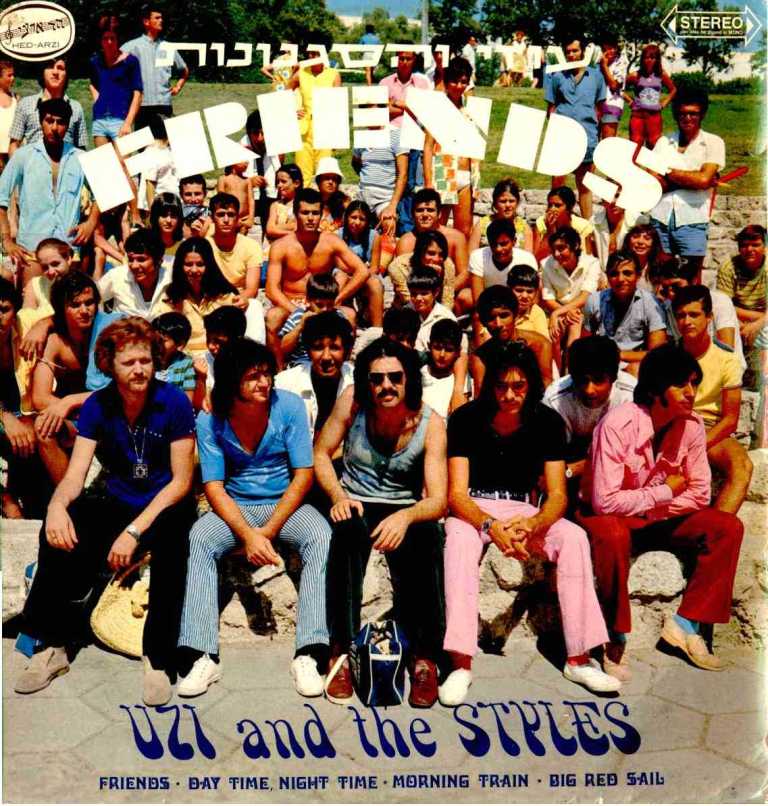
Up until 1967, Israeli popular music was largely based on Russian Folk Music, French Chansons, Argentine Tango and more “Easy Listening” fare. But all of that changed after the Six Days War in June of 1967, when students, tourists and volunteers began to arrive in The Holy Land, bringing with them musical equipment, record collections and most importantly hippie culture. The result was an emergence of a number of Beat groups who had their first opportunity to perform in a small but lively discothèque scene.
The Styles were founded the following year in 1968 by Itzhak Klepter (who had played in The Churchills), Avi Karpel (from The Spiders – no relation to The Spiders from either Japan or Singapore) and Meir Israel (The Monks – and no, not The Monks as in “Black Monk Time“). Their first performance was at the 1968 Battle of the Bands, along with The Blue Stars, The Fat & The Thin, The Mosquitoes, The New Stars and Tel Aviv Express. The Styles were the only band to sing in Hebrew at the event, where they took third place. First prize went to The New Stars and their lead singer Uzi Fuchs (a.k.a. Uzi Fux). After leaving The New Stars, Fuchs sang for The Fat & The Thin briefly before joining The Styles in 1969 – thus becoming Uzi & The Styles.
That same year, a British group called Revolver (no relation to the current band by that name) came to Israel on tour. After which their keyboardist Abe Orchover and songwriter Tony Price decided to stay behind and join the band. The two Englishmen were the main influence over the band’s material and soon they recorded Manfred Man‘s “Daytime Nighttime” which became a big hit. They followed that with a three song EP with “Morning Train”, “Someday” and “Where Were You Last Night?” – all of which were hits. Due to the EP’s success, it was licensed as a single to record labels outside of Israel, in Belgium, England, France, Germany, The Netherlands, Spain and the United States.
In 1970 they recorded their first and only album, “Friends“. The album was recorded and sung in entirely in English, and is still considered one of the greatest albums in Israeli music history. But, the band broke up soon after the album was released. In 1990, They played a single reunion show in Israel.
Catalog number 07.769 on Belter of Spain, released 1970.
Filed under: Thailand

Occasionally I will come across a record that produces more questions than it answers. This album definitely falls into that category…
I often wonder who was the intended listener? Who was it that ‘They’ – ‘They’ being the record company or musician or the powers that be – thought would want to buy this record? Was it intended for tourists or the local populous? Was it even available in Thailand, or was it only released somewhere else, in another country? Who knows?
The real puzzle is that one side of the cover is entirely in Thai, while the other side is in English with Chinese subtitles. There were only two phrases that were on the front that are not on the back: สงวนลิขสิทธิ์ , which translates to “copyright reserved” and วงดนตรี มาริเนอร์, which – to the best of my knowledge – translates to “Orchestra Maaríner”.
I have not been able to find any information available about Orchestra Maaríner – if indeed that is the correct name. When I got this record, I did not know what to call it. So, I opened up the Unicode character pallet, and tried to recreate the Thai text – with full knowledge that it was probably wrong. When I did not hear back from the person who usually translates Thai for me, I figured I would just try and see what the Thai to English translator had to say with the words I had pieced together. And it worked! Well, at least three of the four words that I tried to translate. I am still not too sure about that “Maaríner” bit… The record was most likely recorded by studio musicians and manufactured in Singapore. If you any information about this record, please contact me.
Catalog number LST-121 on Mervels Records, although the other side of the cover says Lily Records Company. No other information available.
◄●►◄●►◄●►◄●►◄●►◄●►◄●►◄●►◄●►◄●►◄●►
Since this posting, I have been contacted by Peter Doolan, who curates the blog Monrakplengthai. Here’s what he had to say:
… The song you posted (and the title of the album) is “สาวบ้านแต้” (Sao Ban Tae). It was a very popular Ramwong, or rural folk-style dance which, if I’m not mistaken, is from a 1968 film of the same name. It was originally sung by เลิศ ประสมทรัพย์ (Loet Prasomtarap) and ศรีสุดา รัชตวรรณ (Sisuda Rattawan), two prominent singers of the famed Suntarapon big band. Needless to say, this is not the original, and your hypothesis seems likely to be very close to the mark! The arrangement sounds not-very-Thai (particularly the flute and string), although there is what sounds like a khim (Thai hammered dulcimer) in the background. Overall, this seems to be one of the many “Melodies of _____” sort of instrumental records floating around in that era (Rene Paulo springs to mind…). Very nice band though… Oh! and if you hadn’t figured out, มาริเนอร์ is the Thai transliteration of the English word ‘mariner’. I’ve never heard of this orchestra! You can listen to the original here.”
Filed under: Zaïre

♬ Save Me
♬ Sookie
Docteur Nico & L’Orchestre African Fiesta were from Zaïre, which is now known as the Democratic Republic of the Congo.
Hailed throughout Africa as “Le Dieu de la Guitar” (“The God of the Guitar”), Nicolas Kasanda wa Mikalay was born on July 7th, 1939 in Mikalayi in the Kasai province of what was then the Belgian Congo.
In 1950, at age 11, Nico was introduced to Opika Studios by his cousin Tino Baroza and older brother Mwamba Déchaud who were session musicians there. At 14, he joined Joseph “Grand Kalle” Kabaselle‘s African Jazz. In 1957 he took up electric guitar and can be heard playing electric guitar on ‘Sophie Ya Yotema,’ recorded in 1960. In 1961 he temporarily split with Kabaselle and formed African Jazz Aile Nico before returning to Kabaselle in 1962 and 1963. Young Nico graduated with honours from high school and went on to college, while keeping his night job as Leopoldville‘s hottest young guitarist. He taught auto mechanics at the Christian Brothers school in N’djili district, Kinshasa, which earned him the nickname ‘Docteur’.
Nico quit teaching and broke away from African Jazz to form L’Orchestra African Fiesta in 1963 with Tabu Ley Rochereau, brother Déchaud, Kwamy, Mujos, Depuissant on conga and bassist Joseph Mwena. The band was joined by Roger’s brother Faugus Izeidi on third guitar, with both Dominique “Willy” Kuntima and Jeef Mingiedi on trumpet. Rochereau split two years later in 1965 to form African Fiesta National.
In 1969, the entire band, except his brother Déchaud, walked out Nico because they felt they weren’t getting their due. The Docteur quickly assembled a new band that included Josky Kiambukuta and Lessa Lassan on vocals. Bopol Mansiamina joined on guitar in 1970 and they kept it together for a few more years.
Success eluded Docteur Nico. He withdrew from the music scene in the mid 1970s following the collapse of his Belgian record label, and made a few final recordings in Togo. He drank heavily, leading to his early death in a Belgium hospital on 22 September 1985.
The two songs here, are credited to Bovick (a.k.a. Bovick Ye Bondo) who was also known to record with Verckys Kiamuangana Mateta’s Orchestre Vévé. He sang on their version of the Shocking Blue song “Venus“.
There is a complete discography for Docteur Nico here.
Catalog number SAF 50007, Sonafric records of Paris, France. No release date given.
Filed under: Pakistan

Where as the music of Bollywood has only just started to break into the mainstream here in The West, the music of Pakistan’s film industry – sometimes referred to as “Lollywood” – is often overlooked. Much like their neighbors in India, the music plays a significant part of the film.
After the partition of India, the city of Lahore was the only film production center in the newly-founded Pakistan. The first film was titled Teri Yaad, and was released on August 7th, 1948. Since then, film production studios have been opened in the cities of Karachi and Peshawar.
The film Do Raha was originally produced in 1952, and then remade in 1971 with a new score from Sohail Rana – although all of the information that I have been able to find (other than what is printed on the label of this record) says that duo of Sapan Chakraborty and Jagmohan Bakshi scored the film and that the film was supposedly produced in India.
The Bugs probably were not a real band. They were most likely a studio creation, that may have even been part of the film. As far as I know, this is there only release – and they are only featured on one side. The flipside is the original version of the theme song from the film.
If you any information about the band, please contact me.
Catalog number 7KCE-5000 on Columbia Records of Pakistan. No other information available.
◄●►◄●►◄●►◄●►◄●►◄●►◄●►◄●►◄●►◄●►◄●►
Since this posting, I have been contacted by Jimmy Jumshade, who was the drummer of the band. Here’s what he had to say:
Thanks for writing and your research into that Era! Indeed those were the most fantastic days of Pakistan when Pakees were not over-dosing on Religion! We did make a couple of recordings at the only record Company then, I forget it’s name (HM something).
At that time the only 4/5 star Hotels in Pakistan (InterContinental) opened and they only exclusively engaged foreign bands, mainly from Italy. We were the first local band hired to perform at that chain.
We did instrumentals and also songs of that day. Mainly The Beatles, Rolling Stones, The Animals, Creedence Clearwater Revival, The Shadows, The Ventures, Tom Jones, Englebert Humperdink, Gerry & The Pacemakers, The Eagles and some Pakee folk songs / instrumentals.
You got the bands at that time right. There also were “THUNDERS”… Of course The Four Thoughts were very, very talented and popular, I saw several times, Benazir dancing to them at the famous Disco in Metropole Hotel. Zulfiqar Ali Bhutto was one of our fans. So was Yahya Khan and his son. So was Marlon Brando who was thrilled at our performance, when he visited Pakistan…
The four members of “THE BUGS” were:
Farooq Fatah: Lead Guitar (Now in Toronto)
Ayaz Fatah: Rhythm Guitar (alive and well in Toronto)
Afzal Javeri: Bass Guitar (Who died about a decade ago)
Myself: Drummer (settled in Dallas, Texas)
Amazing time we had like Rock Stars. We also travelled to the music and art loving people of that time East Pakistan (now Bangladesh) where we were welcomed like heroes and we had the best time of our music days… We were good friends with late Waheed Murad and others of the film lndustry and all Pakistanis loved and enjoyed our “make-u-dance” music not only foreigners. We had a large following of Swedes, in Lahore. We also performed at Shahbagh Hotel, Flashman’s at Islamabad, Rawalpindi and Faletti’s in Lahore.
 Radiodiffusion Internasionaal Annexe