

Filed under: Turkey

♬ Adanali
Turkey has a long tradition of musical talent to begin with, and being Europe’s crossroads into Asia, the whole phenomenon of East-meets-West hybridization (in this case, traditional Anatolian folk and ’60s pop) makes for some amazing music that couldn’t come from anyplace else. In the last few years there has been a few great compilations and a handful of albums that have been re-issued.
Here is a really good overview of the evolution of the music scene in Turkey, written by Gökhan Aya:
“Turkish rock’n’roll scene started as early as 1956 and blossomed by the arrival of The Shadows. It is very important to underline the influence of The Shadows because the missing essence which held the rock music from being popular in the first years was the problem of language. As Turkish did not have any roots in relation to English it was really very hard to understand what rock’n’roll was all about. The Shadows served very good as the nation was very used to listen to instrumental music. It also should be noted that 60’s marked very rapid changes in Turkey: year by year general level of culture was increasing, by 1961 the most democratic period of country started and by every year, as far music’s concerned, record sales were geometrically multiplying.
“The Shadows reigned heavily until The Beatles came along and that blew up everything! There was such a blasting of bands that one of the biggest national newspapers called Hürriyet decided to organise a big contest that would help the young amateur bands have their names heard throughout the country. But, what the contest organisers wanted was interesting: the musicians who wanted to attend the contest had to either compose songs in Turkish or arrange a traditional tune. Also they had to perform this in a western style with electric western instruments! The ones who ware finalists ware to perform live In many cities that the newspapers arranged a tour for them. If Altin Mikrofon had not been assembled, we wouldn’t likely to be talking about 60’s & 70’s Turkish rock scene.”
Between 1966 and 1968, they recorded five singles, two of which were for Altin Mikrofon (Golden Microphone) contests. This song is from their second single which was part of the 1967 contest, and their third single was in the 1968 contest.
Catalog number H-019 on Altin Mikrofon of Turkey, released 1967.
Filed under: Kenya

Madico were from… Well, I’m not sure.
The person who sold me the record said that they were from Kenya, which is where the record says it was manufactured in the small print.
But, the language listed on the label says “Lingala”, which is spoken throughout the northwestern part of the Democratic Republic of the Congo (formerly Zaïre) and a large part of the Republic of the Congo, as well as to some degree in Angola and the Central African Republic.
I guess that they may have been from Angola, due to the song’s title. But if that was the case, the record would have been pressed either in that country or Portugal. Similarly, if they had been from the Democratic Republic of the Congo or the Republic of the Congo, the record would have been pressed in France. So that leaves the Central African Republic… But then why would the song have Angola in the title?
If you have any information, please contact me.
Catalog number PEA 200 on Pathé Records, manufactured in Kenya. No other information available.
Filed under: Indonesia

Dara Puspita (Flower Girls) was Indonesia’s most successful girl band of the 1960s. While there were many popular female vocalists in Indonesia at that time, they nearly all relied on the services of a backing band. Dara Puspita was one of the few girl groups who actually played all their own music as well. Comprising Susi Nander (the drummer, who was featured on the cover of this single), Titiek Hamzah, and sisters Titiek A.R., and Lies A.R., they formed in 1964, after being inspired by ‘The Beatles‘ sound. With all of them still in their late teens, they initially faced parental objections, but soon won them over. Apparently, when on stage, these girls had the habit of jumping up and down while shouting, such that their lyrics were often inaudible.
Over at Toshi’s A Go Go Asian 60’s Beat • Pretty Flamingo 2 site, he has an interview with Mr. Anthena Leo, who was a friend of Titik Hamzah during the time the band was active. Here is an excerpt:
Because their style was referred to as “A Go-Go” or “Twist” it was considerably unusual then, they hit the top seat and became pop icons among young people in the blink of an eye at that time. In 1966, they had performed in Bangkok before they made their debut in Indonesia, and you can listen to some works based on their memories of Bangkok in their first and second albums.
Dara Puspita started on a journey to perform in Europe immediately after they released their 4th album. They kept touring in many countries such as Iran in the Middle East, West Germany, Turkey, Hungary and other countries for 1 year and 3 months. Until they came back to Indonesia in October, 1969, they performed 250 concerts held in 70 cities total.
Collin Johnson, who was an initial manager of the Beatles, just appeared in front of them in those days. At Collin’s request, they went to Britain at once and debuted with “Welcome To My House/I Believe In Love,” but it did not become a hit. 2nd EP “”Ba Da Ba Dum/Dream Stealer” did not become a hit, either. Drummer Susy Nander looks back at that time, saying “No one will be sure to buy the record of the unnamed female band like us”.
In concerts held in Britain, they mostly performed as an opening act for top groups such as Uriah Heep and Shocking Blue. They also toured to France, Belgium, Spain, and the Netherlands. They were very welcomed in the Netherlands. Everyone seems to have cried when they performed a song “Surabaja” from their first album. (It could be because Indonesia was a colony in the Netherlands for 360 years.) One single phonograph record put on the market in the Netherlands included an English version of “Sjurabaja” as A-side and “Cabaleuro” as B-side, which were the most popular at their concert.
Afterwards, they returned home to Indonesia, the triumphant return performance of the stadium class was done, and their popularity faced its peak. I still remember that in the concert, Titik Hamzah who was the bassist and the chairperson said honestly “We debuted in foreign countries, but we failed…” while talking about the story of life in foreign countries. When I heard her sincere comment toward her experience, I felt like assisting them more and more.
Later, Titik Hamzah told me that dissolution already seems to have come out in Dara Puspita before they returned to Indonesia even though it was made secret. Actually, the idea of dissolution was from her, Titik Hamzah, who was the most talented of the four. While the other 3 members said “Let’s continue because we are still popular,” Titik insisted “It is boring to keep playing songs by others. We should dissolve our band while we are popular.” Finally, as a result of the fact that the other 3 members couldn’t persuade Titik, dissolution was announced from their mouths on the final day of their triumphant return concert. Even though there had been a rumor of dissolution, the impact was still huge and all of the fans felt sad when we heard it…
After years, Titik A.R, the lead guitarist of the band, formed a reunion band with the original drummer Susy Nander, a new bassist Judith and a keybordist Dora Sahertian.(I believe they released an album with these members). Neither Titik Hamzah nor Lies A.R participated in this reunion because they had already married.
Titik Hamzah, who had never forgotten to sing, returned to the scene later. She released 2 albums with drummer Susy Nander until it dissolved. The sound of this newborn Dara Puspita by Titik and Susy was different from the original Dara Puspita. In these records, they tried to play various genres of music together. “There was no will to make hit-songs then. I just wanted to show my zeal to music.” said Titik Hamzah afterwords…
By the way, the original 4 albums of Dara Puspita were released only in record format not even in cassette format. There have been no re-issued versions so far. According to Titik Hamzah, once, the father of Titik A.R. and Lies A.R. tried to reissue them as cassettes, but it didn’t go well (Or Titik Hamzah refused) because there were a bunch of problems related to copyright. Therefore, it is very difficult to obtain Dara Puspita’s four original albums currently.
There is a good post on Dara Puspita, as well as songs from their first two albums at Garage Hangover. Also, Toshi has a gallery of most of Dara Puspita’s records here.
Catalog number BT-107 on Bintang records. No release date listed.
Filed under: Iran

Manouchehr is from Iran. I have not been able to find any information about him, except that his last name is either Sakhai or Sakhaie…
Unfourtunately, when Farsi is translated into English… You tend to get many different variations depending on who translated the text. For instance, I have seen multiple different spellings on the name Kourosh Yaghmaie (Yaghamaie, Yaghmayee, Yaghmaee…) as well as two totally different spellings for The Remarkables (Aajubehaa and Ojoobeha).
Thanks to Arash who runs a very informative blog on Iranian music on MySpace called Fars Funk. Keep an eye out for his compilation “Pomegranates”, which is to be released on the B-Music label.
Catalog number SARE-1045 on Ahang Rooz (which means “Song Of The Day”) of Iran, no release date given.
Filed under: Gambia

Anyone who has heard the song Love’s A Real Thing from Luaka Bop’s World Psychedelic Classics volume 3: Love’s A Real Thing will know why that song’s title was selected for the title of the compilation.
Here are the liner notes from the RetroAfric disc Senegambian Sensation (which for some reason, these two songs were left off):
The Gambian band Super Eagles were pioneers of popular music in the Senegambian region at the end of the 1960s / start of the 70s, delivering a progressive blend of afrocuban, pop, soul, bluebeat, Congolese rumba, highlife and ndagga music. Using Wolof lyrics and rhythms, ndagga is the basis of what was to become ‘mbalax’. During their five year existence, the Super Eagles became one of the best travelled bands in West Africa.
In Bathurst (now Banjul), the capital of this ex-British colony, the first modern dance band was a loose collection of musicians who played under the name African Jazz. Members included Badou Jobe, Paps Touray, Laha Sosseh (later to join Afrocuban outfits such as Africando), Modou Cham and Oussou Njie.
Jobe, Cham and Njie had started their careers with the Foyer Jazz Band, formed by veteran, partly classically trained musicians, which provided a rich cocktail of European & Latin ballroom music, light classical, old jazz and the hugely popular ‘morna’ from Cape Verde. The popular music scene, catered for by modern dance hands, had no connection with traditional music, which remained the exclusive domain of the hereditary musicians caste known as griots.
In 1965 seven of the African Jazz musicians turned full-time professionals as The Eagles of Banjul. They played regularly in Banjul’s dancehalls and throughout the country and their patron Malick Seck took them on international tours to Senegal and Sierra Leone. After Sammy Ndami left, Badou Jobe took over as bandleader, and increasingly defined the band’s repertoire by composing original music.
Eventually the core members regrouped in 1967 as the Super Eagles. Helped with a generous gift from diamond dealer Solo Darboe, they ordered instruments, amps and a PA from England. this independence enabled them to travel and play what they liked for whom they liked.
The front men of the new Super Eagles were solo guitarist / bandleader Badou Jobe, lead vocalists Paps Touray (seen in this photo) and Datida Njie (a.k.a. Edu Haffner) and guitar / keyboard wizard Francis ‘Senami’ Taylor. Other members were Modou Cham (tenor sax and congas), Oussou Njie (singer and lyricist), Charles Valentine (bass) and Malan Gassama (drums, percussion), who was one of The Gambia’s finest drummers.
Jobe assisted by Taylor formed the creative team behind most of the compositions and arrangements. The songs were mostly in Wolof or (broken) English with Touray providing some belting vocals in the style of Otis Redding – he was voted best soul singer of Africa – and the band’s compositions melded elements from the indigenous music of The Gambia, specifically Wolof and Mandinka.
The Super Eagles’ use of amplifiers, effects and electric keyboards to interpret African music laid the foundation for mbalax, which was popularised a decade later by Youssou N’Dour. In 1968, while touring all over the larger neighbouring country, the band earned acclaim as the top group in Senegal.
In 1969 they visited Europe and were the first Senegambian band to tour England, where they recorded their album Viva Super Eagles, the title track of which called on Gambians to unite in support of the group. At a memorable concert at the Commonwealth Institute in London the band was joined by Teddy Osei and Mac Tontoh, founders of Osibisa. The album was a hit throughout West Africa but, typically the musicians claim never to have seen a penny of the royalties.
Jobe and Touray deliberately disbanded the Super Eagles in 1972 at the height of their popularity. As pan-Africanists and music pioneers they felt the urgent need for an authentic African identity which led to the creation of the seminal roots hand Ifang Bondi (Be Yourself), since grown into one of West Africa’s leading bands.
In 1999 Badou Jobe Won the prestigious KORA All Africa Music Award – the African equivalent of the Grammy – for Best Arranger in Africa.
The song “Sock It To Me” was re-recorder by El Rego as “Feeling You Got” for the Legendary Albarika Store label in Dahomey (now Benin), which was the first hit for the label.
Catalog number FN28 Ghana Films Label FNS, manufactured and distributed by Decca. No release date given.
Filed under: Taiwan

I could find no information what so ever on Wu Jing Xian, who was to the best of my knowledge, from Taiwan.
This record has almost no English on it, with the exception of the song titles. I scanned it in, and e-mailed it to Menghsin Cindy Horng, who I had corresponded with in the past about Asian pop music… But she couldn’t find anything either.
Thanks to Menghsin Cindy Horng for her help.
If you have any information, please contact me.
There is no catalog number listed, but “吴 SM-1“ is engraved in the vinyl. It was released on Four Seas Records. No other information is available.
Filed under: Azerbaijan

Despite the fact that it was part of the Soviet Union from 1922 to 1991, Azerbaijan’s population mostly Muslim, with 70% Shī‘a and the remaining 30% are Sunni.
Surprisingly, Azerbaijan has a long history of jazz dating back to the first State Popular Orchestra in 1938. But during to Cold War, Soviet authorities dubbed jazz a “seditious western music” and jazz performances were officially banned. Despite the prohibition, jazz fans gathered in secret to listen to western radio stations and afterwards tried to play what they had heard.
In the late 1960s, jazz music began its second life in Azerbaijan with such composers as Gara Garayev, Tofig Guliyev, Rauf Hajiyev and Rafiq Babayev who formed Boкaльньiй Kвapтет „ГAЯ” or Vocal Quartet “Gaya”.
Rafiq Babayev later went on to become the conductor of the National Orchestra for the Azerbaijani National Radio and Television. Unfortunately, he was killedwhen a bomb exploded in a public transit train station in Baku, Azerbaijan on March 19, 1994.
Catalog number C 01735-36 on the Soviet state-owned and operated Μелодия (Melodiya) label. No release date listed.
Filed under: Ghana

♬ Hammatan
Tall Emma & His Skippers were from Ghana.
Unfortunately this record, like many singles from Africa, doesn’t have a picture sleeve. I can only imagine what they must have looked like.
The only information I have been able to find about this band is from a mention from an article by Miles Cleret from Soundway Records. While the single is credited to “Tall Emma”, the song writing credit is “Richard Tall Amma”. Also, the vocals are credited to Chester Adams, who went on to play in the Uppers International and the Kamela Band.
Hammatan is the Ghanaian Twi word for the cold dry air blows off the Sahara in the Winter.
If you know anything about them, especially if there is any more recordings by them, please contact me.
Catalog number DKN 231 on Obuoba of Ghana. No other information available.
Filed under: New Guinea

♬ The Kopy Kats • Meisi Emu Nega
♬ The Freebeats • Kekeni Ani Mase
When I started this whole thing, there were a few places I was sure that I would never find records from… Papau New Guinea was definitely on that list.
This record is of a somewhat questionable origin. There is no information about the three bands on this compilation: The Kopy Kats, The Freebeats and The Stalemates. All three suspiciously sound like the same band and most of the songs are covers like “Last Train to Clarksville”. “The Mighty Quinn” and the Scottish folk tune “Skye Boat Song”.
After I initially had posted this record, I was informed that The Freebeats were all Australians who had moved to New Guinea. The band consisted of Graham Dunich, Roy Turner, Neville Josey, Ray Michelle and Phil Neilson. They were originally know as The Statesman when they were based in Sydney, but changed their name after moving to Port Moresby at the invite of Graham Dunich who was already living there. The Freebeats supposedly did quite well, especially since they were known to translate popular songs into “Motu“, which was the local language. They were together for three years before they became The Combines in 1970.
Thanks to Bård Hodneland for the information.
Catalog number VP 318 on Viking Record Company Ltd of New Zealand. Recorded by the Australian Broadcasting Corporation, Port Moresby, New Guinea. No release date given.
Filed under: Lebanon
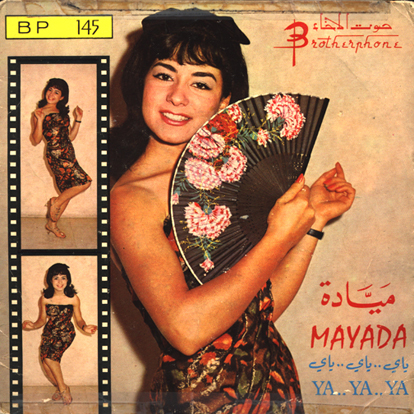
Mayada was from Lebanon.
Her sister was Taroub, who was a well known singer in both Lebanon and Turkey as well, and they both were of Turkish descent. Mayada had a very short lived career from mid to late Sixties, recording few singles and singing in night clubs in Beirut. From this single, you can hear an influence of the Yé Yé Girl movement from France.
Thanks to Hany Zaki for the information.
Catalog number BP 145 on Brotherphone of Beirut, Lebanon. No other information is available.
 Radiodiffusion Internasionaal Annexe
