Filed under: Ethiopia

Menelik Wossenachew was from Addis Ababa, Ethiopia.
There is not a lot of information available on him. He did record at least one other single for Ahma Records, with The All Star Band that was written and arranged by Mulatu Astatke.
Menelik Wossenachew was a member of the second incarnation of the Ras Band, which was lead by Girma Beyene. The Ras Band took their name, like The Ghion and The Shebelle Bands of the time, after the hotels that employed them.
The majority members of the first Ras Band came from the Haile Selassie I Theatre Orchestra, who was then led by the famous Armenian Nerses Nalbandian. These included Girma Beyene, Wodajeneh Felfelu, Assefa Bayisa, Tefera Mekonnen, Tilahun Yimer and Bahru Tedla. Up to 1955 the last three were also in the Imperial Bodyguard Orchestra Jazz Symphony under Austrian Franz Zelwecher. The first Ras Band stayed in this form until 1965 when the entire band, with the exception of Girma Beyene, went on to form the Ghion Band at the Ghion Hotel.
Girma Beyene, was a lyricist, a music writer, an arranger, a vocalist, a pianist and bandleader. To most, if any name comes to mind with the word arranger, it is probably that of Mulatu Astatke. Yet, according to Ethiopiques Series producer Francis Falceto, in the heyday of vinyl records, Girma Beyene is credited to having arranged close to 65 titles, compared to Mulatu’s 40. Girma left a handful of recordings as a vocalist, but it was as an arranger and pianist that he is most remembered.
After leaving the second incarnation of The Ras Band, Girma Beyene was in The Girmas Band with Girma Zemariam for a brief period before forming The All Star Band in 1970. It members were for the most part taken from two popular bands, the second Ras Band, and The Soul Ekos Band with Menelik Wossenachew on vocals. But that only lasted for two years, before Girma Beyene left to form the Alem-Girma with Alèmayehu Eshété in 1972.
Catalog number AE 810, Amha Records of Addis Ababa, Ethiopia. No release date given.
Filed under: Pakistan

♬ Bondure
The Mods were from Pakistan.
Apparently, there was a market for traditional music played on Western instruments. Not sure who this was being marketed to, either the indigenous population or foreign tourists. But there were a number of bands that released similar records, most notable being The Fore Thoughts, The Panthers and The Slihouettes. But who that market was remains a bit of a mystery.
Here’s the liner notes from the back cover:
This album “FOUR FOLK INSTRUMENTALS FROM PAKISTAN” is a beautiful collection of traditional oriental tunes, played on modern western instruments, by “THE MODS”. This is their first disc and judging from the masterly performance quite a lot of creative work is expected of this upcoming group of young and talented quintet.
I have not been able to find out any information about the band, or their composer / songwriter Mohammed Yousuf. As far as I know, this was their only recording. If you have any information, please contact me.
Since the initial posting, Garage Hangover has posted the entire single, and a scan of the back cover here.
Catalog number EKCE-20012 on The Gramophone Company of Pakistan Limited, a member of the EMI group of companies. No release date given.
Filed under: Hong Kong

One would assume that the Philippines Five Sisters were from the Philippines…
But if you listen to the track, they say that they are The Blue Star Sisters… And they were from Hong Kong, which probably explains why this is in English. Also, it appears that they are still active today, in Thailand…
As for the two comedians, Ya Fong and Wong Sa, they were popular throughout Singapore, Malaysia, Hong Kong and Taiwan during the 1960’s and into the 1970’s.
Catalog number RTC 88 on Rockson Record. The only other information is that the cover was printed by Chiyo Printing Ltd. of Singapore.
Filed under: Israel

Arik & The Einsteins were formed by Arik Einstein in Tel Aviv, Israel.
Arik Einstein has had a long career, not only in music but also on the stage and on televison.
He was born in Tel Aviv, to Yaakov Einstein, a theatre performer. He participated in the Young Guard movement and became the Israeli junior champion for high jump. His father urged him to apply for an army band, and Arik was accepted into the Nahal Brigade band.
Upon his release from the IDF in 1959, Einstein joined the Green Onion Band and the Sambation theatre. In 1960, he released his first solo album.
He sang in a band under the pseudonym Ari Goren, and then went on to join the Yarkon Bridge Trio, where he performed with Yehoram Gaon, Beni Amdorsky and later Israel Gurion. As the band became successful, so did Einstein.
In 1964, he played in the comedy film Sallah Shabbati, along with Chaim Topol, who was also from the Green Onion Band.
In 1966, he released the album Singing for You (שר בשבילך Shar Bishvilekh), and joined The High Windows, where he performed pop songs.
In 1968, Einstein released his album Mazal Gdi (lit. Capricorn), which was not very successful. He therefore looked for a new tune, and went on to produce the album Poozi with The Churchills Band, which was considered the first Israeli rock album.
Einstein was part of the critically acclaimed, early 1970s TV series Lool (Chicken Coop), a sketch and song show with an original format and a creative cast. The show had an off-the-wall sense of humor not unlike Monty Python’s Flying Circus. However, it also featured songs written by some of the most prominent poets and performed by some of the best singers Israel has ever produced. In spite of the fact that it had only four parts, it remains a cult-show to this day. The show, as well as movies such as Shablool (Snail), showcased Einstein both as a first line singer and a top comedian.
Einstein continues to write songs and release albums to this day. In 2004, he released Two Guitars, Bass, Drums (שתי גיטרות בס תופים Shtei Gitarot Bas Tupim).
Arik & The Einsteins only released three singles, all of which had at least one song that was originally written by The Beatles (but redone with Hebrew lyrics).
Catalog number MN – 545 Hed Artzi (which translates to “The Echo of My Country”) of Tel Aviv, Israel, released in 1966.
Filed under: Dahomey

D’Almeida Blucky et Les Black Santiago were from the city of Cotonou in Dahomey, now known as Benin.
Other than the fact that they obviously had listen to some James Brown (most noably “Licking-Stick Licking-Stick” and “Mother Popcorn”), I have been unable to find any information.
Catalog number L.A. 32, on L. A. Aux Ecoutes of Cotonou, Benin. No release date given.
Filed under: Thailand

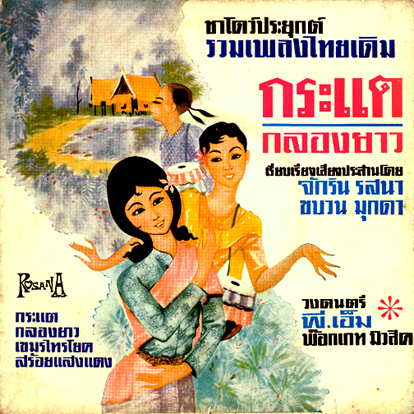
Anyone who picked up the first volume of Subliminal Sound’s Thai Beat A Go Go compilation, was most likely amazed at the wild and crazy sounds coming out of their speakers. The first track entitled “Kratae” by Johnny Guitar is truly unlike anything Western ears had heard before.
Just one problem… That song is not “Kratae”, and the artist who recorded it was not Johnny Guitar. The song is “Klong Yao”, and it was recorded by Payong Mukda, also known as Pocket Music. In addition, he has recorded under the name Son of P. M.
The music of Payong Mukda, as well as Noparatana Tipayaosot (a. k. a. Johnny Guitar), was known as “Shadow Music”. The term was in reference to the British instrumental band The Shadows, who were quite popular throughout all of Asia. Recordings of this music were often billed as “Thai Modernized Music“, taking classic Thai compositions and mxing in elements of surf guitar, a-go-go music and other styles to create an entirely new form of music. Sublime Frequencies “Shadow Music of Thailand” compilation features tunes by P.M. Pocket Music, The Son of P.M., P.M.7, Johnny Guitar and Jupiter.
In 1991, Payong Mukda was honored with the National Artist award which is presented by the Office of the National Culture Commission in Ministry of Culture of Thailand. Here is a brief biography from their website:
Lieutenant Commander Payong Mukda was born in Ratchburi Province. He was an artist who composed more than one thousand country songs, popular songs, and modern-songs as well as influencing a number of new singers. He was awarded Golden Record Awards for his musical compositions for three years in a row. Apart from writing music and lyrics, he was also a singer who sang humorous songs and owned a band called Pocket Music. Regarded as a pillar of musical circles, he was invited to perform for the general public at the Or. Sor. Station, Chitrlada Palace. He was also one of the founders of a number of associations such as the Musicians Association of Thailand under the Royal Patronage of His Majesty the King. He was a musician who could portray the messages in his music, and he liked to offer consultation and guidance to music lovers. Besides this, his songs were beautifully crafted, both in terms of language and meaning, with valuable ethical and moral messages closely intertwined. As such, he was considered a role model for people who fought through life with perseverance as well as being a master of the Thai music industry.
While researching information about Payong Mukda, I came across this strange news article from June 1st, 1999:
On World No-Smoking Day, anti-smoking advocates proved that cigarettes can be hazardous to your health. Their huge mock cigarette stuffed with hydrogen-filled balloons accidentally caught fire and exploded in a sheet of flame. No one among the two dozen or so celebrities and activists standing next to the cigarette was seriously hurt — although there were were several singed eyebrows and hair. Payong Mukda touched off the three-second inferno. The popular singer was supposed to cut the 10-metre cigarette with a sword. As he hacked at the stubborn smoke, flames suddenly shot five metres into the air.
Catalog number 3 on Rosana Records of Bangkok, Thailand. No release date given.
Filed under: Algeria

Brothers Rachid and Fethi Baba Ahmed were from the Northwestern town of Tlemcen in Algeria.
They formed their first band in the 1960’s, which was called The Vultures. Althought I have been unable to find any recordings by the band, they were supposed more Western styled rock ‘n’ roll.
After The Vultures, they released a few records as Rachid et Fethi (here’s one other that I know of), and made a number of appearances performing on Algerian television in the 1970’s.
Since that time, Rachid and Fethi became the most well known Raï producers in Algeria. They openned one of the first 24 track studios in the country, which is in the town of Oran. They were the first to introduce the synthesizer and drum machine into Raï in 1982, which would galvanize that music’s signature sound.
Sadly, Rachid Baba Ahmed was killed on 15 February 1995 in his car with shots from a submachine gun in Oran.
Thanks to Anis Bousbia for his help.
Catalog number 28846 Editions Rally of Tlemcen, Algeria. No release date given.
◄●►◄●►◄●►◄●►◄●►◄●►◄●►◄●►◄●►◄●►◄●►
UPDATE: 05/27/23 This song – as well as it’s flip side – can be found on the Sublime Frequencies compilation 1970’s Algerian Folk And Pop. You can also find one of their other records that has eluded me for ages – the “Youk Baba Jeïm” / “Maghboun” single – over at Gary Sullivan‘s Arabic Singles Going Steady blog.
Filed under: India

Sunil Ganguly was born at Sonamura village in Tripura, which is a state in North East India. He was one of the first musicians to popularize guitar in Bengali music in the early 1960’s, but then he switched to mainly release recordings of popular Bollywood songs on steel guitar. He is widely considered to be the best and set the standard for all who followed him. It has been said that “his instrument seemed to sing like a human voice”.
Surprisingly, the best information I was able to find was from Answers.com
One of the most respected Hawaiian electric guitarists in the Indian sub-continent is the Late Sunil Ganguly. Coming from a modest background, Ganguly developed his very own style of playing the instrument. No matter what he played, his instrument seemed to sing like a human voice. For years his recordings have formed the basis of many aspiring guitarists in the country in terms of style and technique. Nuances were a child’s play for Ganguly and he never went overboard doing it.
Ganguly’s repertoire ranged from classical based songs to Hindi movie hits and from traditional folk songs to those composed by the greats like Dr. Rabindranath Tagore and Kazi Nazrul Islam. Major labels like HMV and Concord Records have recorded and released at least one album of Sunil Ganguly every year starting from late sixties / early seventies till about a year or two before he passed away.
There were years when Radio Ceylon and All India Radio used to regularly broadcast his recordings which actually used to be a motivating factor for many aspiring young guitarists.
The Indian style of playing the Hawaiian Guitar is based around Ganguly’s style and most of his contemporaries used to discreetly copy his style or claim to be based around Ganguly’s school of playing.
Many references to Ganguly can be found on the internet and there are some interesting comparisons made. Perhaps it was due to Sunil Ganguly that the Hawaiian guitar rose to popularity in India but alas in these days of electronic music, the instrument’s popularity has dwindled. Of course, there are still some who would like to promote the instrument, post-Ganguly. Newer styles and newer techniques have come up and some of them are again from India (Brij Bhushan Kabra, Vishwa Mohan Bhatt etc.).
This song was originally from the 1978 movie Don, which was a very popular Bollywood film that has reach cult status outside of India. The movie was recently remade as Don – The Chase Begins Again in 2006.
Since the initial post, this song was included on the “Bollywood Steel Guitar” compilation on Sublime Frequencies.
Sunil Ganguly passed away at the age of 62 in Calcutta in 1999.
Catalog number S/MOCE 3015 EMI of India, manufactured and distributed by The Gramophone Company of India Limited in 1979.
Filed under: Madagascar

Although I have read that some people thought Les Safari may have been from Morocco, they were originally from Madagascar.
They moved to France in an attempt to have the same success as fellow Malagasys Les Surfs (who were not a surf band).
They released four records between 1965 and 1967. This record is the second of two singles that they recorded for the French Palmarés label. They would later record two singles for CBS. Before they changed their name to Les Safari, they were called C.C.C. Guitares.
Thanks to Stéphane Leroux-Lemeuier at Encyclopédisque for the information.
Catalog number 1010 M on Palmarés records of France, released in 1966.
Filed under: Brunei

♬ Rindu
Kugiran Irama Perindu were from Brunei.
Brunei is a country located on the island of Borneo, in Southeast Asia. Apart from its coastline with the South China Sea, it is completely surrounded by the states of Sarawak and Sabah of East Malaysia. Brunei, the remnant of a very powerful sultanate, restored its independence from the United Kingdom on January 1st 1984.
What little information I have been able to find about Kugiran Irama Perindu is about their Management / Label: Times Record Company.
Around 1960’s in Singapore, Times Record was a record company which released Malaysian EP’s and LP’s, on labels such as Olympic, Eagle, Sea Lion, etc. There record labels had competition with international recording companies such as EMI and Philips. In the 1960’s there were many artists and singers and records under Times management, so audience can listen them.
This song is from their first single. I do know that they released at least two other singles, one of which is pictured here. The liner notes on the back of that record reads:
Only one time when Time Record, which was popular with Olympic label has recorded some new songs with Irama Perindu, it’s also popular in Brunei Darussalam, Singapore, and Malaysia. These songs were playing on radio stations and a night club in Brunei. With a new songs which was playing in our edition will make you had a romantic feeling. Thank you and enjoy our songs!!
Thanks go out to Anton Pulung of Red Chamber for the translation.
Catalog number T.R.C. 1033 on Olympic Records of Singapore. No release date given.