Filed under: Tunisia

Yet another “one hit wonder” from Tunisia.
I have not been able to find any other information about any of the musicians of this band:
• Electric Guitar, Voice – Ridha Cherif
• Bass Guitar – Brahim Tlili
• Drums, Percussion – Taieb Karchani
• Saxophone, Flute – Nabil Bougattef
• Violin, Piano – Ahmed Karchani
If you have any further information about this artist or anything else about this recording, please leave it in the comment section below.
Catalog number Super Hit 1, released 1978. Published by النغم / En’nagham of Tunisia.
Filed under: Thailand

♬ The Moon Departs the Sky / จันทร์จากฟ้า
Kabuan Mukda / ขบวน มุกดา – not to be confused with his adoptive father and manager Payong Mukda – was from Thailand.
The first track Kratae / กระแต may sound familiar. It’s a version of the first song of the Thai Beat A Go Go compilation which you can hear here. The second song – The Moon Departs the Sky / จันทร์จากพ่า – was originally written by Phranbun / พรานบูรพ์ and recorded by Phensi Phumchusi / เพ็ญศรี พุ่มชูศรี. You can here it here.
Many thanks to the amazing Peter Doolan of Monrakplenthai for translation and for the information about this record. You can find more more information about and recordings by Kabuan Mukda over at Monrakplenthai here.
Catalog number MLK – 739 on Metro Records of Bangkok, Thailand. No release date listed.
Filed under: Guinea

El Hadj Djeli Sory Kouyate – better known as Kouyate Sory – was from Kindia, Guinea. Not to be confused with Kouyate Sory Kandia – who he played with and who was also from Guinea. He has been called “the world’s greatest balafon player”.
Although he received his first balafon at the age of 12, Kouyate was little known outside of Guinea until joining the Ensemble Instrumental National of Guinea in 1961. While touring in the United States, Kouyate and other members met vocalist and political activist Harry Belafonte. Inspired by the group’s music, Belafonte formed the Djoliba Ballet and invited Kouyate to become involved. Accepting the invitation, Kouyate remained with the ballet company for nearly a decade.
In 1981, Kouyate became director of the National Choral and Instrumental Ensemble in Guinea. Seven years later, he garnered critical acclaim for his playing in the Broadway production Africa Oyé.
Although Kouyate Sory was from Guinea, all of his recordings were released on labels from Côte d’Ivoire – Afriphone, Badmos, Djima and Société Ivoirienne du Disque – instead of Editions Syliphone Conakry.
Catalog number SID 35 of Société Ivoirienne du Disque of Abidjan, Côte d’Ivoire.
Filed under: Lebanon

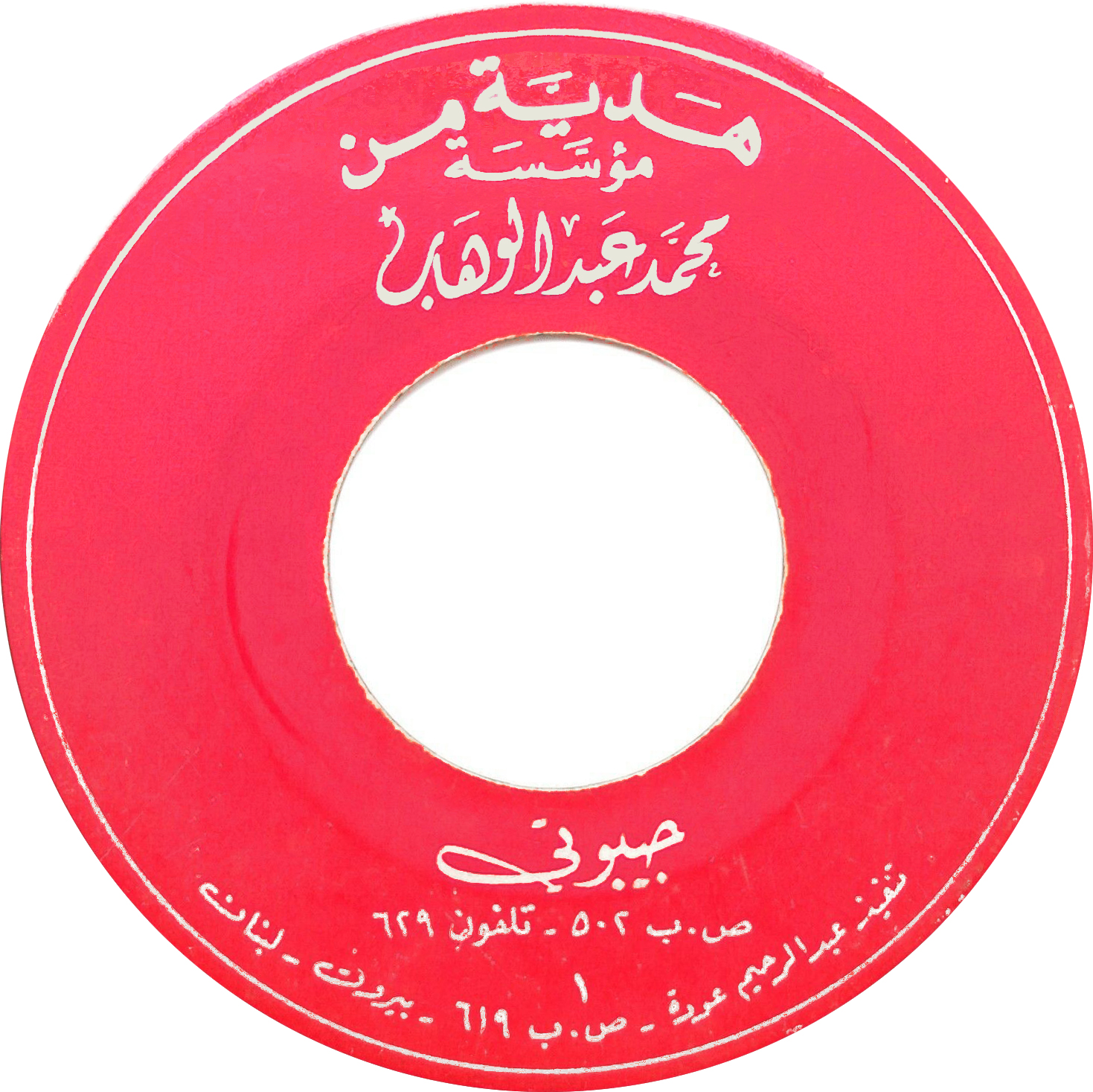
The person who sold this record only had one piece of information – that it was from Lebanon. And for over a year, I have been trying to find anything about this record. I’ve had a few people translate the stylized script, and this is what the label says:
A Gift from Mohamed Abdulwahab Association
Djibouti
P.O.Box 502 – Phone 629
Production by: Abdulraheem Odda
P.O.Box 619
Beirut – Lebanon
Here is a larger scan of the label. If you have any information about this recording, please leave it in the comments below.
Thanks to Hisham Mayet for his help on this post.
No catalog number, record company or release date listed.
Filed under: Singapore

I first became aware of The Siglap Five on Grey Past‘s “Steam Kodok” compilation.
The band formed in the Siglap neighborhood of Singapore in 1963. They were only together for five years before the members had to serve in the National Service. In 1998, they reformed to record some songs with Raden Jeffrydin Raden Imbromsoekaman – AKA Jeffrydin – who the band had backed up on their first four singles.
Of the 13 singles they recorded, this is the only one that did not feature a guest vocalist.
Catalog number 437827 PE on Philips of Singapore, released 1967.
Filed under: Colombia

Columna de Fuego was a rock group from Bogotá, Colombia.
The band was born in 1971 after the dissolution of Siglo Cero , a group made up of Humberto Monroy, Roberto Fiorilli – who was from Italy – and Jaime Rodríguez. Around this time, Fiorilli had also befriended César Hernández who had been in Los Beatniks.
Between 1971 and 1974, they recorded one album and three singles. They also were the backing band for Leonor González Mina, and toured Germany, Spain and the Soviet Union. While they were in Spain, they recorded their lone album “Desde España” for RCA. But the band broke up when they returned to Columbia.
Catalog number 2071011 on Polydor of Columbia, released 1971.
Filed under: Réunion

Les Souls Men – also seen Les Soul Men – were from Réunion. They were active from 1975 until 1980, releasing five albums and thirty five singles – most of which were backing such artists as Gaby Lai Kun, Georges Amaury, Jean-Claude Gaspard , Micheline Picot and Williams Justine as well as others.
Catalog number 4064 on Disques Issa of Saint-Denis, Réunion. Released 1975.
Filed under: Bangladesh

Bangladesh has always been on my radar. For some reason, I’ve always had difficulty finding records from there. But this record? I did not even know about it until I stumbled upon it.
Fakir Alamgir / ফকির আলমগীর was one of the leading exponents of Gono Sangeet – the songs of the masses – in Bangladesh. Synonymous with voicing out for the rights of the voiceless – the perceived weak, the workers and the voiceless, he was one of the most beloved artistes of his generation.
Alamgir was born in Faridpur in 1950 – which at that time was East Pakistan. He started his music career in 1966. During his student life, he was active in politics. He was a student of Mass Communication and Journalism in Dhaka University.
Alamgir played an important role as a member of the cultural organizations Kranti Shilpi Gosthi and Gono Shilpi Gosthi, during the 1969 uprising in East Pakistan. He also worked with Swadhin Bangla Betar Kendra / স্বাধীন বাংলা বেতার কেন্দ্র (Free Bengal Radio Centre) which was the radio broadcasting center of Bengali nationalist forces during the Bangladesh Liberation War in 1971.
Catalog number MLP-0031 on Bangladesh Gramophone. No release date listed.
Filed under: Mauritania

Surprisingly, this is my first post of the music of Mauritania. But other than the fact that Mohamed Ould Nana avec L’Orchestre National Mauritanien recorded two albums and three singles – as well as two singles L’Orchestre National Mauritanien recorded without Mohamed Ould Nana – is that they are NOT the same band as L’Orchestre National de Mauritanie.
If you have any further information about this artist, the label or anything else about this recording, please leave it in the comment section below.
Catalog number MB24 on Boussiphone of Casablanca, Morocco. No release date listed.
◄●►◄●►◄●►◄●►◄●►◄●►◄●►◄●►◄●►◄●►◄●►
UPDATE: 02/03/23 Radio Martiko has reissued both of L’Orchestre National Mauritanien’s records, which you can find HERE.
Filed under: Dahomey

♬ Béthel
One hit wonder from Dahomey – now Benin. There’s only three mentions of this single out there on the web: YouTube, Discogs and the Oro God blog… In the comments of the YouTube posting, Victor Hountondji said that he was 19 when he recorded that song and that it was arranged by someone named Wellborn Henry – who I have not been able to find anything about.
If you have any further information about this artist or anything else about this recording, please leave it in the comment section below.
Catalog number SAT 022 on Disques Tropiques of Dahomey – now known as Benin. Released 1972.
 Radiodiffusion Internasionaal Annexe