Filed under: Iraq

Ja’afar Hassan (also spelled Jafar Hassan) was born in the town of Khanaqin, which is in the Kurdistan Region of Iraq.
The majority of the information I was able to find about him, was from his website… Which is in Arabic:
He learned to play the oud (Google translator: “lute autonomous machine”) at a young age. He later studied violin, viola and voice at the Institute of Fine Arts in Baghdad, where he later became a professor and head of the Department of Music. He has also played in neighboring Kuwait and Syria, as well as Yemen where he is a member of the Federation of Yemeni artists.
Ja’afar Hassan was brought to my attention when I received a copy of the Sublime Frequencies’ compilation ‘Choubi Choubi! Folk and Pop Sounds from Iraq’, which features three songs from his album “Let’s Sing Together”. His music sounded unlike anything else of what little I have been able to find from Iraq during that time period (all of which was recorded in France). It is quite unusal, especially if you consider that there is no oud, for which Ja’afar Hassan is known for playing…
There is almost no mention of this album on his website, except only briefly on the biography page (Google translator: “Cylinder issued to him in Berlin entitled ‘to enrich together’.”). Also on his website, there is a page of his press clippings, but there is a 11 year gap from 1966 and 1997.
Also, there is very little information on the record itself. There is no indication of a record lable, but there is a catalog number. On the front cover, there seems to be something covering the right top corner, where the record company logo may have been and was printed over.
The record was most likely pressed in East Berlin, given that Hassan was supposedly a mouthpiece for the Iraqi Socialist movement just a few years before Saddam Hussein came to power. Also, the design of the almost all red cover and the sequence of the catalog number is similar to records from that time period.
But to make matters more puzzling, the liner notes are in Arabic and English:
Ja’afar Hassan is a progressive Iraqi singer who uses songs as a means to express people’s joyness, victories and sadnesses… He sings for the telling masses, thus giving his songs a new spirit… That is what we call political songs. He is considered to be one of the first young Iraqi singers who devoted their songs to serve the mentioned themes
Which begs the question, who was the intended audience for this record? Was it released, or at least distributed, in Iraq? Or, perhaps was this release for Iraqis living outside of Iraq?
If you have any further information, please contact me.
Thanks to Mark Gergis for his help and information.
Catalog number 8 95 012. No other information.
Filed under: Guinea

♬ Kanimba
Sextet Camayenne were from the African nation of Guinea.
Guinea, officially the Republic of Guinea (French: République de Guinée), is a nation in West Africa, formerly known as French Guinea. It borders Guinea-Bissau and Senegal on the north, Mali on the north and north-east, the Côte d’Ivoire on the south-east, Liberia on the south, and Sierra Leone on the west. Its territory encompasses the water source for the Niger, Senegal, and Gambia rivers, with a coastline facing the Atlantic Ocean. The name Guinea (geographically assigned to most of Africa’s west coast, south of the Sahara desert and north of the Gulf of Guinea) originates from Berber and roughly translates into ‘land of the blacks.’ It is sometimes called Guinea-Conakry per its capital to differentiate it from the neighboring Guinea-Bissau (whose capital is Bissau).
I have not been able to find any information, except that they released one other single and later became the 14 piece band Camayenne Sofa.
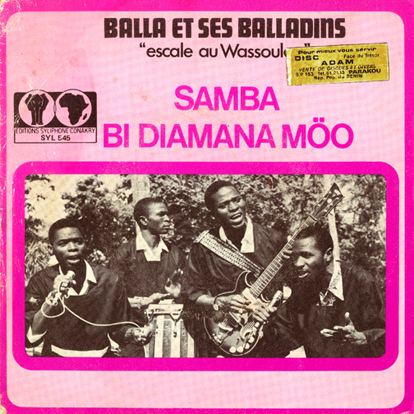
Also as I mentioned back when I posted the song by Balla et Ses Balladins, I don’t know what kind of fuzz pedals they had access to in Guinea at this time, but it doesn’t sound like anything else I’ve ever heard…
If you have any further information, please contact me.
Catalog number SYL 562 the state run Editions Syliphone Conakry, République de Guinée, released 1974.
Filed under: South Korea

♬ 외로운태양
He5 were from Korea.
The records from that time are very scarce, since they did not press that many. Even today when one of these records are re-issued, there is usually only a pressing of 300 copies. Due to this, there’s not a whole lot of information available about the early days of rock ‘n’ roll in South Korea.
One of the best sources of information is the website for the Psyche Van Het Folk programme from Radio Centraal of Belgium has a whole section on Korean rock music (as well as other countires / regions):
Kim Hong-Tak was one of the two leading figures in the early days of “Group Sound Era”, of course with Shin Jung-Hyun. Kim Hong Tak was guitarist and naturally leader of the group. Here, it seems better to put aside the question ” Who was the first?”. Because with this question of ‘the first’ or more properly ‘the Origin’, the answers will not is the same according to the questioner’s perspectives.
For example, if we take one perspective, in this case that of ‘popularity’, it will be the Key Boys of Kim Hong Tak which was followed soon afterwards by the Add4 of Shin Jung-Hyun.
A little remark. This Key Boys is not the ‘Later’ Key Boys who sang the smash hits like “Let’s Go To The Seashore”. or “Memories of The Seaside”, but the ‘Earlier’ Keyboys. They played some ‘Package shows’, under the name of the Lock & Key in the stages of the U.S. Eighth Army which settled in South Korea. Also they played at some new venues like ‘Music Listen Rooms’, ‘Live Music Salons’, or the traditional ones like in Cinema. [At that time the concert was held frequently in Cinema Houses. It was called as ‘Cinema Show’].
With these latter acts they were known to general ‘Korean’ public. They were nicknamed as the ‘Beatles of Korea’ – At that time this meant more similar to a ‘cover band of the Beatles’. [Because the stages in U.S Eight Army was for the Korean in the forbidden area for the evident reason of security. So generally a Korean group or artist who played there was a totally unknown figure to general Korean public].
In the mid-60s which prevailed by the worldwide phenomenon ‘Beatlemania’, the Key Boys, in molding the archetype of the Rock band (or Rock Group) who ‘sing and play’ [With the Kkokkirri Brothers, the Fools, the Kim Chies], became the pioneers of a new cultural phenomenon [we may now be able to say that it was the early days of ‘Pop culture’ in Korea]. And here lies one symbolic fact concerning the popular culture in general that 1964-1965, the period of their debuts coincides with that of the birth of the ‘Weekly Magazine’. With the time, the members of the Key Boys left the group: some Cha Jung Rak and Cha Do Gyun going to solos, some Yoon Hang Ki joining to the Korean Army‘s entertainment Unit which was sent to the Viet-Nam War, and finally Kim Hong Tak too. But Kim Hong Tak had launched his career of guitarist in a rock group. It was the He5.
Precisely speaking, the He5 was not launched by Kim hong Tak. According to the memories of its members, the group was found in the winter of 1967 ‘the five young guys’ all belonged to the Wha-Yange Entertainment Inc. had set up the group together; Han Woong (Rhythm guitar and vocal) issued from the Four Guys, Cho Yong Nam (lead guitar and vocal) from the Shin Jung Hyun and the Jokers, Yu Young Chun (vocal) from the Silver Coins, Han Kwang Soo (Bass) from the Kee Jin Sung’s Orchestra. For the connoisseurs, they were all ‘top-class’ musicians from the leading groups of that time.
And in this period Kim Hong Tak was still in the Key Boys. (Cf. Wha-Yang Entertainment Inc. was one of the enterprises who dealt with matters concerning the distribution of musicians and entertainers for the 8th Army of USA.- with the Universal, Dae-Young, Dong IL).
The He5 begins tis gigs at the Seven Club in I-Tae-Won (a small quarter of Seoul which is now well know even internationally for its diverse markets, restaurants and bars mainly for the foreign customers. This quarter was the bassist Han Kwang Soo soon afterwards was a challenge for the He5. Kim Hong Tak was recruited as a lead guitarist (So-called ‘first guitarist’ at that time) and Cho Yong Nam, the griginal lead guitarist of the band changes his speciality to bass guitar. The joining of Kim Hong Tak not only strengthens the group’s musical forces but also gives the occasion to the group of presenting themselves to ‘general Korean public’. So ends a ‘Boy’ period
I believe this album may have been a soundtrack, and some of the songs feature vocalist Yang Mi-Ran.
Catalog number 갸 12255 Sinsege Records of Seoul, Korea, released 1968.
Filed under: Egypt

♬ Zouba
Baligh Hamdi was from Egypt.
Born Abdul Hamid Hamdi Morsi on October 7, 1932, he showed promise as a musician, even at an early age. He had mastered the oud by age 9, and by age 12 he had applied to the Institute of Music Fuad I, but was not admitted due to his young age.
From here, the Google translator gets a little dodgy…
He apparently started his music career while he was attending law school, when an advisor from Egyptian Radio asked him to sing on a radio programme. Eventually he went on to work with Oum Kolthoum (who apparently no one can agree upon a correct spelling of her name) and Abdel Halim Hafez. He conducted and arranged the live recording of Abdel Halim Hafez’s live recording of Mawood, featuring Omar Khorshid (a portion of which was featured on the Sublime Frequencies release Radio Morocco). Baligh Hamdi also worked with Algerian born singer Warda, who he married to for several years.
He moved to Paris in 1985, where he collborated with artists from around the world, including Indian musician Magid Khan. He returned to Egypt in 1993, but died soon after on September 12, at the age of 61.
Over at the great Waxidermy site, they have two more songs from this record posted here (although the names of the songs are Gada and Sahar), as well as a track from the album with Magid Khan here.
Also, you can find a few clips of Baligh playing live, as well as songs performed by Warda, on YouTube at this link.
Thanks to Hany Zaki for the invaluable information, and the picture.
Catalog number 31-73097 Soutelphan of Cairo, Egypt. No release date given.
◄●►◄●►◄●►◄●►◄●►◄●►◄●►◄●►◄●►◄●►◄●►
UPDATE: 08/13/21 Sublime Frequencies has released a compilation of Baligh Hamdi’s recordings entitled “Baligh Hamdi: Instrumental Modal Pop of 1970’s Egypt“.
Filed under: Togo
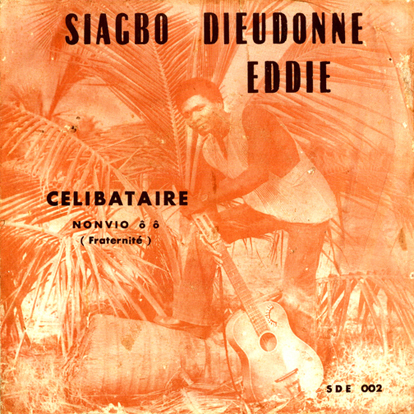
What little I do know about Siagbo Dieudonne Eddie is that he was from the small African nation of Togo. Also, El Rego et Ses Commandos de Cotonou from neighboring Benin were his backing band. And I have seen one other record that he release on his own label…But that’s it.
If you have any further information, please contact me.
Catalog number 002 SDE Records of Lomé, Togo. No release date given.
Filed under: Japan

♬ Bunnys • Flying Guitar
♬ Sharp Five • Golden Guitar
In 1962, The Ventures made the first of what would be many tours of Japan and the Far East. While the shows attracted very little media attention, many had already been exposed to this new reverb-drenched instrumental music through imported records and overseas radio broadcasts, and some of these fans formed their own bands that would become the genesis for a new trend in music. Progenitors of this new sound were tossing out their acoustic guitars in favor of more powerful electric ones, which prompted the name “eleki”, taken from the Japanese for “electric guitar”.
When The Ventures returned back to Japan in 1965, a far different scene awaited them. By this time “eleki” was all the rage. Many established groups had by this time given up playing rockabilly, country, and even jazz to switch over to “eleki”, and high school kids across the nation were rushing out to buy electric guitars and jump on the “eleki” bandwagon, demand for these guitars far outstripping domestic supply for several years running.
In addition to the radio and concerts, there were at least four television programs dedicated exclusively to “eleki” music including Eleki Tournament, Exciting Show, Eleki Tournament Show, and New Eleki Sounds Jumping into the World, and the establishment had begun to cast a wary eye on the “disturbing” trend. This had happened in the past with the rockabilly boom of the 50s, and would happen again with the Group Sounds bands later in the 60s, but regardless of the pressure, “eleki” continued to flourish.
Takeshi “Terry” Terauchi started out as a sideman in Jimmy Tokita & the Mountain Playboys, a country & western band. In 1962, he formed his first eleki band, the Blue Jeans, with whom he remained until 1966. He then formed a new group, the Bunnys, who recorded the eleki classic “Test Driver”. After the Bunnys disbanded in the fall of 1968, Terauchi formed a new version of the Blue Jeans, called Takeshi Terauchi & the Blue Jeans (to distinguish them from the original Blue Jeans, who continued recording and performing after Terauchi’s departure, and even opened for The Beatles at their 1966 Japanese concerts).
Terauchi’s style is very Ventures-influenced, but much faster and more frantic, with a heavy picking style and liberal use of his Mosrite’s whammy bar. Later on, Terauchi experimented with adapting flamenco and other western styles (as well as Japanese musical forms such as enka) to eleki, with mixed results. Terauchi is probably Japan’s first guitar hero, and he has continued recording and touring through the years with new groups of Blue Jeans, and claim to have recorded and released over 300 albums to date.
Where as “Terry” Terauchi is still well known in Japan, and throughout the rest of the world, not many people know about Munetaka Inoue & His Sharp Five. The leader of the band was Munetaka Inoue on drums and percussion, with guitarists Nobuhiro Mine and Hidemasa Yamauchi, bassist Masaaki Ito and Osumu Furuya on organ and keyboards.
The only other information I have been able to find on Munetaka Inoue & His Sharp Five, is an article in Japanese, and the Google translator isn’t much help…
As the Sharp Hawks, the band personnel consisted of people from mixed European or American and Japanese lineage. They originally started as a vocal and dance group in ’63, and were four
boys and a girl (who later left the band in ’65). But when the Group Sounds boom happened, they became GS, a vocal beat combo. As the story goes, they couldn’t play well, so the Sharp Five became their backing band.
Thanks to John Sharp for getting this translated for me.
Catalog number SKK 303 on King Records of Japan, released 1967.
Filed under: Morocco

♬ Zina
Ouiness was from Morocco… I think .
There is no information available, except what you see on the front cover. He apparently won a Special Mention at a International music competition in Paris, and on the back it says that his fan club was in Paris… But other than that, who knows?
If you have any information, please contact me.
Catalog number R.C.V. 71.481 on R.C.V. International, manufactured in France and released in 1979.
Filed under: Ethiopia

Menelik Wossenachew was from Addis Ababa, Ethiopia.
There is not a lot of information available on him. He did record at least one other single for Ahma Records, with The All Star Band that was written and arranged by Mulatu Astatke.
Menelik Wossenachew was a member of the second incarnation of the Ras Band, which was lead by Girma Beyene. The Ras Band took their name, like The Ghion and The Shebelle Bands of the time, after the hotels that employed them.
The majority members of the first Ras Band came from the Haile Selassie I Theatre Orchestra, who was then led by the famous Armenian Nerses Nalbandian. These included Girma Beyene, Wodajeneh Felfelu, Assefa Bayisa, Tefera Mekonnen, Tilahun Yimer and Bahru Tedla. Up to 1955 the last three were also in the Imperial Bodyguard Orchestra Jazz Symphony under Austrian Franz Zelwecher. The first Ras Band stayed in this form until 1965 when the entire band, with the exception of Girma Beyene, went on to form the Ghion Band at the Ghion Hotel.
Girma Beyene, was a lyricist, a music writer, an arranger, a vocalist, a pianist and bandleader. To most, if any name comes to mind with the word arranger, it is probably that of Mulatu Astatke. Yet, according to Ethiopiques Series producer Francis Falceto, in the heyday of vinyl records, Girma Beyene is credited to having arranged close to 65 titles, compared to Mulatu’s 40. Girma left a handful of recordings as a vocalist, but it was as an arranger and pianist that he is most remembered.
After leaving the second incarnation of The Ras Band, Girma Beyene was in The Girmas Band with Girma Zemariam for a brief period before forming The All Star Band in 1970. It members were for the most part taken from two popular bands, the second Ras Band, and The Soul Ekos Band with Menelik Wossenachew on vocals. But that only lasted for two years, before Girma Beyene left to form the Alem-Girma with Alèmayehu Eshété in 1972.
Catalog number AE 810, Amha Records of Addis Ababa, Ethiopia. No release date given.
Filed under: Pakistan

♬ Bondure
The Mods were from Pakistan.
Apparently, there was a market for traditional music played on Western instruments. Not sure who this was being marketed to, either the indigenous population or foreign tourists. But there were a number of bands that released similar records, most notable being The Fore Thoughts, The Panthers and The Slihouettes. But who that market was remains a bit of a mystery.
Here’s the liner notes from the back cover:
This album “FOUR FOLK INSTRUMENTALS FROM PAKISTAN” is a beautiful collection of traditional oriental tunes, played on modern western instruments, by “THE MODS”. This is their first disc and judging from the masterly performance quite a lot of creative work is expected of this upcoming group of young and talented quintet.
I have not been able to find out any information about the band, or their composer / songwriter Mohammed Yousuf. As far as I know, this was their only recording. If you have any information, please contact me.
Since the initial posting, Garage Hangover has posted the entire single, and a scan of the back cover here.
Catalog number EKCE-20012 on The Gramophone Company of Pakistan Limited, a member of the EMI group of companies. No release date given.
Filed under: Hong Kong

One would assume that the Philippines Five Sisters were from the Philippines…
But if you listen to the track, they say that they are The Blue Star Sisters… And they were from Hong Kong, which probably explains why this is in English. Also, it appears that they are still active today, in Thailand…
As for the two comedians, Ya Fong and Wong Sa, they were popular throughout Singapore, Malaysia, Hong Kong and Taiwan during the 1960’s and into the 1970’s.
Catalog number RTC 88 on Rockson Record. The only other information is that the cover was printed by Chiyo Printing Ltd. of Singapore.
 Radiodiffusion Internasionaal Annexe